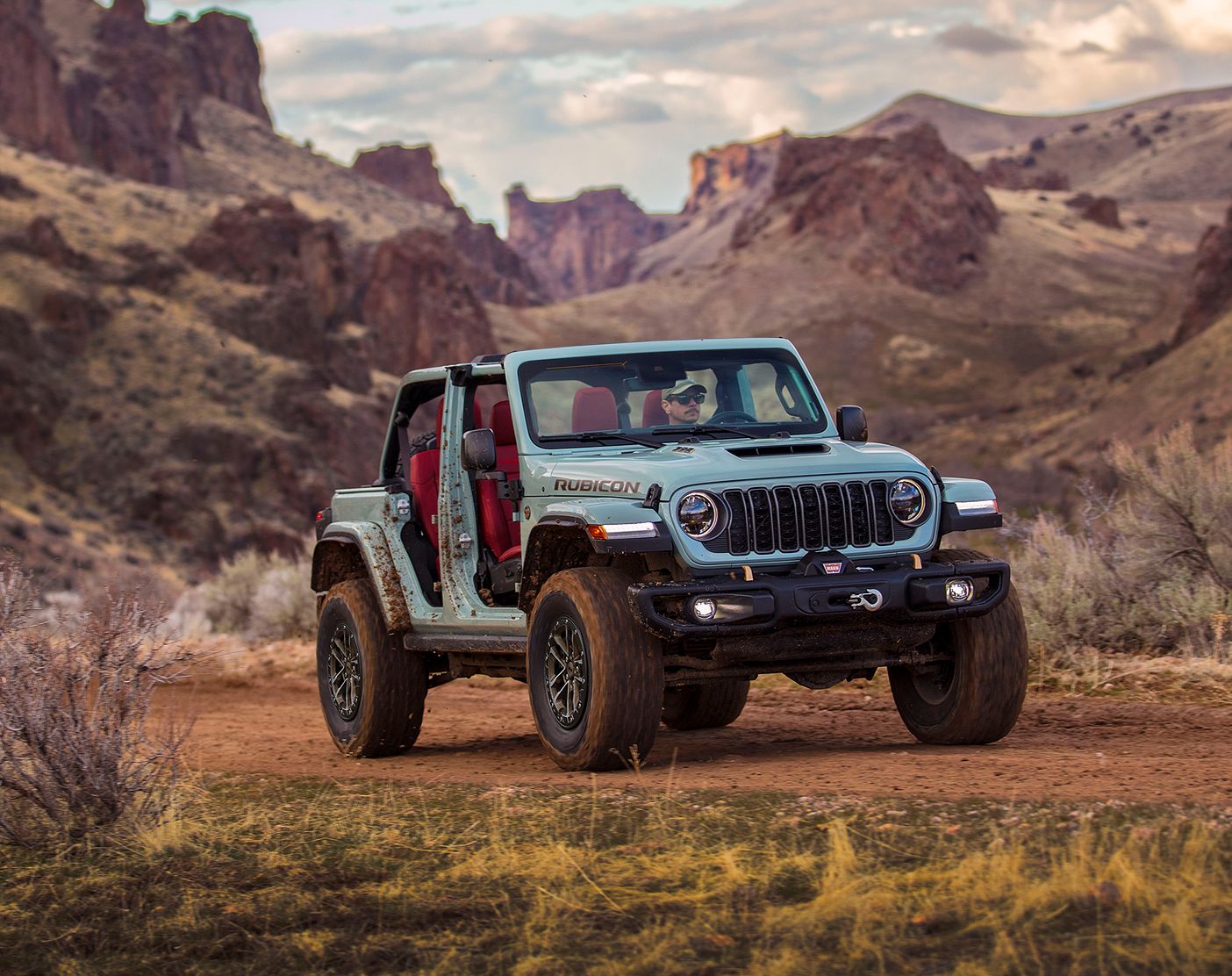
The Jeep Grand Cherokee Trackhawk bridges the gap between everyday family utility and brutal drag strip performance. Packing a supercharged 6.2-liter HEMI V8 engine borrowed directly from Dodge's legendary muscle car lineup, it rockets from 0-60 mph in 3.5 seconds. It defies expectations for a heavy all-wheel-drive utility vehicle, delivering supercar acceleration paired with genuine everyday practicality.
Underneath its aggressive exterior lies a mechanical package built to handle immense power without shredding its drivetrain. We will break down the exact performance numbers, engineering features, driving dynamics, and everyday compromises that make the Trackhawk an automotive anomaly.
The Hellcat Heart: Engine Specs and Output
The defining feature of the Trackhawk is its powerplant. Jeep didn't just tune a standard V8; they dropped the supercharged 6.2-liter HEMI V8 engine from the Challenger and Charger Hellcat right into the Grand Cherokee bay.
- Horsepower: 707 hp at 6,000 rpm
- Torque: 645 lb-ft at 4,800 rpm
- Supercharger: 2.38-liter twin-screw compressor pushing 11.6 psi of boost
- Valvetrain: Pushrod overhead valve with sodium-cooled exhaust valves
This engine breathes through heavy-duty forged-alloy pistons and powder-forged connecting rods designed to withstand extreme cylinder pressures. It pairs with a TorqueFlite eight-speed automatic transmission calibrated to handle up to 850 lb-ft of torque, routing power through a Quadra-Trac active on-demand four-wheel-drive system.
Acceleration and Quarter-Mile Performance
The headline figure for any performance vehicle is its sprint time. The Trackhawk clocks a 0-60 mph time of 3.5 seconds and covers the quarter-mile in 11.6 seconds at a trap speed of 116 mph.
Achieving these numbers in a vehicle weighing over 5,300 pounds requires more than raw horsepower. Jeep equipped the Trackhawk with standard Launch Control, which manages engine torque and optimizes wheel slip for maximum off-the-line traction. Torque Reserve further enhances launches by managing fuel flow and spark advance to pre-fill the supercharger with boost before you release the brake pedal.
Top speed maxes out at an electronically limited 180 mph, a restriction dictated primarily by the speed ratings of factory tires and aerodynamic stability limits on a tall utility body.
Handling, Braking, and Ride Dynamics
Moving a massive vehicle safely at track speeds demands serious hardware upgrades. Jeep partnered with Brembo to install the largest front brakes ever fitted to a production Jeep. Up front, you get massive 15.7-inch vented rotors clamped by six-piston calipers, while the rear features 13.8-inch rotors with four-piston calipers. These bring the heavy SUV from 60-0 mph in just 114 feet.
Body control is managed by a Bilstein adaptive damping suspension system with selectable drive modes:
- Auto Mode: Adjusts automatically for balanced daily driving and mixed road conditions.
- Sport Mode: Stiffens dampers, quickens shift times by 50 percent, and splits torque 35/65 front-to-rear.
- Track Mode: Maximizes responsiveness, firms up shifts to a lightning-fast 160 milliseconds, and sends 70 percent of torque to the rear wheels.
- Snow and Tow Modes: Tailor power delivery for low-traction surfaces or pulling up to 7,200 pounds of trailer weight.
Fuel Economy and Daily Realities
Physics dictates that moving a heavy, boxy machine with 707 horsepower requires immense amounts of fuel. The EPA rates the Trackhawk at a dismal 11 mpg city and 17 mpg highway, resulting in a combined rating of 13 mpg.
In real-world city driving or spirited acceleration runs, single-digit fuel economy is common. The vehicle features a 24.6-gallon fuel tank, meaning frequent stops at the pump if you explore the upper limits of the throttle pedal. Insurance costs and premium fuel requirements add significantly to long-term ownership expenses.
Common Modifications and Aftermarket Potential
While 707 horsepower satisfies most drivers, the Hellcat platform is legendary for its aftermarket tuning capability. Because the engine utilizes a robust cast-iron block and forged internals, owners frequently modify the platform:
- Pulley Swaps: Installing a smaller supercharger pulley increases boost pressure.
- E85 Upgrades: Adding larger fuel injectors and flex-fuel sensors allows the engine to run on high-octane ethanol, unlocking 850 to over 1,000 horsepower on stock bottom ends.
- Exhaust Upgrades: Cat-back exhaust systems amplify the signature supercharger whine and deep V8 rumble, which is notably muted in stock form due to strict emissions regulations.
Frequently Asked Questions
What is the difference between the Jeep SRT and the Trackhawk?
The standard Grand Cherokee SRT features a naturally aspirated 6.4-liter HEMI V8 producing 475 horsepower and hits 0-60 mph in 4.3 seconds. The Trackhawk upgrades to the supercharged 6.2-liter Hellcat engine, boosting output to 707 horsepower and dropping the 0-60 time to 3.5 seconds.
Is the Jeep Trackhawk street legal?
Yes, it is fully street-legal and equipped with standard comfort features, navigation, and driver-assistance tech, despite possessing track-focused performance specifications.
Can the Trackhawk tow a trailer?
Yes, despite its sports car acceleration, it retains a heavy-duty towing capacity of up to 7,200 pounds, making it uniquely versatile for hauling boats or track cars.
Is the Trackhawk still in production?
Jeep ended production of the supercharged Grand Cherokee Trackhawk alongside the standard V8 Grand Cherokee WK2 generation, making low-mileage secondary market models highly sought after by enthusiasts. Learn more about historical lineup updates directly from Jeep.



