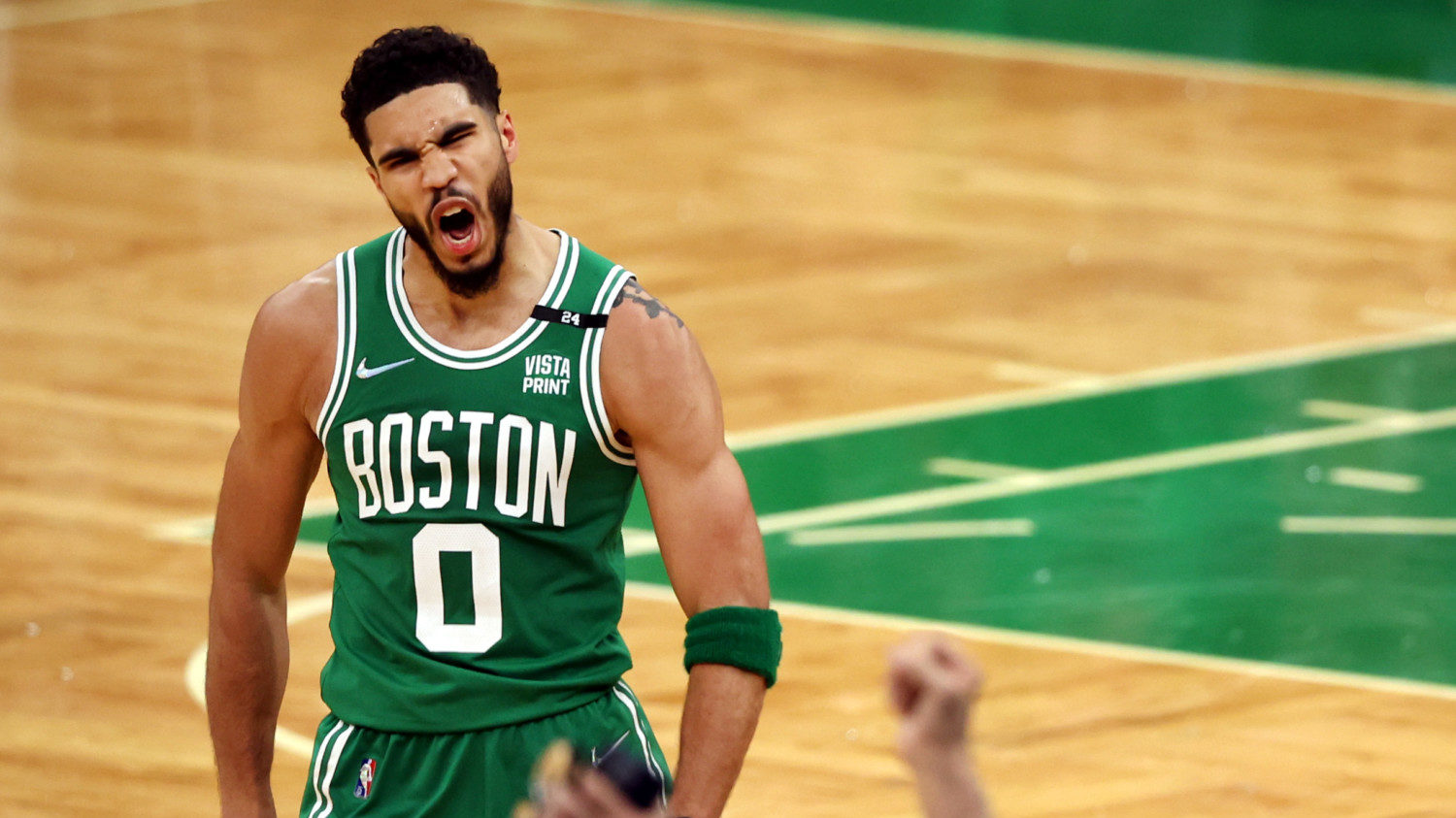
When the Boston Celtics traded down from the first overall pick in the 2017 NBA Draft, few expected the rookie they selected at number three to instantly carry a conference finalist offense. Yet Jayson Tatum's rookie season didn't just meet expectations; it shattered them, laying the permanent foundation for a modern NBA superstar. Thrown into the fire after major injuries sidelined key veterans, Tatum adapted with a poise rarely seen from a 19-year-old.
Examining that foundational year reveals how precise development, high-stakes playoff minutes, and elite technical skill combined to build a cornerstone player for the Boston Celtics.
The Catalyst: Opening the Door Through Adversity
Every breakout rookie campaign needs an opportunity, and Tatum's arrived packaged as misfortune for his team. Gordon Hayward suffered a devastating ankle fracture five minutes into opening night, and star point guard Kyrie Irving missed the entire postseason following knee surgery.
Head coach Brad Stevens needed someone to shoulder the scoring load alongside veteran Al Horford. Tatum stepped directly into the starting small forward role, starting all 80 regular-season games he played. Instead of wilting under defensive schemes designed by opponents to exploit a rookie, Tatum displayed an advanced offensive toolkit built around footwork, balance, and a remarkably high basketball IQ.
Regular Season Efficiency and Advanced Scoring
Tatum's raw regular-season averages of 13.9 points, 5.0 rebounds, and 1.6 assists per game only tell part of the story. Efficiency matters more than volume for evaluating young prospects, and Tatum posted shooting splits that turned heads across the league:
- Field Goal Percentage: 47.5% from the field
- Three-Point Percentage: 43.4% from beyond the arc
- Free Throw Percentage: 82.6% from the charity stripe
Entering the NBA with a reputation as a polished mid-range scorer from Duke University, Tatum quickly expanded his range. He converted over 43 percent of his three-point attempts, punishing defenses that went under ball screens. He didn't rely on raw athletic dominance or unrefined transition running; he used pro-level step-backs, hesitation dribbles, and a devastating turnaround jumper modeled after his idol, Kobe Bryant.
The 2018 Playoff Crucible
The defining chapter of Tatum's rookie year unfolded during the spring of 2018. While most rookies watch the postseason from the bench, Tatum became the focal point of Boston's offense during a grueling 19-game playoff run.
He averaged 18.5 points, 4.4 rebounds, and 2.7 assists per game in the postseason, setting the NBA record for most points scored by a rookie in a single playoff run. In the Eastern Conference Finals against LeBron James and the Cleveland Cavaliers, Tatum did not back down. His crowning moment arrived in Game 7, where he poured in 24 points and posterized James with a ferocious fourth-quarter drive that briefly put Boston on the brink of the NBA Finals.
That series exposed him to elite defensive game-planning, teaching him how physical playoff officiating impacts rhythm and how to counter aggressive double-teams.
Defensive Versatility and Two-Way Growth
Many elite scorers enter the league as defensive liabilities, taking possessions off to save energy for the offensive end. Brad Stevens' defensive scheme offered no such luxury. Tatum used his 6-foot-8 frame and 7-foot wingspan to disrupt passing lanes, switch effectively onto guards and power forwards, and protect the rim.
His ability to guard multiple positions kept him on the floor for over 30 minutes per game. This two-way versatility transformed him from a one-dimensional scoring prospect into a complete wing player capable of matching up against top-tier perimeter threats across the association.
Common Misconceptions About the 2017 Draft Class
Casual observers often look back at rookie classes through the lens of a single award, pointing out that Ben Simmons won Rookie of the Year for the 2017-18 season. However, evaluating Tatum strictly through regular-season award voting misses the unique context of his environment.
Simmons played on a veteran-led Philadelphia 76ers team as a redshirt rookie with a full year in an NBA facility. Tatum entered the league straight out of college at age 19, skipped a traditional developmental ramp-up, and immediately absorbed heavy playoff minutes. The postseason pressure cooker accelerated his basketball education by years, giving him a developmental head start that paid dividends in subsequent playoff appearances.
Frequently Asked Questions
What were Jayson Tatum's exact stats in his rookie season?
During the 2017-18 regular season, Tatum played 80 games, averaging 13.9 points, 5.0 rebounds, 1.6 assists, 1.0 steals, and 0.7 blocks in 30.5 minutes per game while shooting 47.5% from the field and 43.4% from three.
Did Jayson Tatum win Rookie of the Year?
No, Ben Simmons won the 2017-18 Rookie of the Year award. Tatum finished third in the voting behind Simmons and Donovan Mitchell, though he earned a unanimous selection to the NBA All-Rookie First Team.
How far did the Boston Celtics go in Tatum's rookie season?
Driven by Tatum and fellow rookie Jaylen Brown, the youthful Celtics advanced all the way to the Eastern Conference Finals, pushing LeBron James and the Cleveland Cavaliers to a decisive Game 7 before falling just short of the NBA Finals.
Who was drafted ahead of Jayson Tatum in 2017?
The Philadelphia 76ers selected Markelle Fultz with the first overall pick, and the Los Angeles Lakers selected Lonzo Ball with the second pick, before the Celtics traded up with Brooklyn to select Tatum at number three.


