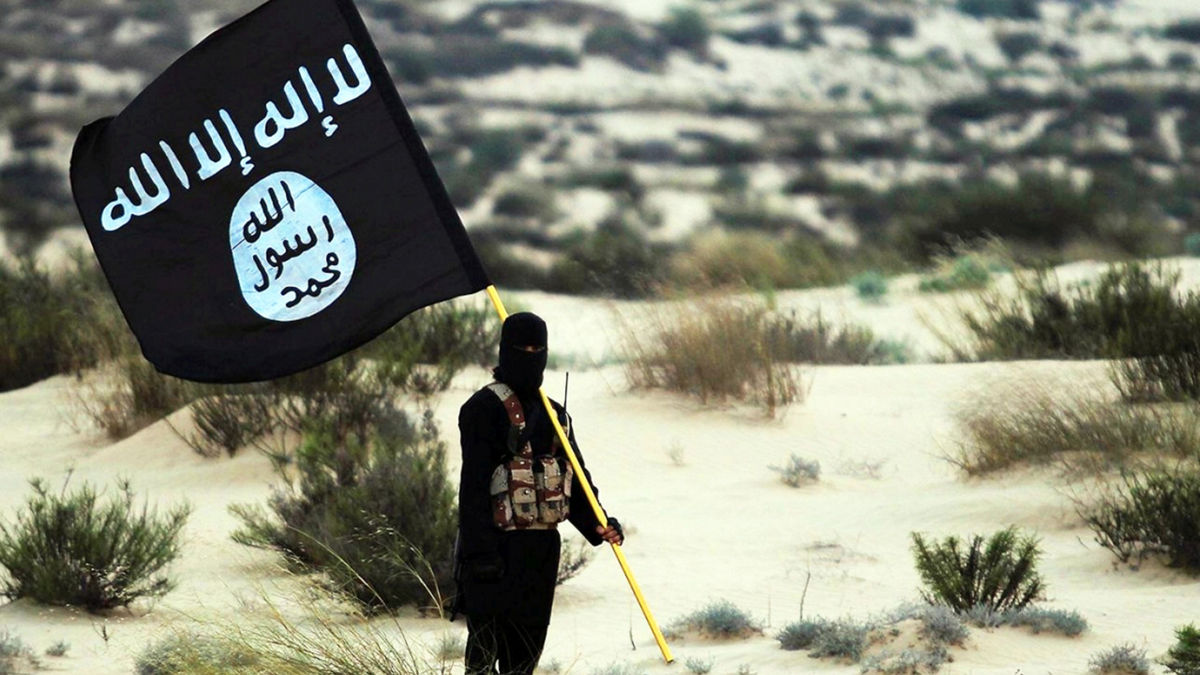
The ISIS flag relies on stark visual elements to project ideological authority, combining a historic black banner with foundational Islamic text. At its core, the design uses the shahada, the universal declaration of faith, paired with a distinct white circle meant to evoke an ancient prophetic seal. Understanding this banner requires separating standard religious expressions from how extremist groups appropriate them for political legitimacy and recruitment.
The group formally known as the Islamic State of Iraq and al-Sham (ISIS) adopted this visual identity to anchor its actions in early Islamic history. While the flag's components draw from centuries-old traditions, their arrangement serves a modern propaganda strategy designed to signal absolute authority.
The Arabic Text and the Shahada
The upper portion of the banner features white Arabic script on a black field. This text reads la ilaha illa-llah, muhammadun rasulu-llah, which translates to "There is no god but Allah, and Muhammad is His messenger". This phrase, known as the shahada, is recited daily by practicing Muslims worldwide and serves as the fundamental profession of the Islamic faith.
By placing the shahada on a militant banner, ISIS co-opts a sacred text to frame its political objectives as a divine mandate. Anyone who opposes the group can thus be rhetorically cast as opposing the faith itself. Other sovereign nations, such as Saudi Arabia, also feature the shahada on green national banners, but the stylistic execution and context differ completely.
The White Circle and the Prophetic Seal
Beneath the primary line of text lies a white circle containing inverted black script. This graphic element reads Muhammad, rasul (messenger), and Allah from bottom to top, forming a rough circle.
This design is engineered to replicate the Seal of Muhammad, an ancient stamp allegedly used by the Prophet to authenticate correspondence sent to neighboring rulers. By mimicking this artifact, ISIS attempts to project a direct lineage to early Islamic governance. The rough, unpolished style of the lettering is intentional. Rather than using clean digital typography, the crude script aims to mimic handwritten manuscripts from the 7th century, creating a manufactured sense of historical authenticity.
The History of the Black Standard
The choice of a solid black background stems from early Islamic lore concerning the al-Rayah, or the Black Standard. Historical traditions suggest that early Muslim armies carried plain black banners into battle.
Over the centuries, various regional movements and rebel factions repurposed the black banner to signal resistance or piety. In contemporary times, radical militant organizations—including al-Qaeda affiliates and splinter groups—revived the black flag. ISIS altered the traditional plain black banner by adding the shahada and the circular seal to distinguish its brand from rival militant factions and maximize visual recognition in media campaigns.
Furthermore, apocalyptic traditions within certain Islamic texts mention armies bearing black banners emerging from Khorasan ahead of the end times. Extremist strategists actively lean into these prophecies to cultivate a doomsday narrative, portraying their campaign as a fulfillment of destiny designed to attract foreign recruits.
Propaganda and Global Recognition
The minimalist design of the banner makes it highly effective for digital distribution. It reproduces clearly in low-resolution online videos, social media profile pictures, and printed propaganda.
Security analysts note that the flag transitioned from a localized battlefield marker to a universal shorthand for terror. Because the banner uses fundamental religious terminology, it creates a deliberate propaganda trap: critics condemning the flag's deployment can be accused by extremists of condemning the sacred text inscribed upon it.
Government bodies and international organizations have classified the public display of the banner as a criminal offense associated with terrorist promotion and incitement in multiple jurisdictions. Law enforcement agencies track the flag's appearance online and offline as a key indicator of radicalization or material support for extremist cells.
Frequently Asked Questions
Is the shahada exclusive to ISIS?
No. The shahada is the foundational declaration of Islam, spoken during daily prayers and used by billions of Muslims globally. Its use by an extremist group is an appropriation of a mainstream religious phrase.
Why is the background black instead of another color?
The black background references historical accounts of early military standards used during the expansion of Islam, as well as apocalyptic prophecies that appeal to extremist recruitment narratives.
How does the ISIS flag differ from the flag of Saudi Arabia?
While both flags feature the shahada, the Saudi flag uses a green background with stylized calligraphic script alongside a sword symbol, representing national sovereignty. The ISIS banner uses a stark black field with crude, unvowelled text and a circular seal designed to mimic ancient correspondence.
What do the words inside the white circle mean?
The text inside the circle reads "Muhammad is the messenger of God" arranged vertically to mimic the physical stamp or signet ring used historically to seal official documents.



