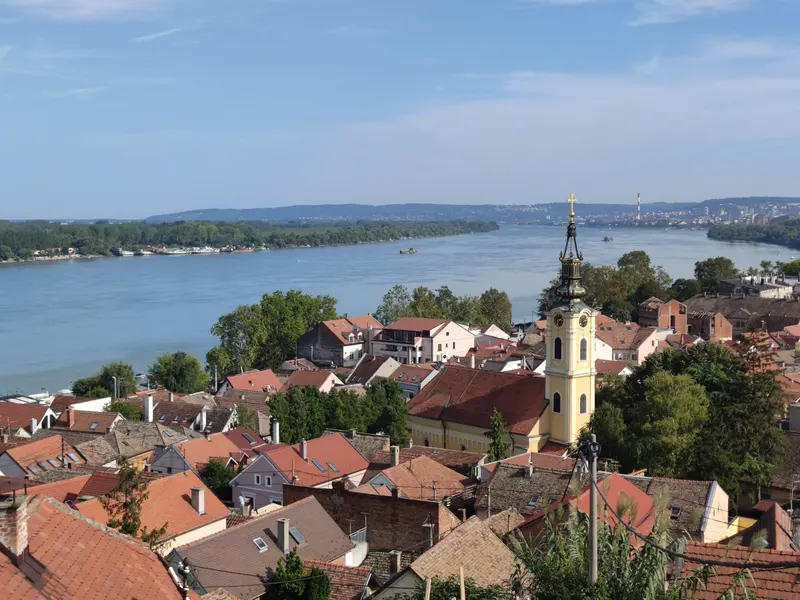
Is Serbia landlocked? Yes, Serbia is entirely landlocked, meaning it has no direct coastline along any ocean or major sea. Located in the central Balkans, it is completely surrounded by eight neighboring countries: Hungary, Romania, Bulgaria, North Macedonia, Kosovo, Montenegro, Bosnia and Herzegovina, and Croatia. Because of this interior placement, it cannot host traditional maritime ports on its own sovereign territory.
Yet, looking only at a standard map misses how nations without sea access bypass physical isolation. Through international agreements, major river networks, and strategic foreign corridors, Serbia maintains robust commercial maritime connections. Let's examine how geography shapes this nation's economic reality and how it trades with the rest of the world.
The Physical Geography of Serbia
Positioned at a historic crossroads between Central and Southeastern Europe, Serbia covers roughly 88,360 square kilometers of varied terrain. The northern half is defined by the flat Pannonian Plain, dominated by rich agricultural fields carved by major river basins. The southern and central regions shift into rolling hills, rugged mountain ranges, and deep river valleys.
Because it sits entirely inland, its borders are entirely terrestrial rather than maritime. The closest it ever came to the sea in modern history ended with the dissolution of the State Union of Serbia and Montenegro in 2006, when Montenegro voted for independence. That peaceful separation left Serbia as a completely landlocked republic, cutting off its direct sovereign window to the Adriatic Sea. For another angle on this event, check out the latest coverage from Reuters.
Navigating Waterways: The Danube River Advantage
Not having a coastline doesn't mean a country is cut off from global shipping lanes. Serbia leverages one of Europe's most powerful natural assets: the Danube River. Flowing right through the heart of the country—including through the capital city of Belgrade and major industrial hubs like Novi Sad—the Danube acts as a vital international water highway.
The river is part of European Union Corridor VII, connecting Central Europe directly to the Black Sea. Heavy cargo, industrial machinery, and raw materials move out of Serbian river ports on barges that travel downstream toward international shipping lanes.
- Corridor VII Integration: The Danube links Serbian ports to the Rhine-Main-Danube canal system, allowing cargo to flow all the way to North Sea ports like Rotterdam.
- Port Modernization: Facilities like DP World Novi Sad and Luka Beograd act as major multimodal logistics nodes, handling millions of tons of freight annually.
- Multimodal Logistics: Freight moves smoothly from river barges onto the European rail network and international highway systems.
While river shipping can't entirely replicate the massive container ship capacity of an ocean port, it gives inland manufacturers a cost-effective alternative for bulk transport. You can review the broader scope of European transport networks via the European Investment Bank.
Economic Impact of Being Landlocked
Economic textbooks often note that landlocked nations face higher transport costs because goods must cross international borders and travel greater distances over land before reaching a container ship. For Serbia, this dynamic influences trade policy, logistics infrastructure, and manufacturing supply chains.
Despite these physical constraints, Serbia has developed a resilient, upper-middle-income economy centered on manufacturing, automotive components, information technology, and agriculture. To offset its lack of a coastline, the country relies heavily on bilateral transit agreements with neighboring coastal states.
Access to Adriatic Ports
To reach global ocean markets, Serbian exporters rely heavily on foreign ports, particularly in neighboring Montenegro and Croatia. The Belgrade-Bar railway, which connects Serbia directly to the Montenegrin port of Bar, has historically served as a critical economic lifeline for heavy industry and steel transport.
Additional freight moves via truck and rail through Croatia toward ports like Rijeka, or south through Greece toward the Port of Thessaloniki. These transit corridors mean that Serbian goods clear customs and reach global container vessels within a single day of transit, neutralizing much of the traditional penalty of being landlocked.
Common Misconceptions About Inland Nations
People often assume that landlocked countries are automatically economically isolated or heavily dependent on foreign charity. Modern logistics have largely dismantled that old narrative.
- Myth: Landlocked means isolated from global trade. Modern containerization, standardized rail gauges, and open European transit corridors mean goods move seamlessly across borders without major delays.
- Myth: Rivers cannot substitute for the sea. While you can't dock an intercontinental container ship on the Danube, river barges handle massive volumes of steel, grain, and oil that feed directly into deep-water ports on the Black Sea.
- Myth: Serbia has no maritime rights. Under international maritime law, landlocked states have the right of access to and from the sea, allowing them freedom of transit through neighboring coastal countries without unnecessary customs duties.
For a deeper dive into regional country profiles and demographic metrics, consult the World Bank.
Frequently Asked Questions
Does Serbia have any navy?
No. Because Serbia has no coastline or territorial waters, it does not maintain a sea-going navy. It does, however, maintain a river flotilla operating patrol boats and minesweepers along its major navigable rivers like the Danube and the Sava.
How does cargo get from Serbia to the ocean?
Cargo travels via inland river barges down the Danube toward the Black Sea, or via overland rail and highway networks to deep-water seaports in Montenegro, Croatia, and Greece.
Did Serbia ever have a coastline?
Yes. Prior to June 2006, Serbia was part of a union with Montenegro, which provided the federation with a direct coastline along the Adriatic Sea. When Montenegro declared independence, Serbia became landlocked.
What are Serbia's main trade partners?
Serbia's primary trade partners include members of the European Union—such as Germany, Italy, and Hungary—as well as regional neighbors in the Western Balkans. Most of this trade flows across land borders via well-established European transport corridors.



