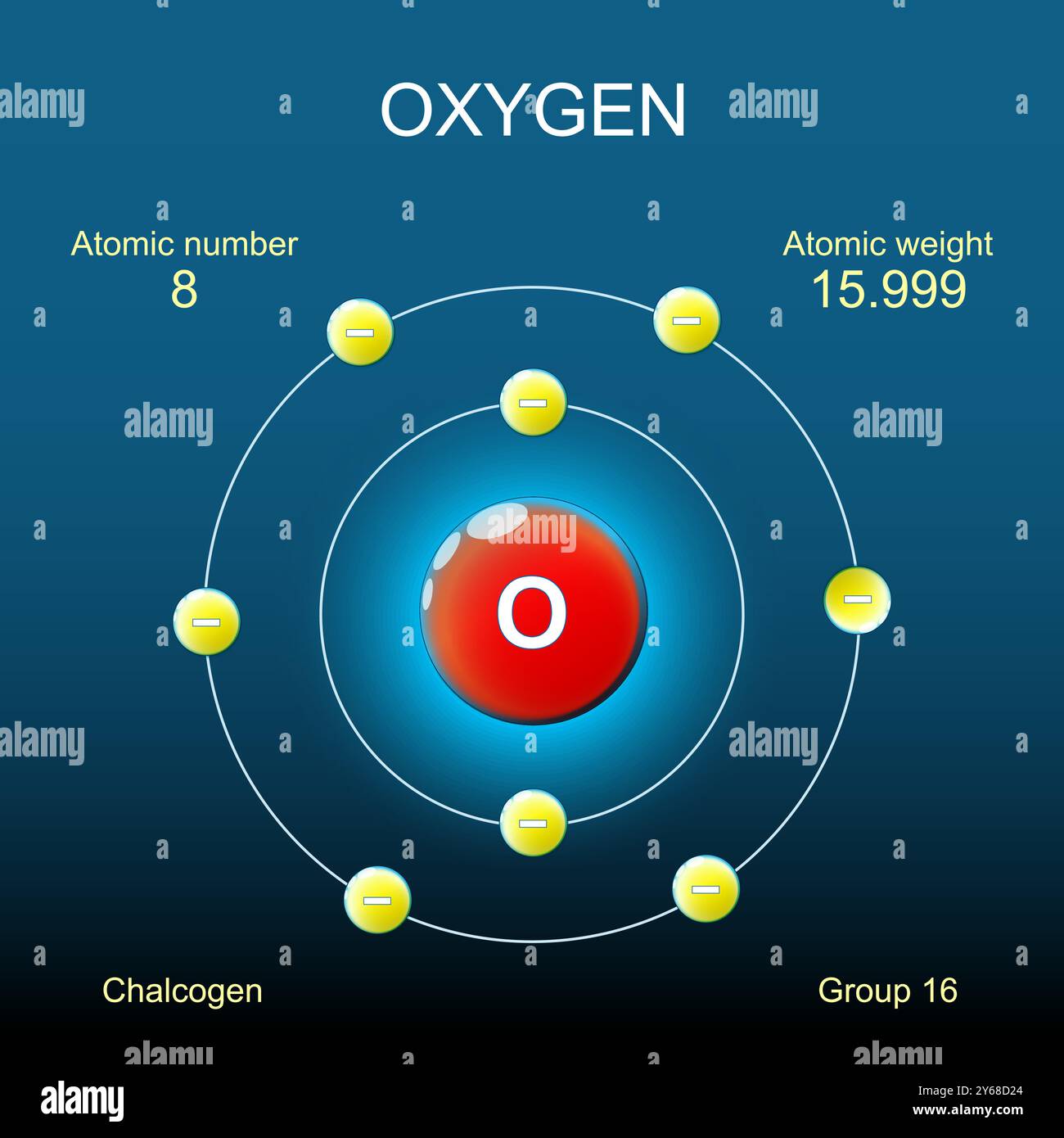
Oxygen is unequivocally classified as a nonmetal on the periodic table. Located in Group 16, it sits far away from the metallic elements that dominate the left and center of the table. Its physical state at room temperature, poor electrical conductivity, and high electronegativity values confirm this categorization without ambiguity.
Understanding why oxygen falls into this category involves looking at its atomic structure and electron behavior. Unlike metals, which freely share or give up valence electrons to form positive ions, oxygen acts as an electron acceptor. This fundamental behavior dictates how it interacts with other substances, whether it's supporting combustion in an engine or bonding with hydrogen to form water.
Where Oxygen Fits on the Periodic Table
The periodic table arranges elements by atomic number and recurring chemical trends. Group 16 contains the chalcogens, a family that includes oxygen, sulfur, selenium, tellurium, and polonium. While elements further down this group begin to show metalloid or metallic tendencies, oxygen remains firmly anchored at the top as a reactive nonmetal.
Its position in the upper-right corner places it right next to fluorine and nitrogen. Elements in this specific region of the table share extreme nonmetallic properties, such as high ionization energies and strong tendencies to form covalent bonds or anions. BBC has also covered this important subject in great detail.
Physical Properties That Define Oxygen
You can identify nonmetals by looking at their physical characteristics, which contrast sharply with traditional metals. Oxygen exhibits every major physical trait associated with nonmetallic elements:
- State of Matter: At standard temperature and pressure, oxygen exists as a colorless, odorless diatomic gas (O2).
- Thermal and Electrical Conductivity: Oxygen is an exceptionally poor conductor of heat and electricity. It acts as an insulator because its electrons are tightly bound to individual nuclei rather than moving freely in a delocalized sea.
- Lack of Luster: Solid and liquid oxygen lack the shiny, reflective surfaces typical of polished metals. Liquid oxygen appears as a pale blue fluid, while solid oxygen takes on a dense, bluish-black appearance.
- Density: Oxygen gas is less dense than standard ambient air, contrasting with heavy, dense metallic solids like lead or iron.
These physical traits mean oxygen cannot support the structural or mechanical uses of metals. You can't hammer it into sheets or draw it into wires.
Chemical Behavior and Electron Affinity
The most critical test for any element's classification is its chemical reactivity. Oxygen has an electronegativity rating of 3.44 on the Pauling scale, making it the second most electronegative stable element behind fluorine.
This high electronegativity means oxygen pulls shared electrons tightly toward itself in chemical bonds. When it reacts with metals like iron or magnesium, it strips electrons away to form ionic oxides, such as rust (iron(III) oxide). When it reacts with nonmetals like hydrogen or carbon, it forms covalent compounds where it dominates the electron cloud.
This tendency to accept or pull electrons rather than donate them is the hallmark chemical signature of a nonmetal.
Common Misconceptions About Oxygen's Classification
Students and researchers occasionally confuse oxygen's classification due to its complex interactions in various chemical environments.
One common confusion stems from the existence of oxides and metallic alloys. People sometimes assume that because oxygen bonds with metals, it might share intermediate properties. However, an element's classification is based on its intrinsic atomic behavior, not the company it keeps in a compound. Carbon is a nonmetal, yet it forms steel when mixed with iron; similarly, oxygen's presence in metallic structures doesn't make it metallic.
Another area of confusion involves unusual oxidation states. In compounds like hydrogen peroxide (H2O2), oxygen exhibits a -1 oxidation state rather than its usual -2. While this reflects bonding complexity, it still involves gaining or sharing electrons, aligning directly with nonmetal chemistry.
Why This Classification Matters in Science and Industry
Knowing that oxygen is a nonmetal isn't just a textbook trivia fact. It guides practical applications across multiple fields:
- Materials Science: Engineers designing high-temperature rocket engines or industrial pipelines must account for oxygen's aggressive oxidizing nature. Because it's a nonmetal that reacts readily with structural metals, corrosion prevention is a multi-billion-dollar engineering priority.
- Medical and Biological Systems: In human physiology, oxygen's nonmetallic electron-accepting properties drive cellular respiration. Hemoglobin transports oxygen through the bloodstream precisely because oxygen can reversibly bind and unbind based on local chemical gradients.
- Chemical Manufacturing: Industrial synthesis relies on oxygen as an oxidizing agent. Chemical engineers control reaction vessels carefully because oxygen's reactivity can trigger rapid combustion or explosions if ignored.
For more details on how elements are grouped, you can review the Royal Society of Chemistry Periodic Table or explore educational references provided by NASA Science.
Frequently Asked Questions
Is oxygen ever a solid or liquid?
Yes. When cooled below negative 183 degrees Celsius, oxygen gas condenses into a pale blue liquid. If cooled further below negative 218.4 degrees Celsius, it freezes into a pale blue or bluish-black solid.
Can oxygen conduct electricity under high pressure?
Under extreme laboratory pressures, scientists have observed exotic phases of oxygen that exhibit metallic-like electrical conductivity. However, under standard and near-standard conditions, it remains a pure electrical insulator.
Why is oxygen diatomic in nature?
Free oxygen atoms have unpaired valence electrons, making them highly unstable and reactive. By pairing up to form O2 molecules, oxygen atoms share electrons to achieve a lower, more stable energy state.
How does oxygen differ from a metalloid?
Metalloids like silicon or germanium possess intermediate electrical conductivity (semiconductors) and brittle, semi-lustrous appearances. Oxygen has zero semiconductor properties and is a complete electrical insulator in gas, liquid, or solid phases.


