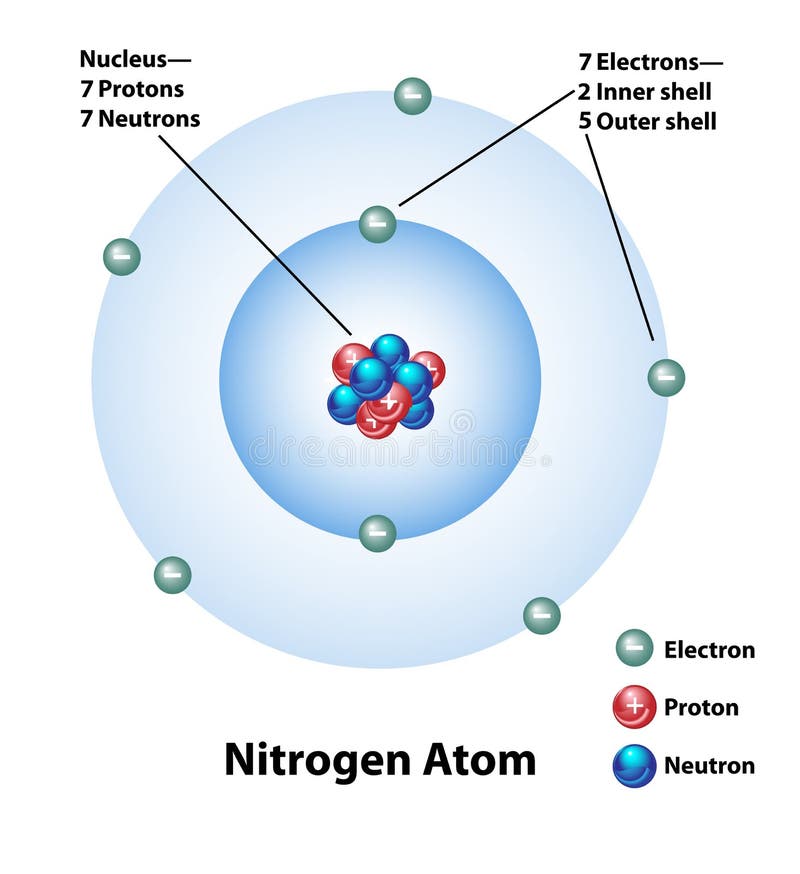
Nitrogen isn't a metal. It occupies Group 15 of the periodic table as a diatomic gas under standard conditions, making up about 78 percent of Earth's atmosphere by volume. Despite occasional confusion stemming from high-pressure physics experiments where extreme forces can force gases into metallic states, normal nitrogen is the textbook definition of a nonmetal. It lacks free valence electrons capable of forming a metallic lattice, doesn't conduct electricity or heat efficiently in its standard states, and cannot be hammered into sheets or drawn into wires.
The confusion around nitrogen's classification usually arises from three places: old internet forum debates, misunderstanding of periodic trends near the metalloid staircase, and high-pressure condensed matter physics. At pressures exceeding one million atmospheres, researchers have observed a polymeric, electrically conductive form of nitrogen known as cubic gauche nitrogen. This extreme laboratory state doesn't change how chemists classify the element for everyday science, industry, or education. Under standard temperature and pressure, nitrogen is firmly a nonmetal.
The Periodic Table Placement of Nitrogen
Nitrogen sits at the top of Group 15, right above phosphorus, arsenic, antimony, bismuth, and moscovium. This group is historically known as the pnictogens. While elements lower down in this column—such as antimony and bismuth—exhibit heavy metalloid or metallic properties, nitrogen sits at the very top. Elements in the upper right corner of the periodic table possess high electronegativity and high ionization energy. These traits prevent them from releasing valence electrons into a shared "sea" of electrons, which is the foundational requirement for metallic bonding.
The periodic table separates metals from nonmetals using a diagonal staircase line running from boron down to polonium. Nitrogen sits safely above and to the right of this dividing line. Its position dictates its chemical behavior: instead of losing electrons to form positive ions like metals do, nitrogen tends to gain or share electrons to complete its octet, forming covalent bonds such as the extremely strong triple bond found in $N_2$ gas.
Core Chemical and Physical Properties of Nitrogen
To understand why nitrogen remains classified as a nonmetal, look directly at its physical and chemical characteristics under normal conditions:
- Electrical Insulation: Nitrogen gas is an excellent electrical insulator. It does not allow free electrons to flow through it, contrasting sharply with copper, aluminum, or iron.
- Lack of Ductility and Malleability: Solid nitrogen, which forms below $-210^\circ\text{C}$, is brittle and crystalline. It shatters under stress rather than deforming plastically like a metal.
- Thermal Behavior: While liquid nitrogen is famous for its extreme cold ($-196^\circ\text{C}$) and finds heavy use as a refrigerant in cryogenics, nitrogen gas is a poor thermal conductor compared to metallic elements.
- Low Density and State: At standard temperature and pressure, nitrogen exists as a colorless, odorless gas. Metals are dense, lustrous solids at room temperature, with the sole exception of mercury.
Metallic Nitrogen: Separating Fact from Fiction
The most common source of the "is nitrogen a metal?" debate stems from theoretical predictions and high-pressure physics experiments. In 1985, theoretical physicists predicted that under immense static pressures, the triple bond of molecular nitrogen would break down, forming a single-bonded network polymer similar to diamond. This phase is often theorized to be electrically conductive, resembling an alkali metal or a semiconductor.
In subsequent decades, diamond anvil cell experiments successfully compressed molecular nitrogen to pressures exceeding 1 million atmospheres (around 100 gigapascals) at cryogenic temperatures. Researchers observed transitions into polymeric, non-molecular states. Some experiments reported increased electrical conductivity under specific shock-compression conditions.
However, these extreme states require laboratory environments that destroy ordinary molecular structures instantly. Transforming nitrogen into a metallic state requires pressures found deep within gas giant planets like Neptune, not in any natural terrestrial environment. Calling nitrogen a metal based on extreme high-pressure physics is akin to calling water a solid at room temperature because it freezes in a freezer.
Industrial Uses of Molecular Nitrogen
Because nitrogen is chemically inert under normal conditions, industries rely on it to prevent unwanted chemical reactions rather than for structural or electrical metal-like properties.
- Food Packaging: Food manufacturers flush bags of potato chips and containers of perishable goods with nitrogen gas to displace oxygen, preventing oxidation and spoilage.
- Chemical Manufacturing: The Haber-Bosch process combines atmospheric nitrogen with hydrogen gas under high heat and pressure to produce ammonia ($NH_3$), serving as the foundation for global agricultural fertilizers.
- Tire Inflation: Racing teams and commercial aviation services fill tires with dry nitrogen instead of compressed air. Nitrogen molecules are slightly larger and less prone to moisture contamination, leading to more stable tire pressure fluctuations across temperature swings.
- Oil and Gas Operations: Energy companies inject high-pressure nitrogen gas into oil wells to maintain reservoir pressure and push crude oil toward the surface.
Frequently Asked Questions
Is liquid nitrogen a metal?
No. Liquid nitrogen is simply the liquefied form of molecular nitrogen gas. It remains a nonmetal, does not conduct electricity, and acts as an effective cryogenic coolant rather than a metallic fluid.
Why is nitrogen gas so stable?
Two nitrogen atoms bind together via a covalent triple bond. This bond requires a massive amount of energy to break, making $N_2$ exceptionally unreactive at room temperature.
Are there any metals in Group 15?
Yes, but only further down the column. Bismuth, at the bottom of Group 15, is a heavy post-transition metal. Nitrogen and phosphorus at the top are strictly nonmetals.
Can nitrogen form alloys?
No. Alloys are solid solutions composed of two or more metallic elements. Nitrogen can form interstitial compounds with certain transition metals (such as nitrides in specialized steels), but nitrogen itself cannot act as the metallic base for an alloy.
Where did the myth that nitrogen is a metal come from?
The misconception typically arises from misinterpretations of high-pressure physics research where scientists compress nitrogen into conductive polymeric phases, combined with confusion over elements lower down in the pnictogen family.


