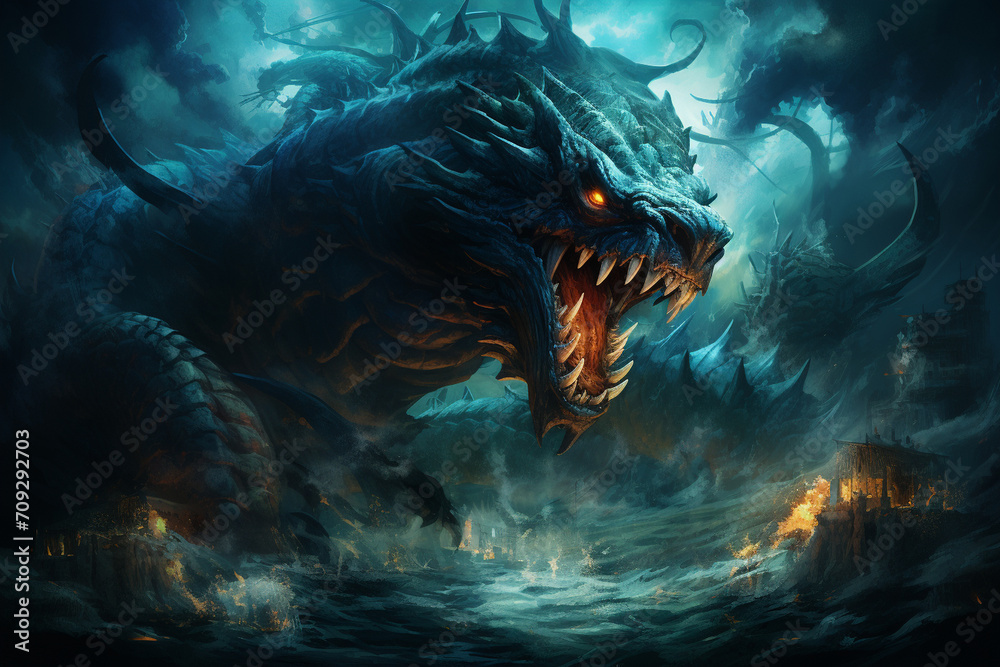
The question of whether the biblical sea monster known as the Leviathan is still alive today stems from a mix of ancient mythology, literalist interpretations of sacred texts, and modern cryptozoology. To answer it directly: no, a physical, fire-breathing, primordial sea serpent named Leviathan does not exist in the world's oceans. The creature is fundamentally a mythological symbol born from ancient Near Eastern cosmology rather than an undiscovered biological animal lurking in the Mariana Trench.
Despite this clear scientific and historical reality, rumors and internet hoaxes persistently suggest that the beast survived or that prehistoric marine predators were actual instances of the legend. Examining why this myth endures requires looking at ancient texts, the science of deep-sea exploration, and the psychological appeal of sea monsters.
Origins of the Mythical Beast
The name Leviathan comes from the Hebrew word livyatan, meaning coiled or twisted. In ancient texts, it describes an immense sea serpent or dragon that embodies chaos, power, and the untamed forces of nature.
Scholars trace the roots of the Leviathan further back into pre-biblical Mesopotamian and Canaanite mythology. For example, Ugaritic texts recount the storm god Baal fighting Lotan, a multi-headed sea serpent. Similarly, the Babylonian creation epic features Tiamat, a primordial ocean goddess and dragon defeated by Marduk.
When these motifs entered Hebrew literature, such as the Book of Job, Psalms, and Isaiah, they were reinterpreted. Instead of portraying a polytheistic battle between equal deities, the texts framed Leviathan as a magnificent or terrifying creature entirely subject to the sovereign power of a single creator. According to the Encyclopaedia Britannica, these descriptions served theological and literary functions rather than acting as biological field guides.
Biblical Descriptions vs. Biological Reality
Literal interpretations often point to passages in the Book of Job, which describe Leviathan as breathing fire, wearing a coat of impenetrable scales, and making the deep sea boil:
"Can you pull in Leviathan with a fishhook or tie down its tongue with a rope? ... Nothing on earth is its equal—a creature without fear." — Job 41:1, 33
From a biological standpoint, no known animal possesses the physiological capacity to generate fire or maintain the extreme physical attributes ascribed to Leviathan. Over the centuries, naturalists and theologians have attempted to rationalize these descriptions by associating the creature with real-world animals:
- Nile Crocodiles: Some historical commentaries suggest the description relies on the formidable armor and aquatic nature of large crocodiles found in the Nile river.
- Great Whales: Early modern sailors and translators frequently used the term leviathan as a generic descriptor for massive marine mammals, particularly sperm whales or blue whales.
- Prehistoric Marine Reptiles: Extinct apex predators like the Mosasaurus or Pliosaurus often inspire modern comparisons, though these creatures vanished millions of years before human texts were written.
Why People Think It Is Still Alive
The persistent belief that Leviathan survives today is fueled by a combination of internet culture, scientific illiteracy regarding the deep sea, and historical misinterpretations of paleontology.
The Unexplored Ocean Fallacy
A common argument is that because humanity has only explored a small fraction of the deep ocean, massive beasts could easily hide away from modern sonar and shipping lanes. While it is true that marine biologists discover new species of fish, invertebrates, and deep-sea corals regularly, discovering an active population of colossal, hyper-predatory reptiles or mammalian-reptilian hybrids is biologically impossible.
Large apex predators require vast quantities of calories and stable breeding populations to survive across generations. An animal the size of a mythical sea serpent would leave a heavy, undeniable footprint on marine ecosystems, depleting fish stocks, altering migration patterns, and appearing constantly on modern sonar arrays and satellite tracking systems.
Hoaxes and Viral Media
Social media platforms frequently host viral videos claiming to show dead sea monsters washed ashore or blurry footage of giant serpents captured on deep-sea cameras. In nearly every case, these viral clips turn out to be decomposing basking shark carcasses (known as globsters), CGI creations, or distorted camera artifacts. A famous historical example involved a fabricated skeleton displayed in the 19th century as proof of the beast, which was later exposed as a composite hoax.
Scientific Misidentifications: The Real-Life "Leviathans"
While the mythical beast is fictional, nature has produced real creatures of staggering proportions that likely fueled ancient sailor superstitions.
Livyatan melvillei
Paleontologists discovered the fossilized skull of an extinct sperm whale in Peru, naming it Livyatan melvillei in honor of Herman Melville, author of Moby-Dick. This prehistoric leviathan lived roughly 10 million years ago, grew up to 55 feet long, and possessed massive, functional teeth on both its upper and lower jaws—unlike modern sperm whales. It hunted other marine mammals, including early baleen whales. However, it went extinct millions of years ago due to changing ocean temperatures and shifts in marine food webs.
The Giant Squid and Colossal Squid
Encounters with giant squids (Architeuthis dux) and colossal squids (Mesonychoteuthis hamiltoni) in polar and deep waters surely inspired ancient mariners to invent tales of tentacled sea monsters dragging ships into the abyss. While these cephalopods are real and grow to impressive lengths of over 40 feet, they inhabit the deep bathypelagic zone and pose no threat to surface vessels.
Common Mistakes When Researching Sea Monster Myths
- Confusing Metaphor with History: Treating poetic or theological literature as a literal zoological inventory leads to false conclusions about ancient history.
- Ignoring Evolutionary Timelines: Assuming that prehistoric monsters like megalodon or ancient marine reptiles managed to survive unnoticed in deep ocean trenches ignores basic marine ecology and fossil records.
- Trusting Unverified Online Media: Accepting low-resolution internet videos or AI-generated images as proof of living mythological creatures without checking peer-reviewed scientific sources.
Frequently Asked Questions
What does the word leviathan actually mean?
The word originates from the Hebrew livyatan, which translates to coiled, twisted, or wound. It describes the serpentine shape of a large aquatic creature.
Is Leviathan mentioned in the Bible?
Yes. The creature is referenced multiple times in the Hebrew Bible, specifically within the Book of Job, the Book of Psalms, and the Book of Isaiah, where it serves as a symbol of divine power, chaos, or earthly enemies.
Could a prehistoric sea monster still live in the deep ocean?
No. Large apex predators require massive food webs to sustain them. If a giant marine predator existed today, its impact on fisheries, marine ecosystems, and ocean tracking equipment would make its presence undeniable.
Is Leviathan related to Satan or demons?
In later Christian theology and demonology, writers frequently associated Leviathan with pride, chaos, or Satan, viewing the creature as an embodiment of spiritual evil that would eventually be vanquished.



