Under ordinary environmental conditions on Earth, hydrogen is not a metal. It sits at the very top of Group 1 on the periodic table—directly above lithium, sodium, and potassium—which leads many people to assume it belongs to the alkali metal family. However, everyday hydrogen behaves entirely as a nonmetal. It exists as a colorless, odorless diatomic gas ($H_2$), has a very low density, and acts as an electrical insulator rather than a conductor.
The plot thickens when you look beyond standard temperature and pressure. Under extreme physical compression—such as the pressures found deep within gas giants like Jupiter or recreated inside high-tech diamond anvil cells in physics laboratories—hydrogen undergoes a radical phase transition. Its molecules break apart, its electrons become delocalized, and it transforms into metallic hydrogen, an electrically conductive fluid or solid.
Why Hydrogen Sits Above the Alkali Metals
If hydrogen isn't a metal, why do chemists place it at the top of Group 1? The arrangement comes down to atomic structure rather than physical appearance.
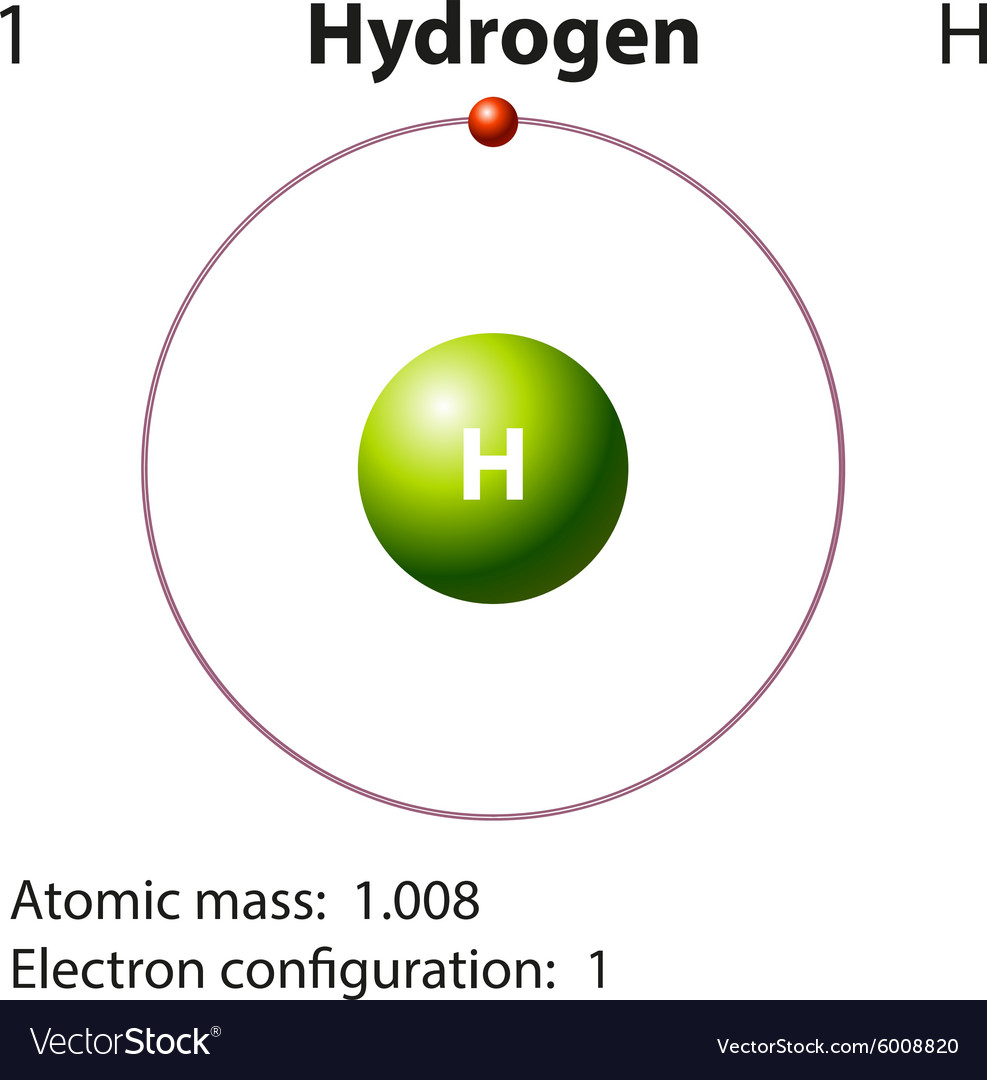
An atom of hydrogen contains a single proton and a single electron, giving it an electron configuration of $1s^1$. Every alkali metal beneath it in Group 1 also features a single valence electron in its outermost shell. Because chemical reactivity is largely driven by valence electrons, hydrogen often forms single covalent bonds or loses its lone electron in reactions, mirroring the behavior of alkali metals.
Even so, hydrogen's chemical properties place it in an awkward middle ground:
- Ionization Energy: Removing an electron from hydrogen requires far more energy than removing an electron from sodium or potassium. Hydrogen holds onto its single electron much tighter than true metals do.
- Electronegativity: Unlike metals—which readily donate electrons to form positive ions—hydrogen has a relatively high electronegativity. When it bonds with reactive alkali metals like sodium, it actually gains an electron to form a hydride ion ($H^-$), acting more like a halogen than an alkali metal.
Because of this split personality, some periodic tables occasionally place hydrogen above the halogens (Group 17) or leave it isolated in the center.
The Physics of Metallic Hydrogen
The most fascinating twist in hydrogen chemistry is its ability to turn metallic. Metals conduct electricity because their outer electrons are free to roam across a lattice of atomic nuclei. Under normal conditions, hydrogen's electrons are tightly bound to individual molecules, creating an insulating gas.
When you squeeze hydrogen with millions of atmospheres of pressure, the distance between atoms shrinks drastically. According to quantum mechanics, the electron wavefunctions overlap, closing the band gap. The electrons are no longer tied to specific proton pairs and can move freely throughout the material.
Where Metallic Hydrogen Exists
- Deep Planetary Interiors: Theoretical models and planetary physics data indicate that the massive interiors of Jupiter and Saturn consist largely of liquid metallic hydrogen. This conductive ocean generates Jupiter's massive magnetic field.
- Laboratory Experiments: Physicists use specialized equipment like diamond anvil cells to crush tiny samples of hydrogen at cryogenic temperatures. Achieving the threshold requires pressures exceeding 400 gigapascals—greater than the pressure at Earth's center.
Researchers also study metallic hydrogen for its potential as a room-temperature superconductor and a high-density rocket propellant, though stable samples at ambient pressure remain an elusive goal.
Common Misconceptions About Hydrogen's State
Discussions around hydrogen frequently lead to crossed wires between chemistry, physics, and astronomy. Clarifying these distinctions prevents common errors.
- "Hydrogen is a metalloid." Metalloids like silicon and boron possess intermediate properties at standard pressure. Hydrogen does not; it is strictly a nonmetal at room conditions and only becomes a metal via a pressure-induced phase change.
- "Astronomy calls everything a metal, so hydrogen must be one." In astrophysics, any element heavier than helium is informally categorized as a "metal". By that specific convention, hydrogen is one of the only non-metals in the universe, which is the exact opposite of standard chemistry terminology.
- "Metallic hydrogen is already widely used in industry." While small amounts have been transiently synthesized in high-pressure physics labs, mass production or commercial application does not exist due to the extreme engineering hurdles required to maintain those pressures.
To explore the broader context of atomic classifications, you can review the National Institute of Standards and Technology Periodic Table or read about current research on phase transitions via Physics Today.
Frequently Asked Questions
Can hydrogen ever be a liquid at room temperature?
No. At room temperature, hydrogen remains a gas regardless of how much pressure you apply, because its critical temperature is far below zero. To liquefy hydrogen, you must cool it below $-252.87^\circ C$ ($20.28\text{ K}$) at standard pressure.
Does hydrogen conduct electricity when it is a gas?
Standard hydrogen gas is an excellent electrical insulator. However, if you apply a high enough voltage to ionize the gas—stripping the electrons away from the protons to create a plasma—it will conduct electricity, just like neon inside a glowing sign.
Why is hydrogen separated from the rest of Group 1 on the periodic table?
Most modern periodic tables place a small visual gap between hydrogen and lithium. Textbook designers and chemists use this gap to signal that while hydrogen shares valence electron traits with alkali metals, its physical properties and nonmetallic nature make it fundamentally unique.
Is solid hydrogen shiny like silver?
Theoretical models and high-pressure experiments suggest that solid metallic hydrogen should have a lustrous, reflective, silver-like appearance, similar to traditional alkali metals like potassium or cesium, though confirming its exact optical properties remains an ongoing challenge in condensed matter physics.


