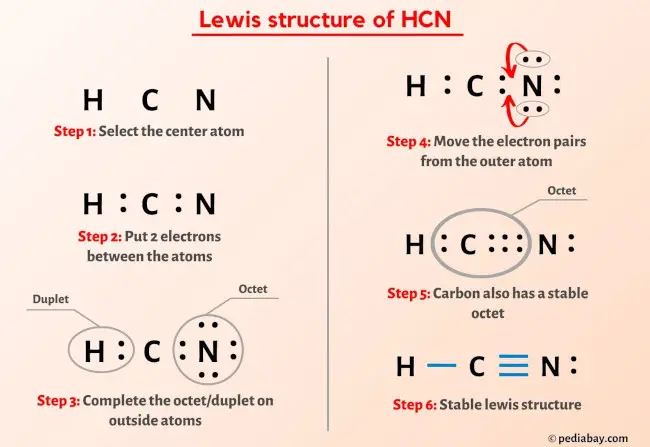
Hydrogen cyanide (HCN) is a polar molecule. Even though it features a perfectly linear molecular geometry, it lacks the symmetry required to cancel out its internal dipole moments. Understanding why this compound behaves as a polar substance requires looking closely at electronegativity values, bond polarities, and molecular asymmetry.
If you're studying general chemistry or reviewing covalent bonding concepts, you'll find that HCN is a classic exam example because its linear shape often tricks students into guessing it's nonpolar. Let's break down the exact physical properties and structural traits that determine its polarity.
The Molecular Geometry and Bonding of HCN
Hydrogen cyanide consists of three atoms bonded in a straight line: a central carbon atom connected to a hydrogen atom on one side and a nitrogen atom on the other. The connection between carbon and hydrogen is a single covalent bond, while the connection between carbon and nitrogen is a triple bond.
Because of this arrangement, the molecule has a linear shape with a bond angle of 180 degrees. Students often confuse linear geometry with automatic nonpolarity—similar to carbon dioxide ($CO_2$). However, geometry is only half the equation. Polarity depends entirely on how electrons are distributed across the entire structure.
Why HCN is a Polar Molecule
To determine whether a molecule is polar, you have to examine individual bond polarities and vector addition.
Electronegativity Differences
Every atom has a specific electronegativity value on the Pauling scale, which measures how strongly it attracts shared electrons:
- Hydrogen (H): 2.20
- Carbon (C): 2.55
- Nitrogen (N): 3.04
Because nitrogen is significantly more electronegative than carbon, it pulls the shared electrons in the triple bond strongly toward its end. Carbon, in turn, is more electronegative than hydrogen, pulling electrons away from the hydrogen atom.
The Asymmetry Factor
In a truly nonpolar linear molecule like $CO_2$, the central carbon atom is bonded to two identical oxygen atoms pulling with equal force in opposite directions. The dipole vectors cancel each other out completely.
In HCN, the two terminal atoms are completely different: hydrogen on the left and nitrogen on the right. Nitrogen exerts a massive electron-pulling force, while hydrogen exerts a very weak one. Because the terminal ends are asymmetric, the bond dipoles don't cancel. Instead, they reinforce a net dipole moment pointing toward the nitrogen end. This creates a permanent partial positive charge on the hydrogen side and a partial negative charge on the nitrogen side.
Common Myths and Misconceptions
When studying molecular polarity, several persistent myths cause confusion. Let's clear them up.
The first myth is that linear molecules are always nonpolar. As HCN proves, linear geometry only results in a nonpolar molecule if the terminal atoms are identical, creating a symmetrical pull.
The second myth claims that triple bonds neutralize polarity. Some learners assume that high electron density in a triple bond acts like a shield. In reality, a triple bond simply concentrates more electron density on the more electronegative side, actually increasing the overall dipole moment of the molecule.
For more detailed guides on molecular geometry and chemical principles, you can check resources provided by the National Institute of Standards and Technology or chemical education repositories like LibreTexts Chemistry.
Physical Properties Driven by HCN Polarity
Because hydrogen cyanide is a polar molecule, its microscopic charge distribution directly dictates its macroscopic behavior:
- Intermolecular Forces: HCN molecules experience dipole-dipole interactions alongside London dispersion forces and hydrogen bonding capabilities due to the active hydrogen-nitrogen environment.
- Solubility: It mixes readily with water and other polar solvents because "like dissolves like."
- Boiling Point: Its permanent dipole moment raises its boiling point higher than nonpolar gases of similar molecular weight.
Frequently Asked Questions
What is the exact dipole moment of hydrogen cyanide?
HCN has a dipole moment of approximately 2.98 Debye. This high value confirms its strong polarity, driven by the intense electronegativity difference between the hydrogen and nitrogen terminals.
Why isn't HCN symmetrical like carbon dioxide?
Symmetry in chemistry requires identical terminal atoms or groups surrounding a central atom in a balanced arrangement. Since HCN terminates with hydrogen on one side and nitrogen on the other, it lacks the mirror-image symmetry needed to cancel out dipole vectors.
Does HCN form hydrogen bonds?
Yes. Although hydrogen bonding typically occurs when hydrogen is bonded to fluorine, oxygen, or nitrogen, the strong partial positive charge on the hydrogen atom in HCN allows it to form weak intermolecular hydrogen bonds with neighboring nitrogen atoms.
How does molecular polarity affect the toxicity of HCN?
While the physical property of polarity governs how HCN dissolves in aqueous solutions and crosses biological cell membranes, its extreme toxicity stems from the cyanide ion ($CN^-$) disrupting cellular respiration by binding to mitochondrial cytochrome c oxidase.
[Intermolecular Forces for Hydrogen cyanide](https://www.youtube.com/watch?v=ob9zmO9OTcc)
This video walks through a visual flowchart process to determine the polarity and intermolecular forces of hydrogen cyanide.


