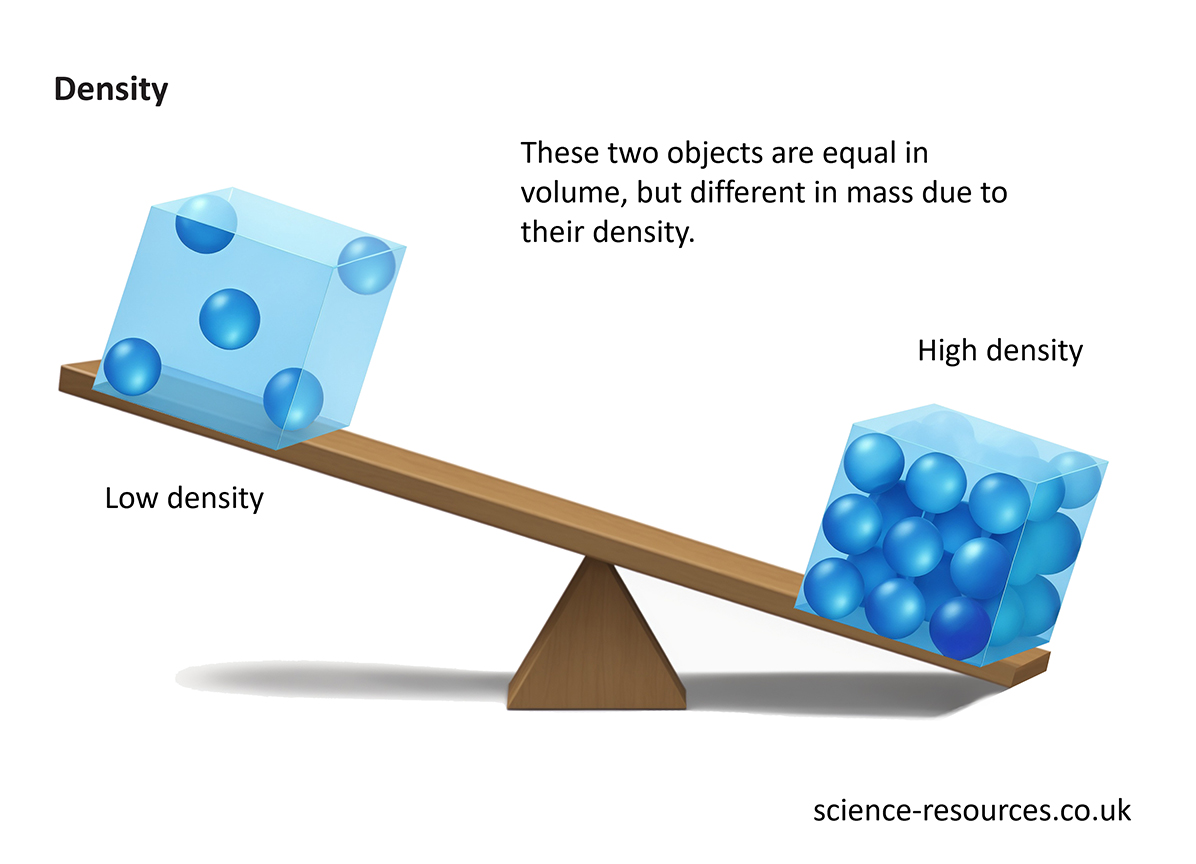
Density is a physical property of matter. It describes how much mass occupies a given amount of space for a specific substance. When you measure the density of an object, you don't change its chemical identity or turn it into something new. You simply look at the relationship between its mass and its volume.
Understanding whether a characteristic is physical or chemical helps us classify matter and predict how different substances interact. While the distinction seems straightforward, people often confuse intensive physical properties like density with chemical behaviors. Let's break down why density earns its classification as a physical property, how to calculate it, and why it matters in practical applications.
Defining Physical Versus Chemical Properties
To understand density's place in chemistry, you need to know the baseline definitions for physical and chemical properties. These categories help scientists organize the characteristics of the universe.
A physical property is a characteristic that you can observe or measure without changing the chemical composition of the substance. If you measure an object's mass, volume, melting point, boiling point, color, or hardness, the substance remains chemically identical before and after the measurement. For example, if you melt a block of ice into liquid water, it changes phase, but every molecule remains $H_2O$.
A chemical property, by contrast, describes a substance's potential to undergo a specific chemical change or reaction. You can only observe a chemical property by altering the internal molecular structure of the material. Examples include flammability, toxicity, oxidation states, and acidity. When iron rusts, it reacts with oxygen to form iron oxide, permanently changing what the material is.
Density fits squarely into the physical category because measuring it requires no chemical reactions. You weigh a sample and measure its space, but its chemical bonds stay intact.
Why Density Is Classified as a Physical Property
Density measures the compactness of a material. The standard formula is:
$$\rho = \frac{m}{V}$$
In this formula, $\rho$ represents density, $m$ is mass, and $V$ is volume. Common units include grams per cubic centimeter ($g/cm^3$) for solids and grams per milliliter ($mL$) for liquids.
The calculation relies entirely on physical dimensions. Measuring the mass of a copper block using a scale and finding its volume using water displacement alters neither the copper atoms nor their metallic bonds. Because the sample's chemical identity stays identical throughout the process, density qualifies as an intensive physical property. It doesn't depend on the size of the sample; a tiny drop of pure water has the exact same density as an entire swimming pool of pure water at the same temperature.
How Temperature and Pressure Affect Density
A common point of confusion arises because density changes when external conditions shift. People sometimes mistake these variations for chemical changes, but they're purely physical adjustments.
As you heat most substances, their particles gain kinetic energy and spread apart. This expansion increases the volume while the mass stays constant, causing the overall density to drop. Conversely, increasing pressure on gases forces molecules closer together, raising their density.
Consider liquid water versus ice. Water reaches its maximum density at approximately four degrees Celsius. When it freezes into ice, the water molecules form a crystalline lattice that takes up more space than the liquid state. That's why ice floats on water. Despite this structural shift during a phase change, the molecules are still $H_2O$. No chemical reaction took place, proving that density fluctuations remain physical phenomena.
Common Mistakes and Misconceptions
Several persistent myths surround how scientists classify material properties. Clearing these up prevents confusion in laboratory and academic settings.
- Mistake: Assuming internal molecular arrangement makes a property chemical. While crystal structures and molecular bonding dictate why a substance has a specific density, observing that density doesn't alter the bonds. Molecular geometry influences physical properties like density, refractive index, and melting point.
- Mistake: Confusing intensive and extensive properties. Density is intensive, meaning it stays constant regardless of sample size. Mass and volume are extensive because they scale with the amount of material. Because density is a ratio of two extensive properties, the size factor cancels out.
- Mistake: Believing phase changes change chemical properties. Melting, boiling, and sublimating change the physical state of matter without altering chemical identity. Density shifts during these transitions, but the underlying substance remains the same.
Practical Applications of Density
Knowing a material's density helps engineers, manufacturers, and researchers solve real-world problems every day.
- Material Identification: Jewelers use density testing to distinguish genuine gold from dense metal alloys plated with gold. Because gold has a distinct density of $19.32 , g/cm^3$, calculating mass and volume quickly exposes counterfeits.
- Shipbuilding and Engineering: Naval architects rely on Archimedes' principle of buoyancy to design vessels that float. A steel ship floats because its overall average density—including the empty air space inside the hull—is less than the density of water.
- Quality Control: Food and beverage manufacturers monitor the density of liquids like milk, juice, and syrup to ensure consistent sugar content, fat ratios, and product purity during mass production.
For more deep dives into material science and physical chemistry, check out resources from the National Institute of Standards and Technology or explore reference datasets on PubChem.
Frequently Asked Questions
Does density change if you cut an object in half?
No. Cutting an object in half divides both its mass and its volume by two. Because density is the ratio of mass to volume, the resulting value remains identical to the original whole object.
Is density an intensive or extensive property?
Density is an intensive physical property. It does not depend on the total amount of matter present in your sample.
Why do some objects float while others sink?
An object floats in a fluid if its overall density is less than the density of that fluid. If the object's density is higher than the fluid's density, it sinks.
Can two different substances have the exact same density?
While it's rare to find exact matches across all temperatures, different materials can share very similar densities at standard room temperature and pressure. For this reason, scientists test multiple physical properties—such as melting point and refractive index—rather than relying on density alone for identification.



