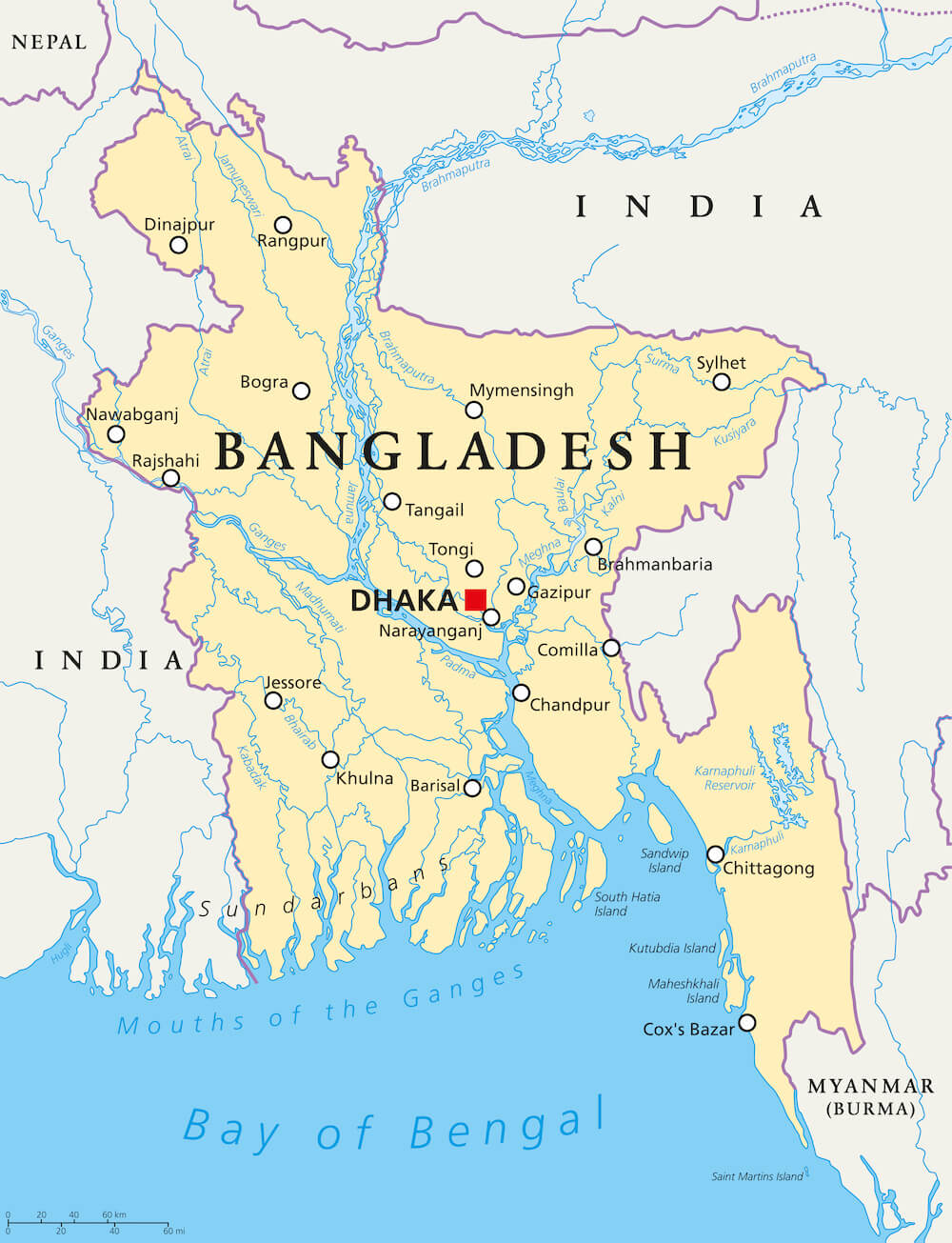
Is Bangladesh part of India? No, Bangladesh is an independent, sovereign nation sharing land borders with India to the west, north, and east, alongside a small border with Myanmar, and a coastline along the Bay of Bengal. Despite their distinct sovereign status, the question often arises due to deep historical, cultural, and geographical ties. Both countries share a Bengali cultural heritage in the Bengal region, and Bangladesh gained independence from Pakistan in 1971 with critical military and diplomatic support from India.
Understanding why this confusion persists requires looking past modern maps into the complex partition of British India, the bloody war of 1971, and decades of border adjustments. This shared history created a unique geopolitical relationship that sets South Asia apart from other post-colonial regions.
The Colonial Roots: Partition and the Bengal Divide
To understand how Bangladesh and India became separate countries, we have to look back to 1947. The end of British colonial rule in India resulted in the hurried partition of the subcontinent along religious lines. British jurist Cyril Radcliffe drew the Radcliffe Line in mere weeks, splitting British India into two independent dominions: India, with a Hindu majority, and Pakistan, with a Muslim majority.
This partition created a bizarre geographical anomaly. Pakistan was divided into two distinct territories separated by over 1,000 miles of Indian territory: West Pakistan (modern-day Pakistan) and East Pakistan (modern-day Bangladesh). Although they shared a religion, East and West Pakistan were culturally, linguistically, and geographically worlds apart. West Pakistan dominated the central government, economy, and military, treating East Pakistan like a colony rather than an equal partner.
Bengalis in the East spoke Bengali, while West Pakistanis predominantly spoke Urdu and Punjabi. This linguistic and cultural suppression sparked decades of resistance, setting the stage for a violent political showdown.
The 1971 War of Independence and Indian Intervention
Tensions boiled over in 1970 when the Awami League, a Bengali nationalist party led by Sheikh Mujibur Rahman, won a landslide victory in Pakistan's national elections. The West Pakistani military junta refused to hand over power. Instead, on March 25, 1971, the Pakistani military launched Operation Searchlight, a brutal crackdown involving mass killings, systematic sexual violence, and the destruction of infrastructure in East Pakistan.
Millions of Bengali refugees fled across the border into India, straining Indian resources and destabilizing the region. Prime Minister Indira Gandhi's government provided humanitarian aid, covert training, and logistical support to the Mukti Bahini, the guerrilla resistance movement of Bengali fighters.
By December 1971, direct military conflict erupted between India and Pakistan. The Indian Armed Forces decisively intervened, leading to the surrender of the Pakistani military in Dhaka on December 16, 1971. This military victory secured the birth of the People's Republic of Bangladesh. Because of this intervention, modern Bangladeshis remember India's critical support, though bilateral relations have experienced complex diplomatic friction in the decades since.
Resolving the Enclave Crisis: The 2015 Land Boundary Agreement
For decades after independence, the border between India and Bangladesh remained one of the most complicated in the world due to a legacy of bizarre feudal land swaps from the eighteenth century. Pockets of Indian territory sat entirely inside Bangladesh, and vice versa—known as enclaves. Within some of these enclaves were counter-enclaves: an enclave inside an enclave inside another country.
Citizens living in these patches of land lacked basic government services, schools, hospitals, and legal identity because neither government could easily police or administer the territories. People were effectively stateless, unable to cross international borders without risking arrest.
After decades of stalled negotiations, India and Bangladesh finally ratified the historic Land Boundary Agreement in 2015. The two nations exchanged enclaves and simplified their international border. Residents were given the unprecedented right to choose their nationality, with thousands opting to move or stay and take up citizenship in either India or Bangladesh. This monumental treaty resolved one of the most stubborn territorial headaches of the post-colonial era.
Contemporary Relations: Trade, Water, and Border Security
Today, relations between India and Bangladesh are multifaceted, driven by economic partnership, security cooperation, and occasional friction over resource sharing. Bangladesh remains one of India's largest trading partners in South Asia, exporting textiles, garments, and agricultural products while importing raw materials and manufactured goods.
Several key issues continue to define daily interactions between the two neighbors:
- Border Security: The Indo-Bangladesh border spans over 4,000 kilometers, making it one of the longest land boundaries in the world. India has constructed extensive fencing and deployed border security forces to curb illegal migration and cross-border smuggling of cattle and goods.
- Water Sharing: Fifty-four transboundary rivers flow from India into Bangladesh, culminating in the Ganges-Brahmaputra delta. Agreements on sharing water during the dry season—particularly the Teesta River treaty—remain a frequent point of diplomatic debate.
- Geopolitical Balancing: Both nations navigate complex diplomatic relationships with regional heavyweights like China, which heavily invests in infrastructure projects across South Asia.
Frequently Asked Questions
Are people from Bangladesh considered Indian?
No. People from Bangladesh are Bangladeshi citizens. While they share historical roots and linguistic ties with people from the Indian state of West Bengal, they belong to an entirely separate sovereign nation.
Why do Bangladesh and West Bengal share a language?
Both regions make up the historical and geographical region of Bengal. When British India was partitioned in 1947, the western Hindu-majority part joined India (becoming West Bengal), while the eastern Muslim-majority part became East Pakistan (later becoming Bangladesh). Both areas speak Bengali, but they belong to different countries.
Did Bangladesh used to be part of India?
Technically, no. Bangladesh was never part of independent India. Before 1947, both regions were colonies under British rule as part of undivided India. When the British left, the territory that is now Bangladesh became East Pakistan, remaining separate from the modern Republic of India until gaining independence in 1971.
How do travel requirements work between India and Bangladesh?
Citizens of both countries require valid passports and visas to cross the international border, except for specific bilateral travel allowances for medical care, business, or tourism under regulated border checkpoints.



