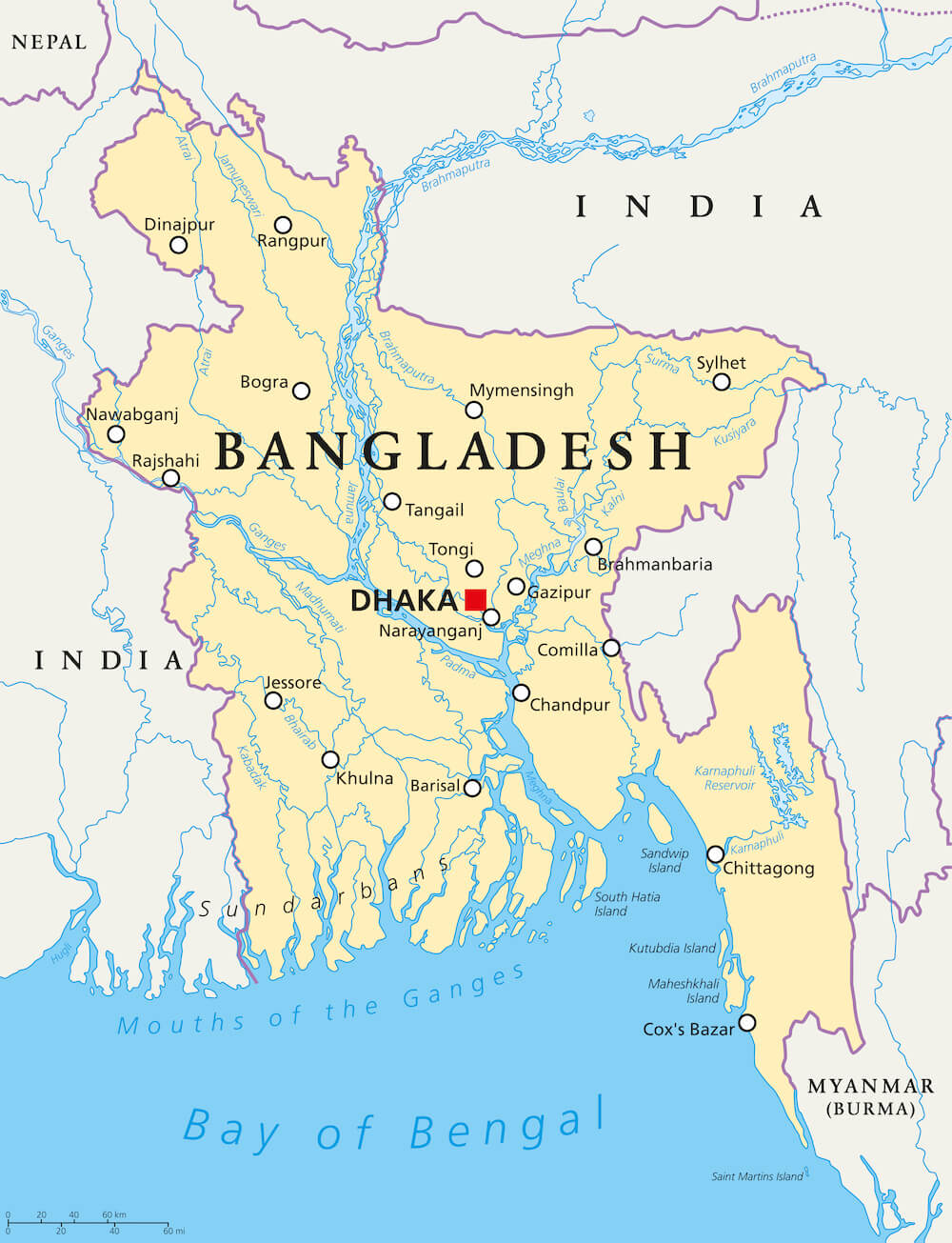
No, Bangladesh is not part of India. It is a sovereign, independent republic sharing land boundaries primarily with India and a small southeastern border with Myanmar. Though it's nearly surrounded by Indian territory and shares deep cultural and linguistic ties with the neighboring Indian state of West Bengal, Bangladesh functions as an entirely separate nation with its own government, constitution, economy, and seat at the United Nations.
Confusion about whether Bangladesh is part of India usually stems from geography and history. The country sits right in the Bengal delta region of South Asia, and looking at a map can make its borders look like an enclave inside India. To understand why it's a distinct country today, we have to look back at the dramatic partitions and conflicts that reshaped the Indian subcontinent across the twentieth century.
The Shared Roots of British India
Before 1947, the entire region—including modern-day India, Pakistan, and Bangladesh—was governed as a single colony under the British Empire. This era is commonly referred to as British India. Society across the subcontinent was diverse, comprising a Hindu majority alongside a massive Muslim minority, anchored by regional identities like the Bengalis.
As the British prepared to withdraw after two centuries of colonial rule, political leaders couldn't agree on how a unified, independent state would protect minority rights. The result was the brutal and hurried Partition of 1947. British India was divided along religious lines into two separate dominions: a Hindu-majority India and a Muslim-majority Pakistan. More reporting by Bloomberg explores similar perspectives on the subject.
From East Pakistan to Independence
Pakistan was born with a bizarre geographical layout. It was split into two distinct regions separated by over a thousand miles of Indian territory:
- West Pakistan: Located in the Indus River basin (modern-day Pakistan).
- East Pakistan: Comprising the eastern wing of historical Bengal, which is modern-day Bangladesh.
Despite being geographically separated and culturally distinct—West Pakistanis mostly spoke Urdu and Punjabi, while East Pakistanis spoke Bengali—they were governed as a single nation. Tensions flared almost immediately. The political and military elite in West Pakistan dominated the central government, marginalizing the Bengali population despite East Pakistan holding a larger share of the overall population.
Decades of economic exploitation, cultural suppression of the Bengali language, and political disenfranchisement boiled over in 1970. When the ruling establishment refused to honor election results that favored the Bengali Awami League, protests erupted.
The Pakistan Army responded with a brutal military crackdown in March 1971. This sparked the Bangladesh Liberation War. Millions of refugees fled across the border into India to escape the violence. Facing humanitarian disaster and strategic instability on its eastern flank, India intervened militarily in December 1971. Combined forces defeated the Pakistan Army in just thirteen days, paving the way for the emergence of the independent People's Republic of Bangladesh on December 16, 1971.
Modern Geopolitics and Relations
Today, the relationship between India and Bangladesh is complex, defined by heavy economic interdependence, border management challenges, and shifting political dynamics.
Because India surrounds Bangladesh on three sides—sharing borders with Indian states like West Bengal, Assam, Meghalaya, Tripura, and Mizoram—cross-border security is a constant priority. Smuggling, illegal migration, and water-sharing treaties regarding major rivers like the Teesta remain frequent diplomatic flashpoints.
At the same time, cooperation runs deep. Both nations are key partners in trade, transit, and regional security frameworks through organizations like SAARC. You can read more about bilateral diplomatic frameworks via the Ministry of External Affairs India and global developmental metrics on the World Bank Bangladesh Overview.
Frequently Asked Questions
Do people in Bangladesh speak the same language as people in India?
Yes and no. The official language of Bangladesh is Bengali (Bangla). This is the exact same language spoken by over 100 million people in the neighboring Indian state of West Bengal. However, the dialects, scripts, and cultural nuances differ, and the rest of India speaks hundreds of entirely unrelated languages like Hindi, Tamil, and Telugu.
Why didn't Bangladesh join India in 1947?
Religion and political identity dictated the 1947 partition. The eastern Bengal region had a Muslim majority, which chose to join Pakistan based on the two-nation theory of the time. By 1971, Bengalis realized that swapping British colonial rule for West Pakistani domination was a mistake, driving them to fight for sovereign independence rather than annexation by India.
Are there travel restrictions between India and Bangladesh?
Yes. Because they are two distinct sovereign nations, travelers moving between India and Bangladesh must pass through international customs, hold valid passports, and secure visas in advance.
How does Bangladesh's economy compare to India's?
India possesses one of the largest nominal economies in the world, while Bangladesh has a smaller, rapidly developing market fueled heavily by its massive ready-made garment manufacturing sector, pharmaceuticals, and remittances.



