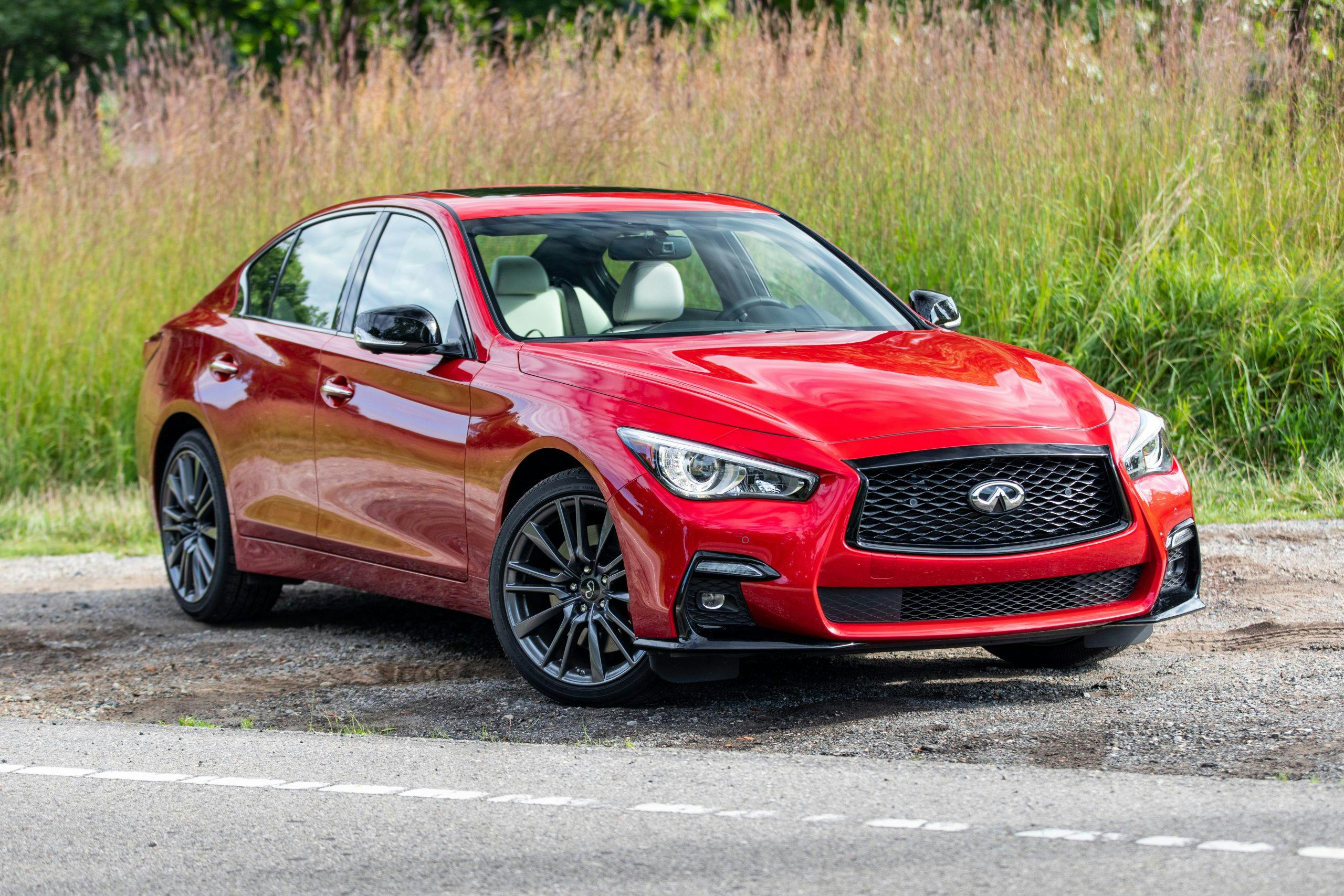
Deciding between the standard Q50 Sport (or lower trims equipped with the 300-horsepower engine) and the peak-tier Q50 Red Sport 400 comes down to a simple question: do you want a composed luxury commuter, or an aggressive twin-turbo charger with track-ready hardware? The standard Q50 delivers 300 horsepower and 295 lb-ft of torque, offering plenty of passing power for daily driving without a heavy penalty at the pump. Conversely, the Red Sport 400 unlocks a massive 400 horsepower and 350 lb-ft of torque from the exact same displacement 3.0-liter V6 block, paired with distinct mechanical upgrades that change how the chassis handles corners and heavy braking.
If your daily routine involves heavy stop-and-go traffic and highway cruising, the standard setup provides all the thrust you'll realistically use. But if you crave a sharper throttle response, an upgraded braking package, and a stiffer suspension, the price gap to the Red Sport 400 starts to make sense. Let's break down the mechanical, structural, and real-world differences so you can choose the right Infiniti Q50 performance sedan for your garage.
Engine Architecture and Power Output
At the heart of both models sits Nissan's VR30DDTT 3.0-liter twin-turbocharged V6 engine. Despite sharing a block, Infiniti configures them differently right out of the factory.
- Standard Q50 Power: Produces 300 horsepower at 6,400 rpm and 295 lb-ft of torque starting at a low 1,600 rpm. It pulls cleanly and moves the sedan with authority, hitting highway speeds effortlessly.
- Red Sport 400 Power: Pumps out 400 horsepower and 350 lb-ft of torque. It adds a secondary turbo speed sensor and a dedicated water-cooled intercooler system to keep intake temperatures stable under sustained high-load driving.
That extra 100 horsepower isn't just a simple software flash. The Red Sport 400 uses unique turbo architecture designed to handle higher boost pressures safely over the long term. When you plant your foot, the Red Sport pulls harder through the mid-range and keeps climbing with real urgency up to its redline. Similar insight on the subject has been provided by BBC.
Handling, Suspension, and Braking Hardware
Power is only half the battle for a performance sedan. The chassis setup creates a distinct divide between these trims.
- Braking Systems: Standard Q50 models feature capable factory brakes, but the Red Sport 400 upgrades straight to the Akebono performance braking system with four-piston front and two-piston rear calipers gripping larger cross-drilled rotors. If you drive aggressively or hit winding backroads, the Red Sport resists fade far better.
- Suspension Tuning: The Red Sport 400 comes standard with Dynamic Digital Suspension (DDS). This adaptive electronic damper system monitors vehicle body motion, steering angle, and speed to adjust ride stiffness dynamically. Lower trims make do with a fixed-rate sport suspension that is tuned firmly but lacks adjustability.
- Final Drive and Wheels: The Red Sport sits on staggered 19-inch aluminum-alloy wheels wrapped in wider performance rubber, backed by a unique rear differential ratio that optimizes initial launch acceleration.
Interior Appointments and Cabin Feel
Stepping inside reveals a more subtle gap between the two trims. Infiniti focused most of its budget on the mechanical updates for the Red Sport rather than reinventing the cabin.
The Red Sport 400 distinguishes itself with quilted semi-aniline leather seating, red contrast stitching throughout the cabin, dark chrome interior accents, and genuine paddle shifters mounted directly to the steering column. Lower sport trims feature comfortable leatherette or standard leather surfaces with silver or aluminum trim accents.
Infiniti's dual-touchscreen infotainment layout remains consistent across both models. While functional, it feels dated compared to the digital cockpits found in rivals like the Audi S4 or BMW M340i. Smartphone integration via Apple CarPlay and Android Auto is present, but don't expect a cutting-edge digital instrument cluster.
Ownership Costs and Fuel Economy
Fuel economy is surprisingly close given the power disparity. Both models hover around an EPA-estimated 20 mpg in the city and 26 to 27 mpg on the highway for rear-wheel-drive configurations. In real-world driving, however, your right foot dictates the fuel bill. The Red Sport 400 invites aggressive driving, which will drop your average fuel efficiency quickly if you exploit the turbos often.
Maintenance costs skew slightly higher for the Red Sport due to its complex cooling architecture and expensive replacement consumable items like the Akebono brake pads and rotors. Insurance premiums also lean higher for the 400-horsepower variant because insurers classify it as a high-performance vehicle.
Common Mistakes When Choosing
Buyers often make a few critical errors when shopping for a used or new Q50 performance sedan:
- Assuming you can easily mod a standard Q50 to Red Sport spec: While aftermarket tuners can push a standard 300hp Q50 past 400 horsepower with a simple ECU tune, you still miss out on the Red Sport's upgraded cooling system, auxiliary water pumps, bigger brakes, and digital suspension. Upgrading those components afterward costs far more than buying a Red Sport from the start.
- Ignoring all-wheel-drive weight penalties: Both trims offer intelligent all-wheel drive, which helps with winter traction. However, adding AWD adds roughly 150 pounds to the vehicle, blunting initial launch agility slightly compared to the rear-wheel-drive variants.
- Overlooking ride comfort: If you live in an area with badly broken pavement, the firmer damping of the Red Sport's suspension even in standard mode can feel busy compared to a plush Infiniti Luxe trim.
Frequently Asked Questions
Can a standard Q50 match a Red Sport 400 with a tune?
Yes, engine tuning can easily equalize or exceed the horsepower output of the Red Sport, because the base 3.0t engine shares the same displacement block. However, a tuned base car still lacks the factory oil coolers, upgraded turbos, larger brakes, and adaptive suspension hardware of the Red Sport.
Do both trims require premium fuel?
Yes, both the 300hp engine and the Red Sport 400 require high-octane premium unleaded gasoline to achieve their advertised power figures safely and prevent engine knock under boost.
Is the Red Sport 400 reliable as a daily driver?
The VR30DDTT engine is generally robust when maintained properly, but aggressive factory tuning means routine oil changes every 5,000 miles are non-negotiable. Turbocharger longevity depends heavily on proper cool-down periods after hard driving.
Which model holds its resale value better?
The Red Sport 400 typically commands stronger interest on the secondary market among enthusiasts, though luxury sedans as a category depreciate rapidly during their initial ownership years.



