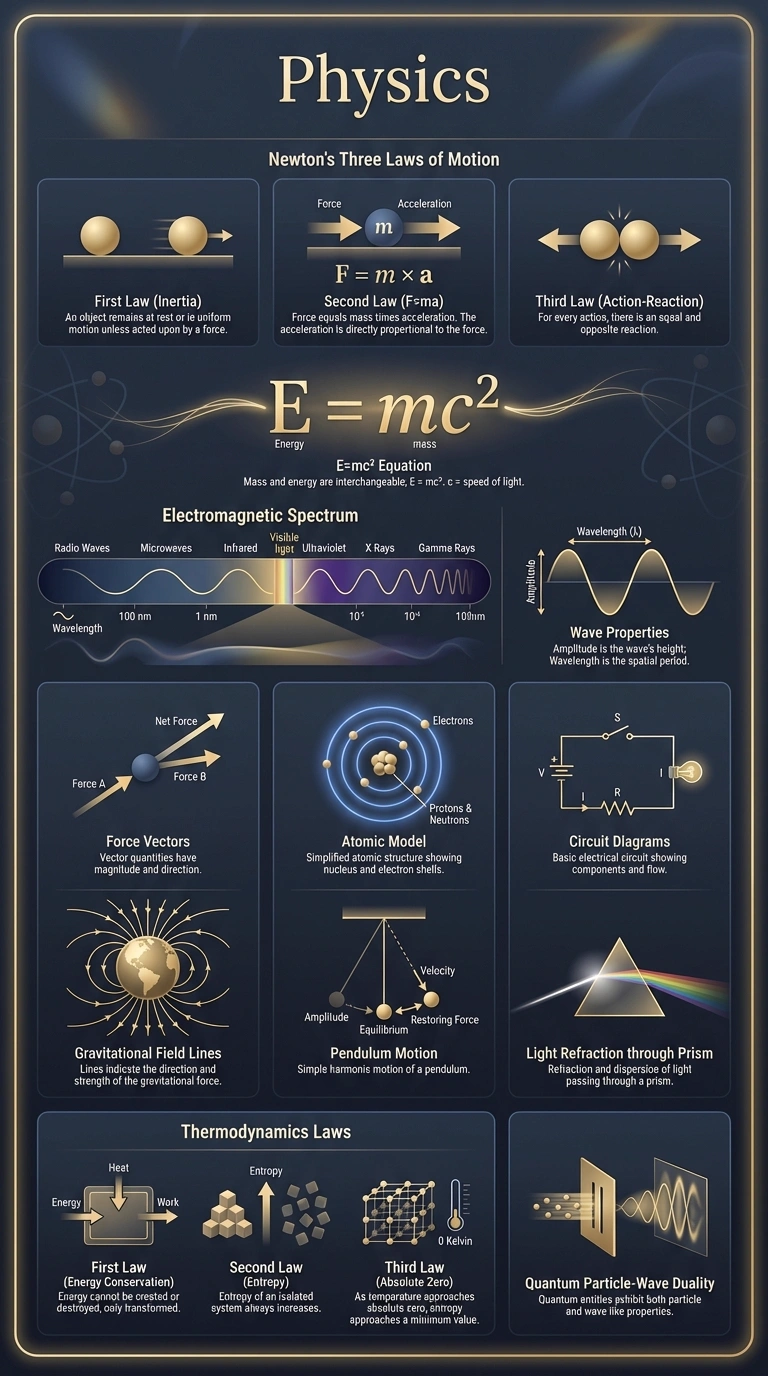
Inertia describes an object's natural resistance to any change in its state of motion. Whether an object sits completely still or moves at a constant velocity along a straight line, it requires an external force to alter that state. Understanding inertia units means looking at how classical mechanics quantifies this resistance for both linear and rotational systems.
Linear inertia relies entirely on mass, measured in kilograms ($\text{kg}$). Rotational inertia, known as the moment of inertia, incorporates both mass and the distribution of that mass relative to an axis of rotation, measured in kilogram meter squared ($\text{kg}\cdot\text{m}^2$). Mastering these units allows engineers and physicists to calculate torque, predict acceleration, and design stable mechanical systems.
Defining Inertia and Resistant Motion
The concept traces back to Galileo's inclined plane experiments and was later formalized in Newton's First Law of Motion. Every physical object possesses inertia. It isn't a separate force acting on an object; it's an intrinsic property of matter.
When you push a heavy crate across a floor, the resistance you feel comes directly from its inertia. If you slide a small box versus a heavy steel safe, the safe requires significantly more force because its mass is much greater. This resistance manifests in three distinct ways:
- Inertia of rest: The tendency of a stationary object to stay at rest until a force pushes or pulls it.
- Inertia of motion: The tendency of a moving object to continue traveling at a constant speed and direction unless friction or another force stops it.
- Inertia of direction: The resistance an object has to changing its path, forcing it to move in a straight line unless a sideways force acts upon it.
Linear Inertia and Mass Units
For straight-line motion, calculating or expressing inertia is straightforward because linear inertia is identical to mass.
$$\text{Inertia}_{\text{linear}} = m$$
In this equation, $m$ represents the mass of the object.
The Metric and Imperial Breakdown
- SI / MKS System: Mass is measured in kilograms ($\text{kg}$). An object with a mass of $15\text{ kg}$ has a linear inertia value of $15\text{ kg}$, meaning it resists velocity changes with a specific quantitative magnitude.
- CGS System: Mass is measured in grams ($\text{g}$).
- Imperial System: Mass is measured in slugs or pounds-mass ($\text{lbm}$).
You don't need a complex conversion factor to find linear inertia units. If a cart has a mass of $20\text{ kg}$, its linear inertia is simply $20\text{ kg}$.
Rotational Inertia and Its Units
When objects spin around a fixed axis, linear mass no longer tells the whole story. Consider a figure skater pulling their arms inward to spin faster, or extending them to slow down. Their total mass hasn't changed, but their rotational resistance has.
This rotational counterpart is the moment of inertia ($I$). According to Khan Academy's rotational mechanics overview, moment of inertia depends on both the mass of the object's components and the square of the distance from the axis of rotation:
$$I = \sum m_i r_i^2$$
For continuous bodies, this translates into an integral:
$$I = \int r^2 , dm$$
Dimensional Analysis of Rotational Units
Looking at the formula $I = m r^2$, we can derive the standard SI units:
- Mass ($m$) is measured in kilograms ($\text{kg}$).
- Distance squared ($r^2$) is measured in meters squared ($\text{m}^2$).
Therefore, the SI unit for rotational inertia is $\text{kg}\cdot\text{m}^2$. In the CGS system, this converts to $\text{g}\cdot\text{cm}^2$. In Imperial units, it is expressed as $\text{slug}\cdot\text{ft}^2$ or $\text{lb}\cdot\text{ft}\cdot\text{s}^2$.
Calculating Moment of Inertia for Common Shapes
Different geometries distribute mass differently relative to their center, altering their resistance to angular acceleration. Here are standard formulas used in physics and mechanical design:
- Thin Hoop or Cylindrical Shell (about central axis): $I = m r^2$
- Solid Cylinder or Disc (about central axis): $I = \frac{1}{2} m r^2$
- Solid Sphere (about diameter): $I = \frac{2}{5} m r^2$
- Long Uniform Rod (about center perpendicular to length): $I = \frac{1}{12} m L^2$ (where $L$ is length)
Practical Calculation Example
Imagine a solid mechanical disc used in an industrial flywheel. The disc has a mass of $4\text{ kg}$ and a radius of $0.5\text{ meters}$, rotating around its central axis.
Using the solid disc formula:
$$I = \frac{1}{2} m r^2$$
Substitute the known values:
$$I = \frac{1}{2} (4\text{ kg})(0.5\text{ m})^2$$
$$I = 2 \times 0.25 = 0.5\text{ kg}\cdot\text{m}^2$$
The rotational inertia of this disc is $0.5\text{ kg}\cdot\text{m}^2$. If you double the radius to $1.0\text{ meter}$, the inertia quadruples because the distance term is squared.
How Inertia Connects to Torque and Force
Inertia units are not just abstract labels; they dictate how systems react to physical inputs.
In linear motion, Newton's Second Law links force, mass, and acceleration:
$$F = m a$$
Here, mass ($m$) acts as the resistance measure.
In rotational dynamics, torque ($\tau$) replaces force, rotational inertia ($I$) replaces mass, and angular acceleration ($\alpha$) replaces linear acceleration:
$$\tau = I \alpha$$
If you apply a constant torque of $10\text{ N}\cdot\text{m}$ to a flywheel with a rotational inertia of $2\text{ kg}\cdot\text{m}^2$, you can determine its angular acceleration by rearranging the formula:
$$\alpha = \frac{\tau}{I} = \frac{10\text{ N}\cdot\text{m}}{2\text{ kg}\cdot\text{m}^2} = 5\text{ rad/s}^2$$
Common Mistakes to Avoid
- Confusing mass with weight: Mass is an intrinsic measure of matter and inertia, constant regardless of gravity. Weight is a force measured in Newtons ($\text{N}$) resulting from gravity acting on that mass ($\text{W} = mg$). Don't treat weight values as direct inertia units without dividing by local gravitational acceleration ($g$).
- Dropping the square in rotational units: Beginners often write rotational inertia units as $\text{kg}\cdot\text{m}$ instead of $\text{kg}\cdot\text{m}^2$. Because distance is squared in the formula, the unit must always reflect that geometric scaling.
- Ignoring axis placement: An object does not have a single fixed moment of inertia. The same rod or disc has completely different rotational inertia depending on whether it spins around its center or its edge. Always specify the rotation axis.
Frequently Asked Questions
Can inertia be negative?
No. Mass is always a positive scalar quantity, and in rotational inertia, distance is squared ($r^2$), which always yields a positive value. Inertia represents an absolute resistance magnitude.
Why does mass affect linear inertia but distance affects rotational inertia?
Linear motion treats all parts of an object moving together equally, so total mass is enough. Rotational motion involves different parts of an object traveling at different speeds depending on how far they sit from the pivot point. Parts further out move faster and resist rotation more heavily, which is why distance gets squared.
What is the parallel axis theorem used for?
The parallel axis theorem allows you to calculate the moment of inertia of a rigid body about any arbitrary axis, provided you know its moment of inertia about a parallel axis passing through its center of mass and the total mass. The formula is $I_o = I_c + m d^2$.
How do engineers use inertia units in real life?
Automotive engineers calculate rotational inertia for flywheels, transmission gears, and wheels. Lowering rotational inertia in drivetrain components allows a vehicle to accelerate faster because the engine wastes less energy spinning up heavy parts.



