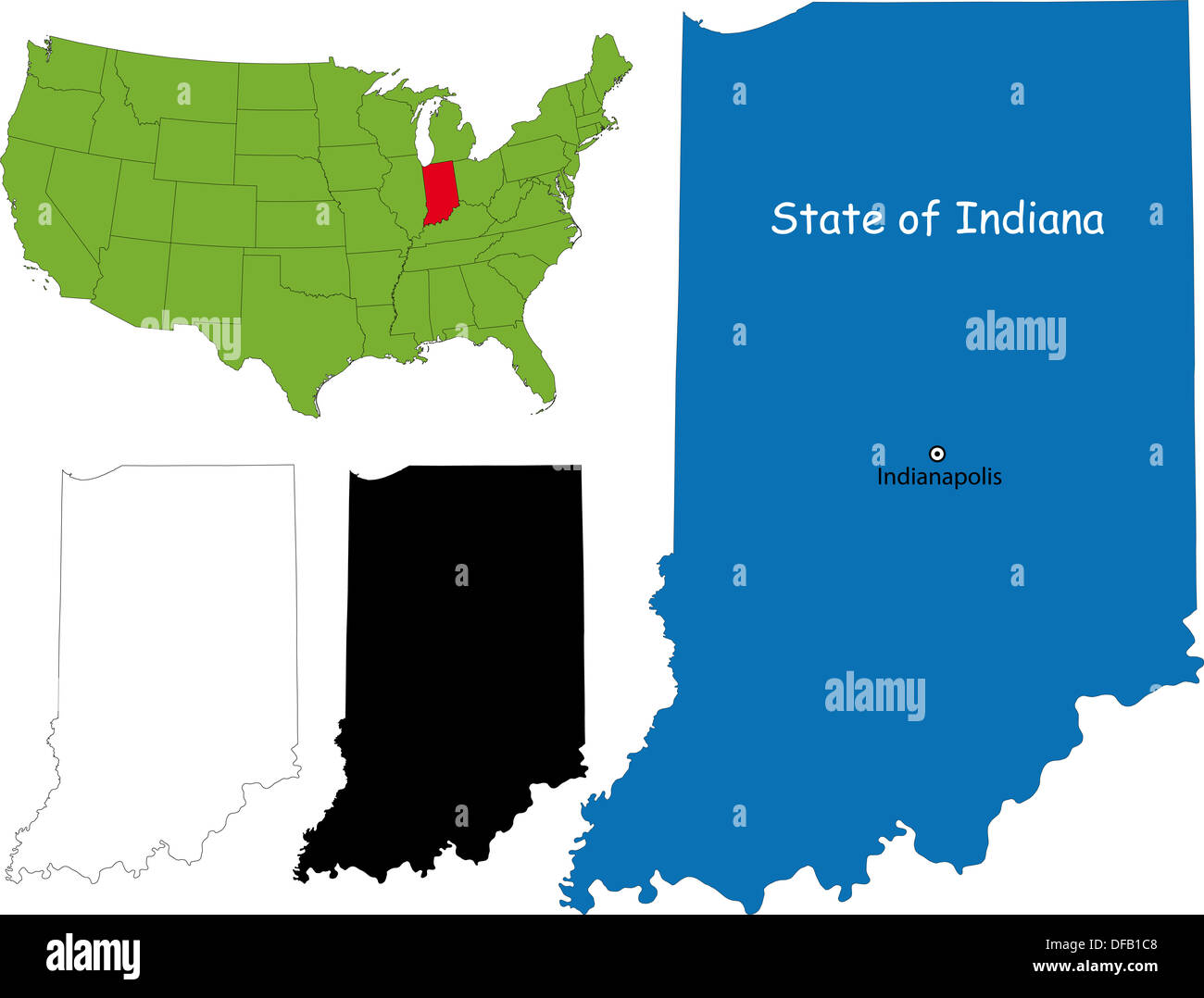
Navigating time in Indiana used to require a regional decoder ring and a firm grasp of local politics. Today, the situation is much simpler, though the state still splits its allegiance between two zones. Eighty of Indiana's ninety-two counties operate on Eastern Time, while twelve counties in the northwest and southwest corners follow Central Time. Every part of the state now observes Daylight Saving Time, but getting to this uniform setup took nearly a century of fierce public arguments, legislative showdowns, and federal intervention.
If you're planning a trip across the Hoosier State or trying to schedule a call with a business in Indianapolis, South Bend, or Evansville, knowing where the boundaries lie prevents missed appointments. Understanding why the map looks this way reveals a fascinating slice of American logistical history.
The Modern Indiana Time Zone Layout
The state currently divides its counties into two distinct groups regulated by the U.S. Department of Transportation.
- The Eastern Time Zone: Eighty counties fall under Eastern Time, matching cities like New York, Detroit, and Cincinnati. This includes major population centers like Indianapolis, Fort Wayne, Bloomington, and South Bend.
- The Central Time Zone: Twelve counties use Central Time, matching Chicago and St. Louis. These are split into two clusters: six in the northwest corner near Chicago (Lake, Porter, LaPorte, Jasper, Newton, and Starke) and six in the southwest corner near Evansville (Posey, Vanderburgh, Warrick, Spencer, Gibson, and Pike).
During the spring and autumn transitions, the entire state shifts clocks together. There are no longer rogue counties refusing to spring forward or fall back, which eliminated decades of confusion for television broadcasts, commercial transit, and phone scheduling.
A Century of Clocks and Conflict
Indiana's relationship with time hasn't always been straightforward. When Congress passed the Standard Time Act of 1918, the federal government placed the entire state of Indiana in the Central Time Zone. However, cities in the eastern half of the state, such as Muncie and Fort Wayne, had close economic ties with Ohio. They wanted to match Ohio's Eastern Time, so they simply ignored the federal standard and changed their clocks anyway.
For decades, the state existed in a chaotic patchwork. The official federal map said one thing, while local chambers of commerce, factories, and schools picked whatever time suited their trade partners.
State lawmakers tried repeatedly to fix the mess through legislation:
- In 1949, the General Assembly passed a law putting the entire state on Central Time and banning Daylight Saving Time entirely. The law lacked enforcement power, and eastern cities kept running on Eastern Time.
- In 1957, lawmakers tried again, making Central Time official while allowing summer Daylight Saving Time for communities that wanted it. Again, local compliance was scattered.
- In 1961, the Interstate Commerce Commission formally split the state, moving Indianapolis and the eastern half to Eastern Time while the western half stayed Central.
- In 1967, the U.S. Department of Transportation took over time zone regulation under the Uniform Time Act, moving most of the state to Eastern Time and leaving just a handful of counties on Central.
The 2006 Daylight Saving Time Shift
The most profound change in modern memory happened in 2006. Before that year, most of Indiana's Eastern Time counties did not observe Daylight Saving Time. That meant during the summer months, Indianapolis shared the exact same time as New York, but during the winter months, it matched Chicago.
Businesses complained that this half-year shift wreaked havoc on accounting, shipping schedules, and software systems. After a narrow vote by the Indiana General Assembly in 2005, the state petitioned the federal government to adopt statewide Daylight Saving Time.
When the change took effect in April 2006, several counties unhappy with their designated zones petitioned to switch. For instance, Pulaski County and several southwestern counties quickly asked to move back to Eastern Time or shift to Central, resulting in the final 80-12 split we see today.
Common Mistakes to Avoid
Travelers and remote workers often trip up on a few specific details when dealing with Indiana schedules:
- Assuming uniform time across the Chicago suburbs: Northwest Indiana counties like Lake and Porter are right next to Chicago and share Central Time, but just a short drive east into LaPorte or St. Joseph counties brings you back to Eastern Time.
- Forgetting the Ohio River border crossings: Crossing the river from Kentucky into southern Indiana keeps you on Eastern Time in most spots, but crossing into southwestern counties like Vanderburgh puts you on Central Time.
- Looking for old rules: If you read travel guides printed before 2006, throw them away. They will falsely claim that Indianapolis stays on standard time all summer.
Frequently Asked Questions
Does all of Indiana change its clocks twice a year now?
Yes. Every county in the state observes Daylight Saving Time, springing forward in March and falling back in November.
Which major cities in Indiana are on Central Time?
Evansville in the southwest and cities like Hammond, Gary, and Merrillville in the northwest operate on Central Time. Indianapolis, Fort Wayne, South Bend, Evansville's eastern suburbs, and Bloomington are all on Eastern Time.
Why did Indiana resist Daylight Saving Time for so long?
Many Hoosiers, particularly in the agricultural sector, preferred keeping solar time steady during the hot summer months so farm chores and livestock routines weren't disrupted by artificial schedule shifts.
How many counties changed their time zones after 2006?
Several counties requested adjustments immediately after the statewide DST rollout. For example, Daviess, Dubois, Knox, Martin, and Pike counties switched from Central back to Eastern Time by late 2007.
Read more about state boundaries on the official State of Indiana FAQ, or review federal adjustments via the Federal Register archive. For broader geographic context, check resources provided by the National Conference of State Legislatures.



