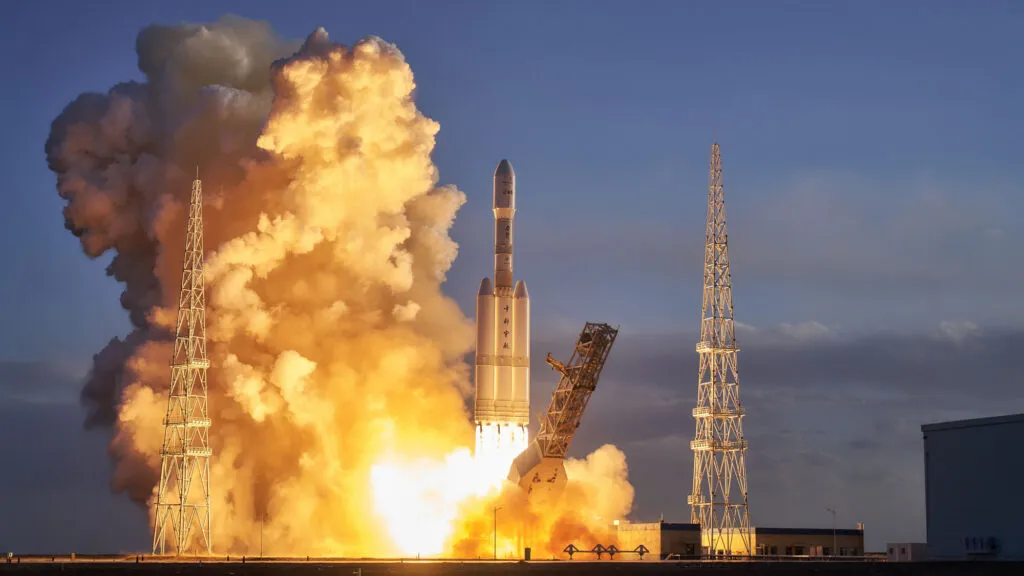
Human curiosity has always chased the horizons of the night sky, but leaving Earth changed how we view reality. For millennia, humanity relied on ground-based telescopes, squinting through a distorting atmosphere at distant points of light. When rockets finally broke free of gravity, they turned astronomy from a passive viewing exercise into an active, tactile science. We didn't just look at the universe anymore; we touched it, orbited it, and sent probes past the edges of our solar system.
The impact of space exploration on our understanding of the cosmos goes far beyond pretty pictures of distant nebulae. It shattered geocentric biases, revealed the hidden spectrum of invisible light, and proved that Earth is part of a dynamic, violent, and deeply interconnected system. By stepping off our home planet, we gained the vantage point needed to measure the true scale of time and space.
Shifting From Ground-Based Guesses to Direct Observation
Before space missions, astronomers operated with severe handicaps. Earth's atmosphere blocks massive portions of the electromagnetic spectrum, including ultraviolet rays, X-rays, and most infrared light. Ground-based telescopes only caught a narrow slice of what the universe was broadcasting.
Placing observatories above the atmosphere changed everything. The Hubble Space Telescope and later the James Webb Space Telescope stripped away the atmospheric haze. We started seeing the universe in high definition. Suddenly, star nurseries, galactic collisions, and the faint glow of the early universe came into sharp focus.
Space exploration also allowed us to visit planetary bodies directly. When Viking landers touched down on Mars, or when Voyager probes flew past Jupiter and Saturn, theoretical models met ground-truth reality. We stopped guessing what gas giants were made of and started measuring their atmospheric compositions directly.
- In-situ analysis: Probes can scoop soil, sample atmospheres, and measure magnetic fields directly on site.
- Extended baselines: Spacecraft like Voyager 1 have traveled past the heliosphere, measuring the interstellar medium outside our sun's immediate protective bubble.
- Unobstructed views: Orbiting telescopes eliminate atmospheric distortion completely, capturing light that has traveled uninterrupted for billions of years.
Rewriting the History of Our Solar System
Early models of the solar system assumed planets formed in neat, orderly orbits and remained static ever since. Space exploration proved this tidy picture wrong. Missions across the solar system revealed a chaotic history of planetary migration, violent impacts, and unexpected geological activity.
Consider our moon. Before Apollo astronauts brought back lunar rocks, scientists debated whether the moon was captured by Earth's gravity, spun off a rapidly rotating early Earth, or formed alongside it. Radiometric dating of moon rocks proved that the moon shares an isotopic signature with Earth's mantle, supporting the giant impact hypothesis. A Mars-sized body slammed into early Earth, and the debris coalesced into our lunar neighbor.
Outer solar system missions challenged assumptions about where water and organic molecules could exist. We used to think liquid water was strictly confined to the inner habitable zone near the sun. Then, spacecraft discovered subsurface oceans beneath the icy crusts of moons like Europa, Enceladus, and Ganymede. These discoveries expanded the cosmic habitable zone, proving that life-supporting conditions might lurk far from the sun's direct warmth.
Probing the Deep Cosmos and Cosmic Evolution
Space exploration didn't just clarify our solar neighborhood; it unlocked the history of the broader universe. Because light takes time to travel across vast distances, looking deep into space means looking back in time.
Space-based observatories can capture light emitted hundreds of millions of years after the Big Bang. This allowed astrophysicists to map the Cosmic Microwave Background—the leftover radiation from the universe's infancy. These measurements confirmed that the universe is not only expanding, but that its expansion is accelerating due to an enigmatic force we call dark energy.
Without space-based instruments, we wouldn't have empirical constraints on cosmological models. We learned that ordinary matter—stars, planets, and gas—makes up only a tiny fraction of the universe. The rest consists of dark matter and dark energy, invisible components that dictate the structure of the cosmos. Space missions provided the precise astrometry and gravitational lensing data needed to map where this invisible mass sits.
The Technological Leap That Made It Possible
You can't talk about cosmic discovery without looking at the tools that enabled it. Building instruments robust enough to survive launch vibrations, extreme thermal swings, and intense radiation belts forced engineering breakthroughs that transformed science back on Earth.
Miniaturized sensors, advanced digital imaging, and autonomous navigation systems were pioneered to keep deep space probes functioning millions of miles from human help. These technologies trickled down into terrestrial applications, improving everything from medical imaging to environmental monitoring satellites that track climate change on Earth.
Ground-based engineering also evolved. Adaptive optics, originally developed to help ground telescopes compensate for atmospheric distortion, now allow doctors to image the human retina with microscopic precision. The engineering rigor required to explore space forced a revolution in how we process data and build precision instruments.
Common Misconceptions About Space Discoveries
Many people misunderstand how space exploration shapes our cosmic perspective. Clearing up these errors helps highlight the real value of space missions.
Some assume that finding water on Mars or Europa means we have found alien life. In reality, missions have found chemical ingredients and liquid water environments, but definitive biosignatures remain elusive. Exploration gives us the map of where to look, but the search for life is an ongoing, methodical process.
Another common myth is that space probes are obsolete once they launch. In practice, teams continuously rewrite software on distant spacecraft, finding creative ways to extend missions far past their original lifespans. Voyager 1 and 2, launched in the late 1970s, continue to send back telemetry from interstellar space despite failing power sources.
Frequently Asked Questions
How does space exploration help us understand the origin of the universe?
By placing telescopes above the atmosphere and sending probes to study primordial bodies like comets and asteroids, scientists can analyze pristine materials left over from the formation of the solar system and capture ancient light from the early universe.
Why can't we rely solely on ground-based telescopes?
Earth's atmosphere absorbs large portions of the light spectrum, such as ultraviolet and X-rays, and creates optical distortion due to shifting air currents. Space-based telescopes bypass these limitations entirely.
What was the most significant impact of lunar exploration on cosmology?
The Apollo missions provided lunar samples that allowed scientists to date planetary surfaces accurately and formulate the giant impact hypothesis for the moon's origin, giving us a clearer model of early planetary formation.
Does space exploration affect our daily lives on Earth?
Yes. The engineering requirements of space missions drove advancements in satellite communications, weather forecasting, GPS navigation, material science, and medical imaging devices.
How do we measure distances to faraway galaxies?
Astronomers use a cosmic distance ladder, combining parallax measurements, standard candles like Type Ia supernovae, and redshift data gathered by space telescopes to map the expansion rate of the universe.