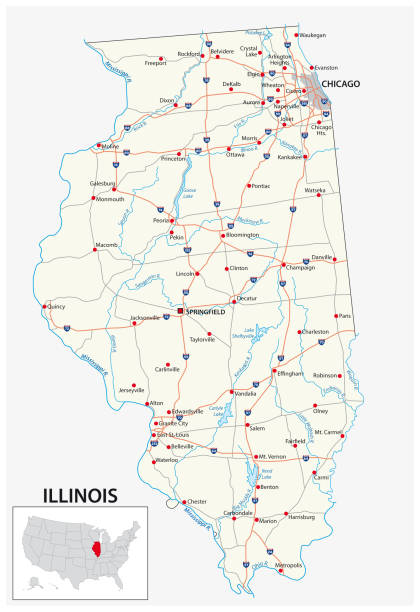
Illinois Time Zone Overview
Almost the entire state of Illinois operates within the Central Time Zone, meaning you're aligned with cities like Chicago, St. Louis, and Houston. Standard time sits at UTC-6, while daylight saving shifts the clock to UTC-5 during the warmer months. Unlike neighboring states like Indiana or Kentucky, which split across multiple zones, Illinois maintains a uniform time zone across all 102 counties. You don't have to worry about crossing a boundary line mid-commute or missing a meeting because a neighboring county runs on a different hour.
Chicago anchors this regional timekeeping, driving business hours, broadcasting schedules, and train departures across the Midwest. Whether you're visiting downtown or driving down to Cairo at the southern tip, your phone will update to the exact same local hour.
Standard Time Versus Daylight Saving Time
The state observes seasonal clock adjustments dictated by federal guidelines. Knowing when and how these shifts occur keeps your schedule intact.
- Central Standard Time (CST): Running from early November to mid-March, clocks sit at UTC-6.
- Central Daylight Time (CDT): Running from mid-March to early November, clocks push forward one hour to UTC-5.
The transition happens twice a year at 2:00 AM local time. In the spring, you lose an hour of sleep when clocks jump forward. In the fall, you gain an hour back when clocks fall backward. Federal oversight of these changes stems from standards managed by the U.S. Department of Transportation, which regulates official time zone boundaries nationwide.
Historical Shift to Standardized Time
Before railroads reshaped American commerce, time was entirely local. Every town in Illinois set its clocks based on the local position of the sun, creating dozens of distinct time variations across short distances. If you traveled from Peoria to Chicago in the 1870s, your pocket watch would be noticeably out of sync with the local station clock.
This fragmentation caused severe scheduling nightmares for railway operators, leading to missed connections and safety hazards. On November 18, 1883, American railroads unilaterally adopted standardized time zones. Chicago officially transitioned to Central Standard Time (then referred to as 90th Meridian Time) the following day. Congress later formalized these voluntary railroad zones through the Standard Time Act of 1918, anchoring Illinois permanently within the Central zone.
Common Clock Confusion and Travel Coordination
Even though Illinois is uniform internally, coordinating across its borders can cause slip-ups.
- Indiana Border: If you drive east out of Chicago into Northwest Indiana (such as Lake or Porter counties), you cross into the Eastern Time Zone. Your watch will jump forward by one hour immediately. However, other parts of Indiana—like counties near-by—also share Central time, making travel confusing if you don't check a Time and Date reference map beforehand.
- Wisconsin and Iowa: Driving north into Wisconsin or west across the Mississippi River into Iowa keeps you in the Central Time Zone, requiring zero adjustments to your schedule.
- Kentucky Border: Southern Illinois borders Kentucky, where the state splits down the middle. Western Kentucky runs on Central time, while eastern Kentucky (including Louisville and Lexington) runs on Eastern time.
Frequently Asked Questions
Does any part of Illinois observe Eastern Time?
No. Every single county in Illinois is officially in the Central Time Zone.
When do clocks change in Illinois?
Clocks move forward one hour on the second Sunday in March and fall back one hour on the first Sunday in November.
Why did time zones get created in the first place?
They were established by railroad companies in 1883 to prevent train collisions and streamline transcontinental scheduling amid hundreds of conflicting local sun times.
Is there any movement to abolish daylight saving time in Illinois?
State legislators occasionally introduce bills to exempt Illinois from seasonal changes or stay on daylight saving year-round, but federal law currently requires congressional approval for states to remain on daylight saving permanently.



