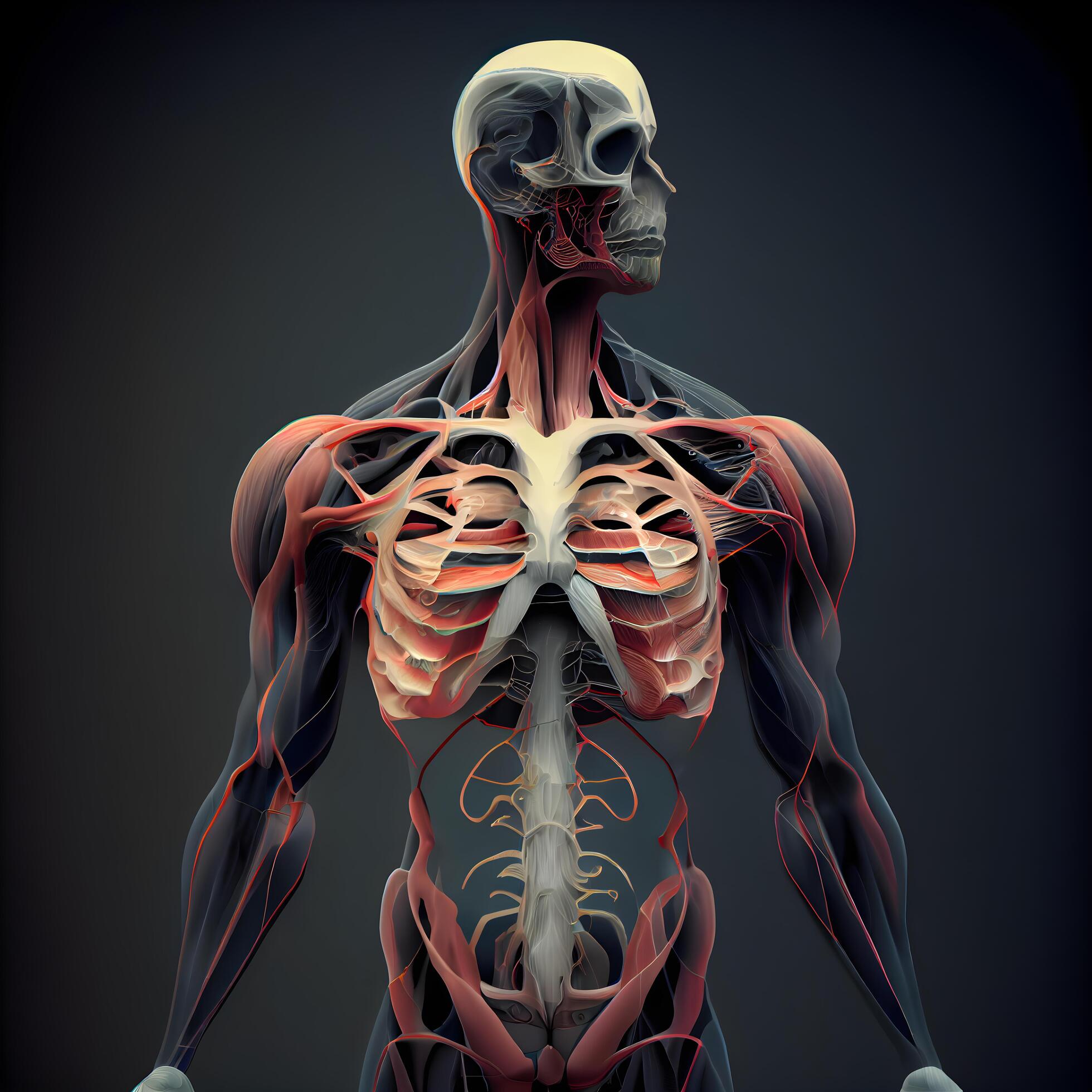
Mastering human anatomy for sculptors separates static, doll-like figures from breathing, dynamic works of art. When you understand the underlying skeletal mechanics and muscle insertions beneath the skin, you stop guessing proportions and start constructing believable weight, tension, and motion in clay, stone, or digital polygons.
Anatomical knowledge serves as your structural framework, not a restrictive set of rules. Without it, figures look bloated, stiff, or anatomically impossible under changing light. Let's break down the essential blueprint of the human body, turning complex medical terms into practical, tactile sculpting techniques.
The Skeletal Foundation
You can't build a durable house on a swamp, and you can't sculpt a convincing figure without a correct skeletal armature. Treat the skeleton as a system of rigid levers and movable fulcrums. The skull balances on the cervical spine, the ribcage acts as a flexible bellows, and the pelvis anchors the entire upper torso.
Bony Landmarks
Bony landmarks are your visual anchors. Because skin tightly coats these points, they never shift position relative to the bone beneath. Memorize these critical locations before touching your clay:
- Acromion process: The outer edge of the shoulder blade, dictating shoulder width.
- Iliac crests: The upper ridges of the pelvis that define the waistline and hip tilt.
- Greater trochanter: The upper bony protrusion of the femur on the outer thigh.
- Medial and lateral epicondyles: The bony bumps at the elbow and knee joints.
Structural Weight Distribution
Gravity dictates how a pose feels. In a standing figure, the pit of the neck should align vertically with the ankle of the supporting leg. If this plumb line falls outside the base of support, your sculpture will look like it's falling over. When shifting weight to one hip, drop that side of the pelvis and raise the corresponding shoulder to maintain natural balance.
Proportional Systems
Proportion gives your sculpture immediate legibility. Viewers spot incorrect proportions instantly, even if they can't name the anatomical error.
The standard classical canon measures the adult human body using the head length as a base unit. An average heroic figure stands roughly eight heads tall.
- Head height: From the crown to the chin equals one unit.
- Nipple line: Sits roughly two head-lengths down.
- Navel and elbow level: Falls at the three-head mark.
- Crotch: Marks the exact midpoint at four heads down in a standard adult.
- Knees: Sit at the six-head mark.
- Feet: The remaining two heads complete the height down to the soles.
Keep in mind that these proportions shift with age, gender, and individual body type. A heroic figure elongates the legs slightly, while a portrait bust requires intense focus on the facial thirds: hairline to brow, brow to nose base, and nose base to chin.
The Muscular System in Action
Muscles don't just add bulk; they tell a story of physical effort, fatigue, or relaxation. When a muscle contracts, it shortens and bulges in the middle, pulling on its tendon insertion.
Origin and Insertion
Every major muscle connects bone to bone. The origin stays relatively fixed during movement, while the insertion moves toward it. For example, the biceps brachii originates at the shoulder blade and inserts into the radius bone of the forearm. When you flex, the muscle belly gathers upward toward the shoulder, creating a sharp volumetric change.
Opposing Muscle Groups
Muscles work in pairs. When a prime mover contracts, the antagonist muscle on the opposite side must lengthen. If you sculpt a bicep in full contraction without stretching the triceps on the back of the arm, the limb will look locked and unnatural. Look for this push-and-pull dynamic across the back, thighs, and torso.
Surface Anatomy and Fat Deposition
Surface anatomy is what you actually see and touch: the soft transitions where muscle meets tendon and fat softens hard geometric forms.
Subcutaneous fat alters the silhouette differently depending on gender and genetics. Male fat accumulation tends to center around the abdomen and upper back, while female fat distribution favors the hips, thighs, and outer buttocks. Knowing these patterns prevents you from applying a uniform layer of muscle to every figure you sculpt.
Veins also play a crucial role in realism, particularly in the hands, feet, and forearms of active or aging subjects. Surface veins swell when body temperature rises or during intense physical exertion, tracing paths directly over major muscle intersections.
Step-by-Step Sculpting Workflow
Translating anatomical data into a physical or digital sculpture requires a methodical layering process. Work from the inside out to avoid proportions drifting out of alignment.
- Build the armature: Construct a wire or digital skeleton matching your pose's line of action and height proportions.
- Block in primary masses: Add rough clay or digital voxels for the massive forms: skull, ribcage, pelvis, and major thigh blocks. Do not carve details yet.
- Establish major muscle groups: Wedge in the primary movers like the deltoids, pectorals, latissimus dorsi, and quadriceps, checking origin and insertion points.
- Refine bony landmarks: Scrape away clay or smooth digital surfaces until bony landmarks poke through the muscular mass naturally.
- Add skin tension and texture: Introduce minor surface wrinkles, skin folds, and subtle asymmetry last. Perfect symmetry looks artificial.
Common Sculpting Mistakes
- Treating limbs like cylinders: Arms and legs taper, twist, and flatten. The cross-section of a forearm is an oval, not a round tube.
- Ignoring the spine's curve: The spine is never a straight vertical rod. It weaves in a gentle double-S curve from skull to tailbone, even in standing poses.
- Over-rendering details early: Spending hours on finger joints before the torso is proportioned ruins the structural integrity of the piece.
- Neglecting negative space: The gaps between arms and torso, or legs and ground, define the silhouette just as much as the solid masses.
Frequently Asked Questions
Do I need to memorize all 600 human muscles?
No. Focus on the twenty major superficial muscle groups that visibly alter the surface contour of the body, such as the pectoralis major, rectus abdominis, deltoids, and gastrocnemius.
How does digital sculpting change anatomical study?
Digital software like ZBrush lets you push and pull digital clay instantly, but the underlying anatomical rules remain identical to traditional media. Knowing anatomy prevents digital models from looking rubbery or weightless.
Why does my sculpted figure look stiff despite correct proportions?
Stiffness usually stems from a lack of contrapposto or dynamic weight shift. Ensure the spine curves, one hip drops, and the shoulders tilt in opposition to break up rigid symmetry.
How can I practice anatomy without a human model?
Combine anatomical flashcards with life drawing sessions and Écorché cast studies. Sculpting small, one-hour anatomical studies of just an arm or a foot accelerates your muscle memory faster than finishing full figures.


