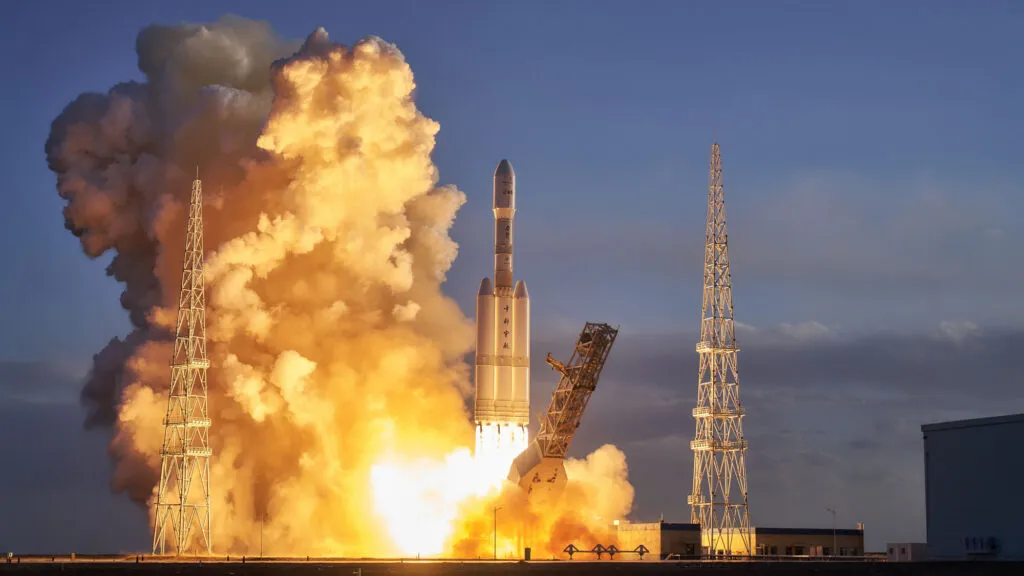
Reaching the Moon takes anywhere from roughly three days to several months, depending entirely on your trajectory, propulsion type, and mission objective. While popular culture often points to a flat three-day window, that figure only applies to direct, high-thrust chemical rocket transfers designed to enter lunar orbit. Modern and historical missions reveal a much wider spectrum of travel times, ranging from an 8.5-hour high-speed flyby to multi-month low-energy transfers that conserve fuel.
The 240,000-mile (384,400-kilometer) gap between Earth and its natural satellite isn't a fixed highway. Gravity wells, orbital insertion burns, and safety margins dictate how fast a craft can safely arrive. Understanding these timelines requires looking past simplified headlines and examining the actual physics of spaceflight.
The Core Timeline: Three Days to Lunar Orbit
For most crewed missions, the standard benchmark sits right around 75 to 80 hours. When Apollo 11 launched on July 16, 1969, its Saturn V rocket injected the spacecraft into a trans-lunar trajectory that reached lunar orbit insertion roughly 75 hours and 50 minutes later. Touchdown on the lunar surface occurred at 102 hours and 45 minutes into the mission.
This three-to-four-day window remains the baseline for direct human missions because it balances crew life-support constraints with the massive fuel expenditure required to accelerate out of Earth's gravity and decelerate upon arrival. If you don't slow down when you reach the Moon, you won't stay there. A spacecraft must execute a precise braking burn—known as Lunar Orbit Insertion (LOI)—to get captured by lunar gravity instead of whipping past into deep space.
Mission Objectives Shape the Clock
The duration of a lunar voyage shifts dramatically based on what the spacecraft intends to do once it reaches the destination.
- Flybys: If a spacecraft only needs to pass by the Moon without entering orbit or landing, travel times drop significantly. For instance, NASA's New Horizons probe hurtled past the Moon's orbit in just 8.5 hours on its way to Pluto, traveling at roughly 16.5 kilometers per second without performing any braking maneuvers.
- Orbits: Entering a stable orbit requires matching orbital speeds, which extends the timeline to roughly three to five days. Artemis missions, such as Artemis II, have utilized wider, safer trajectories like free-return paths that push the initial lunar encounter out to roughly five days.
- Landings: Descending to the surface adds extra days for orbital adjustments, site inspection, and the landing sequence itself, bringing total elapsed time to the surface to four or five days.
Alternative Paths: The Slow and Efficient Route
Not every mission prioritizes speed. Robotic explorers and commercial cargo vessels often utilize low-energy transfers (LETs) or ballistic lunar transfers (BLTs). These routes take advantage of the gravitational pull of the Sun and Earth to nudge a spacecraft toward the Moon over weeks or months.
European Space Agency's SMART-1 ion-drive probe, launched in 2003, took over 13 months to reach lunar orbit. By trading travel time for massive fuel savings, small probes can carry heavier payloads relative to their total launch mass. Similarly, some commercial lunar landers take anywhere from six days to over a month using indirect, fuel-efficient orbital mechanics.
Comparing Historical and Modern Missions
Space technology has advanced exponentially since the 1960s, yet modern missions don't always aim to break speed records. Safety, redundancy, and trajectory optimization take precedence over raw velocity.
- Apollo 11 (1969): Reached lunar orbit in roughly 3 days and 4 hours; touched down at 4 days and 7 hours.
- Artemis II (2026): Took approximately 5 days to reach its crewed lunar flyby while testing life-support systems on a wide free-return trajectory.
- Intuitive Machines IM-1 (2024): Reached lunar orbit in roughly 6 days using a commercial trajectory.
- SMART-1 (2003–2004): Took 13.5 months via continuous ion propulsion.
For official updates on ongoing crewed programs, you can follow NASA Artemis. Additional historical mission parameters are archived by the National Air and Space Museum.
Common Misconceptions About Lunar Travel
When evaluating how long space journeys take, casual observers often stumble over a few recurring points of confusion.
- Confusing flyby speed with orbital insertion: Seeing a probe cross the moon's distance in hours leads people to think humans can arrive that fast. In reality, stopping a crewed capsule requires massive fuel reserves and gradual deceleration.
- Ignoring the return trip: Reaching the Moon is only half the journey. A complete round trip typically spans eight to twelve days, factoring in surface operations or orbital loitering before the Trans-Earth Injection (TEI) burn sends the crew home.
- Assuming a straight line: Spacecraft do not travel in a straight line from Earth to the Moon. They travel along curved orbital arcs that account for Earth's rotation, orbital velocity, and the Moon's continuous motion around our planet.
Frequently Asked Questions
Can a spacecraft travel directly in a straight line to the Moon?
No. Because both Earth and the Moon are constantly moving through space at high speeds, aiming directly at where the Moon is right now means you will miss it entirely by the time you arrive. Spacecraft follow curved trajectories that intercept where the Moon will be.
Why do some modern missions take longer than Apollo?
Safety margins and fuel efficiency dictate modern flight profiles. For example, the Artemis program utilizes wide free-return trajectories and rigorous system checkouts in high Earth orbit before committing to the lunar transfer, prioritizing crew safety over raw speed.
How fast do lunar rockets actually travel?
During trans-lunar injection, rockets accelerate spacecraft to speeds exceeding 24,000 miles per hour (roughly 11 kilometers per second) to break free of Earth's primary gravitational grip before coasting uphill against Earth's remaining gravity well.
What is a free-return trajectory?
A free-return trajectory is a mission design where the spacecraft's path loops around the Moon and uses lunar gravity to swing back toward Earth automatically without requiring a major propulsion burn. This safety feature was vital during the Apollo era and remains a cornerstone of modern crewed testing.