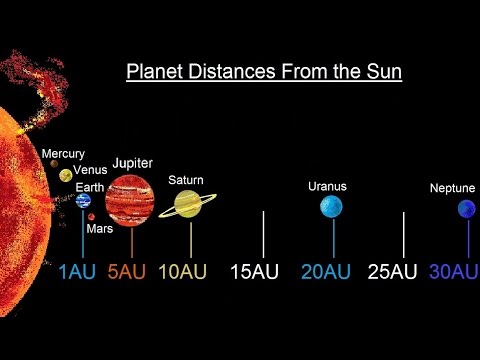
The Sun sits roughly 93 million miles, or 150 million kilometers, away from Earth. Astronomers call this average separation one astronomical unit. Knowing this exact figure helps us understand solar radiation, climate patterns, and spacecraft navigation across the solar system.
People often picture Earth sitting on a fixed circle around the Sun, but our planet follows an elliptical path. That means the distance changes every day, shifting from closest approach in January to farthest point in July. Let's look at how scientists calculated this cosmic gap and why measuring it required centuries of clever geometry and modern technology.
Historical Foundations of Solar Distance
Before modern telescopes, ancient astronomers tried to figure out how far away the Sun is using simple geometry. Greek astronomer Aristarchus noticed that when the Moon looks exactly half-lit, the Sun, Earth, and Moon form a right triangle. By measuring the angle between the Sun and Moon from Earth, he attempted to calculate their relative distances.
Aristarchus got the math right, but his tools weren't precise enough. He concluded the Sun was about 20 times farther away than the Moon, when it's actually about 400 times farther. Even though his final number was way off, his geometric approach set the stage for centuries of astronomical inquiry. As discussed in detailed reports by Reuters, the results are significant.
Centuries later, astronomers realized that timing the transit of Venus across the solar disk could unlock the true scale of the solar system. During a transit, observers stationed at different spots on Earth see Venus cross the Sun at slightly different tracks. By comparing those paths and applying triangulation, scientists could calculate the distance to Venus and scale up to the Sun. Expeditions in 1761 and 1769 risked lives crossing oceans to record these rare events, getting within two percent of today's accepted value.
Modern Measurement with Radar and Light
Today, astronomers don't rely on transit timings or simple angles. They use radar astronomy and the constant speed of light to pin down distances with incredible precision.
By bouncing powerful radio waves off inner planets like Venus and measuring how long the echo takes to return, scientists can calculate exact distances in the solar system. Because we know light travels at a constant speed of roughly 186,282 miles per second, timing the return trip of a radar pulse turns a time measurement into a precise physical distance.
This radar data confirmed the exact baseline for the astronomical unit. In 2012, the International Astronomical Union officially defined one astronomical unit as an exact metric value: exactly 149,597,870,700 meters. This update removed any ambiguity caused by changing gravitational constants and gave researchers a universal standard for interplanetary distances.
Earth's Elliptical Orbit and Seasonal Variations
Earth's orbit isn't a perfect circle. It's an ellipse with a slight eccentricity, meaning our distance from the Sun fluctuates throughout the year.
In early January, Earth reaches perihelion, our closest point to the Sun, at about 91.4 million miles. By early July, Earth hits aphelion, our farthest point, at roughly 94.5 million miles. That creates a swing of about 3 million miles over the course of a year.
Many people assume this distance shift drives our seasons, but it doesn't. Winter happens in the Northern Hemisphere when Earth is actually closest to the Sun. Seasons happen because Earth's axis tilts at an angle of 23.5 degrees, changing how directly sunlight strikes different parts of the globe.
Why Precise Distance Measurement Matters
Calculating the distance to our star isn't just an academic exercise. Space agencies like NASA and the European Space Agency rely on exact solar measurements to plan deep-space missions.
When engineers send probes toward Mars or outer planets, tiny errors in baseline distances compound over millions of miles, causing spacecraft to miss their targets. Furthermore, understanding the exact Sun-Earth separation helps climate scientists model solar irradiance—the total solar energy hitting Earth's atmosphere—which drives weather systems and long-term climate cycles.
Frequently Asked Questions
How long does sunlight take to reach Earth?
Sunlight travels at the speed of light, taking about 8 minutes and 20 seconds to cross the 93 million miles from the Sun's surface to your eyes. When you look at the Sun, you're seeing it as it looked eight minutes ago.
Does the Sun's distance change fast enough to affect human life?
No. The annual variation between perihelion and aphelion happens slowly over a full year and gets masked by weather patterns and atmospheric conditions. It has no noticeable effect on daily life or human biology.
How do we measure distances to other stars if we know the Sun's distance?
Astronomers use the Earth's orbit around the Sun as a baseline for stellar parallax. By observing how a nearby star shifts its position against background stars when viewed from opposite sides of Earth's orbit, scientists use trigonometry to calculate distances to nearby star systems.
Is the Sun slowly moving away from Earth?
Yes, very slowly. The Sun loses mass through nuclear fusion and its constant solar wind. As it loses mass, its gravitational pull weakens, causing Earth's orbit to expand by about 0.6 inches every year.



