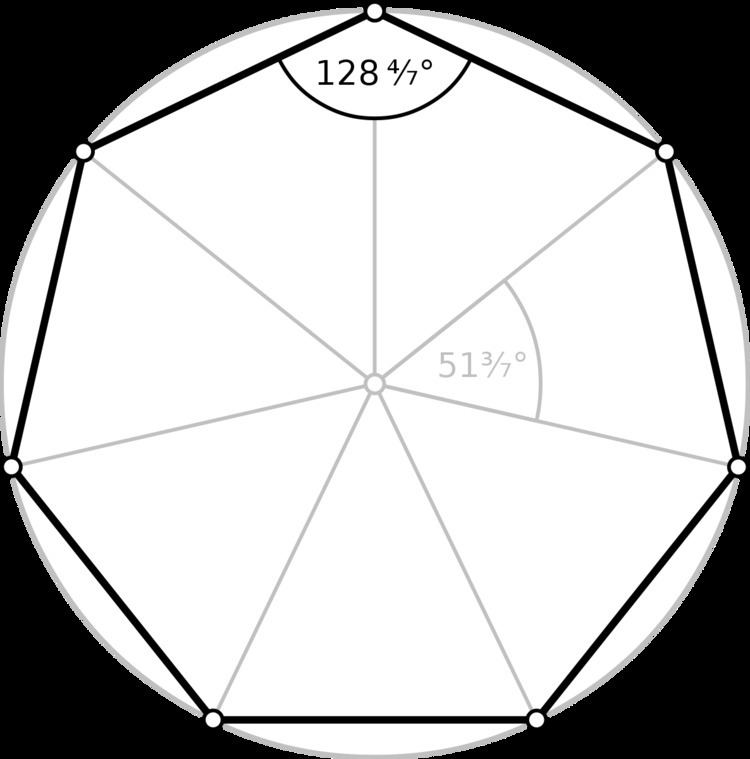
The heptagon is quietly moving from dusty math textbooks into contemporary architectural facades, acoustic panels, and digital network modeling. While squares and hexagons dominate our built environment because they tile neatly without gaps, this seven-sided polygon offers distinct mathematical and structural advantages that designers are only beginning to utilize.
If you're wondering why a shape with an odd number of sides matters, the answer lies in its irrational proportions and unique symmetry properties. Unlike a hexagon or an octagon, a regular heptagon cannot be constructed using a traditional compass and straightedge. This historic quirk kept it sidelined for centuries, but modern computational design tools make working with complex polygonal grids simple, allowing architects and engineers to harness the heptagon's unique acoustic dispersion and load-bearing dynamics.
The Mathematical Foundation of the Heptagon
At its core, a regular heptagon features seven equal sides and seven interior angles that each measure approximately 128.57 degrees. The sum of all interior angles equals 900 degrees. Because seven is a prime number that doesn't divide evenly into 360 degrees, heptagons possess an inherent asymmetry that creates complex rotational symmetry groups.
In number theory, the vertices of a regular heptagon correspond to the seventh roots of unity on the complex plane. This algebraic complexity is precisely why ancient mathematicians found them so elusive. When you plot these points, you unlock non-repeating coordinate systems that prevent visual stagnation in spatial design.
For example, when drafting vector maps or digital textures, software engineers often avoid squares to eliminate repetitive grid patterns. While hexagons are popular for gaming and mapping, heptagonal tessellations introduce irregular intervals that mimic organic patterns found in nature, such as cellular structures and cracked mud formations.
Acoustic Engineering and Sound Dispersion
One of the most practical real-world applications of heptagonal geometry occurs in acoustic architecture. Concert halls, recording studios, and lecture theaters often struggle with parallel walls that create flutter echoes and standing waves.
Traditional rectangular rooms bounce sound back and forth in predictable, muddy paths. By integrating heptagonal wall segments or ceiling baffles, acousticians disrupt these parallel reflections. Because the seven-sided geometry scatters sound waves across varied angles rather than a uniform bounce, it promotes smooth sound diffusion across an entire room.
Architects designing high-performance audio spaces frequently combine heptagonal modules with absorptive materials. This approach maintains a live, natural acoustic warmth without requiring massive, flat sound-deadening panels that suck the life out of a room.
Structural Integrity and Spatial Efficiency
When we look at structural engineering, polygons with higher side counts distribute stress across more points. Heptagons strike a unique balance between the tight packing of hexagons and the circular efficiency of curved structures.
Consider space frames and geodesic structures. While triangles remain the gold standard for rigid load distribution, modular systems built on heptagonal frameworks offer distinct interior volume benefits. They enclose more usable floor space per perimeter unit than a pentagon or hexagon while providing seven distinct load-bearing vectors instead of six.
Engineers building composite panels for aerospace applications use multi-sided polygon cores to maximize crush resistance. A heptagonal honeycomb core absorbs impact energy from multiple directions more evenly than standard hexagonal cells, reducing catastrophic failure points under shear stress.
Digital Frontiers: Cryptography and Sensor Networks
Beyond physical construction, the unique mathematical properties of seven-sided polygons play a critical role in modern technological infrastructure.
Lattice-Based Cryptography
As computer scientists prepare for the cryptographic vulnerabilities of quantum computing, they rely heavily on lattice-based cryptography. These security frameworks utilize high-dimensional geometric lattices. The complex vector relationships found in heptagonal and higher-order polygonal lattices create mathematical problems that are extraordinarily difficult for quantum algorithms to solve, providing a secure backbone for future encryption protocols.
Wireless Sensor Placement
In telecommunications and Internet of Things (IoT) deployments, engineers must map physical coverage zones without creating dead spots. While circular models are common, physical antennas rarely radiate in perfect circles due to interference and obstacles. Heptagonal coverage mapping offers a more realistic approximation of directional antenna scatter, allowing network planners to position transmitters with greater precision and less overlap.
Common Mistakes in Polygonal Design
When creators try to incorporate complex polygons like the heptagon into their projects, they often run into a few predictable pitfalls.
- Ignoring manufacturing constraints: Cutting materials into precise 128.57-degree angles requires specialized CNC routing or laser cutting. Forcing manual fabrication on a heptagonal layout usually leads to sloppy joints and structural weakness.
- Attempting to tile a flat plane: Regular heptagons cannot tile a 2-dimensional surface without leaving gaps. If you try to create a repeating floor or wall pattern using only regular heptagons, you will end up with empty spaces that require filler shapes.
- Overcomplicating simple layouts: Using heptagons purely for the sake of being unique often clutters user interfaces or architectural spaces where straightforward rectangular grids would improve functional clarity.
Frequently Asked Questions
Why is a regular heptagon impossible to construct with a compass and straightedge?
The impossibility stems from Galois theory and abstract algebra. Constructing a polygon requires ruler-and-compass steps that correspond to solving quadratic equations with powers of two. Because seven is a prime number not of the form $2^n + 1$ (known as Fermat primes), the polynomial required to find the angle of a heptagon is cubic and cannot be reduced using square roots alone.
What is the difference between a heptagon and a septagon?
There is no geometric difference. "Heptagon" is derived from Greek roots (hepta meaning seven, gonia meaning angle), while "septagon" mixes Latin (septima) and Greek roots. Mathematicians and designers exclusively use "heptagon" as the correct standard term.
Can heptagons be regular and irregular?
Yes. A regular heptagon has equal side lengths and equal interior angles. An irregular heptagon has seven sides and seven angles of varying lengths and degrees, which is much more common in organic design and natural formations.
How do designers use heptagons without creating gaps?
Because regular heptagons don't tile a flat surface, designers use irregular heptagons, combine them with smaller interstitial shapes like triangles and quadrilaterals, or use them as isolated feature elements rather than continuous repeating grids.



