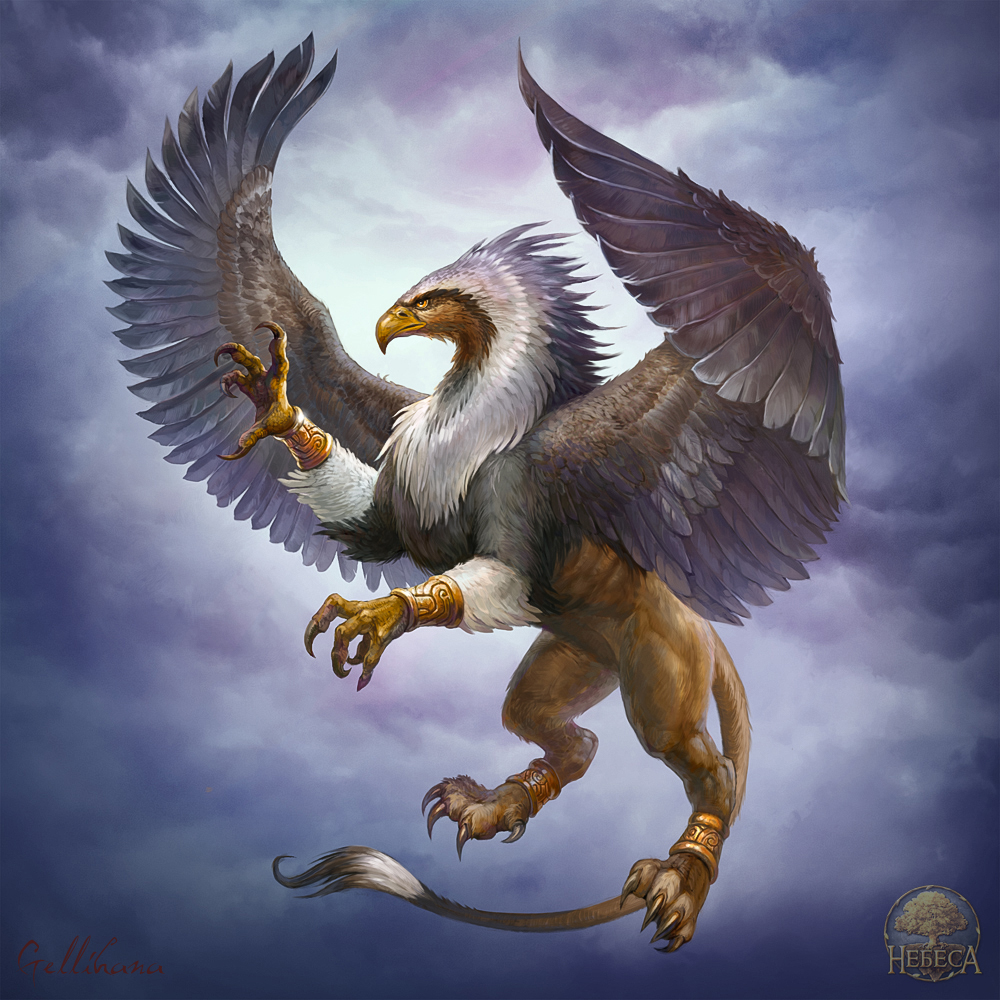
The griffin stands as one of antiquity's most striking composite creatures, merging the body, tail, and hind legs of a lion with the head, wings, and talons of an eagle. Because it unites the acknowledged king of beasts with the king of birds, ancient civilizations viewed the beast as a supreme guardian of divine power, royal authority, and hidden wealth. Unlike creatures born entirely of fantasy, the griffin occupied a strange space in ancient and medieval thought where people treated it less like a fairy tale and more like an exotic animal native to distant, dangerous frontiers.
Origins in the Ancient Near East and Scythia
Long before medieval knights painted the beast onto their shields, the griffin appeared in the art and architecture of the ancient Near East. Archaeological records trace the motif back to the Levant, Egypt, and ancient Persia around the third millennium BC. Stonework and cylinder seals from Elam and Mesopotamia frequently featured winged beasts guarding sacred spaces, throne rooms, and royal treasures.
The Greeks encountered these motifs through trade and conflict with Persian cultures, cementing the creature in Hellenistic literature during the seventh century BC. Greek writers like Aristeas of Proconnesus wrote of nomadic Scythian tribes inhabiting the vast steppes of Central Asia. According to these accounts, griffins nested in the rugged, desolate mountains of Scythia, fiercely guarding massive hoards of gold against one-eyed human adversaries known as the Arimaspians.
A compelling modern theory proposed by folklorist Adrienne Mayor suggests these legends weren't entirely invented. The Scythian gold fields in the Gobi Desert are rich in the fossilized remains of Protoceratops—dinosaurs featuring quadrupedal bodies, sharp beaks, and prominent frills. Nomads stumbling upon these exposed bones in the desert sands likely mistook them for the remains of a giant, bird-beaked predator, giving physical fuel to the myth of the gold-guarding beast. For further background on the matter, detailed reporting is available on The New York Times.
Evolution of Symbolism Across Cultures
As the griffin migrated through different cultures, its symbolic weight shifted to match the values of the societies adopting it.
In ancient Greece, the beast maintained a close association with the gods. Greeks often linked griffins to Apollo, believing the creatures pulled the sun god's chariot, or served as vigilant hounds belonging to Zeus and retributive agents of Nemesis. Their dual nature represented a balance of intellect, swiftness, and raw physical power.
During the Middle Ages, Christian scholars reinterpreted pagan symbols to fit religious doctrine. The griffin's physical composition offered a neat parallel for the dual nature of Jesus Christ. The eagle half symbolized Christ's divine nature and ability to ascend to heaven, while the lion half represented his earthly, human existence. At the same time, because medieval bestiaries claimed griffins mated for life and would die of grief if they lost their partner, the beasts also became emblems of marital fidelity and steadfast loyalty.
The Griffin in Medieval Heraldry
By the high medieval period, the griffin transitioned from a creature of distant folklore into a cornerstone of European heraldry. Knights and noble houses adopted the beast on coats of arms to broadcast specific traits to rivals on the battlefield and at tournaments.
On a shield, a griffin typically signified unwavering courage, vigilance, perseverance, and leadership. Heraldic artists developed specific rules for depicting the creature. When shown standing upright on its hind legs with wings elevated—a posture known as segreant—the griffin appeared ready for combat. Variations included the male griffin, which artists uniquely rendered without wings but with fiery rays or spikes protruding from its body, symbolizing raw, untamed strength.
ciudades and trading republics like Genoa also embraced the motif, carving stone griffins onto the facades of banks, guild halls, and civic buildings to signal security, protection of wealth, and institutional strength.
Common Misconceptions About Griffins
Modern pop culture often conflates the griffin with other mythological hybrids, leading to frequent points of confusion.
One common mix-up involves the Hippogriff. While people often view them as interchangeable, a hippogriff is the legendary offspring of a griffin and a horse. It features the head, wings, and front talons of an eagle, but the body and hindquarters of a horse rather than a lion.
Another misconception is that griffins played active roles in classical heroic myths. Unlike dragons or minotaurs, griffins rarely fought heroes like Hercules or Perseus in surviving Greek texts. Instead, ancient writers described them as part of the natural geography of the far-off edges of the known world, coexisting with ordinary travelers rather than serving as boss monsters meant to be slain.
Frequently Asked Questions
What two animals make up a griffin?
A griffin combines the head, wings, and front talons of an eagle with the body, hind legs, and tail of a lion.
What did the griffin symbolize in ancient times?
Ancient cultures viewed the griffin as a fierce guardian of divine power, sacred spaces, and hidden treasures like gold. It represented a balance of heavenly and earthly authority.
Are griffins and hippogriffs the same thing?
No. A griffin is part eagle and part lion, while a hippogriff is a separate creature born from the mating of a griffin and a horse, featuring an equine body.
Why are griffins common in medieval coat of arms?
Noble families placed griffins on their coats of arms to project an image of extreme courage, watchfulness, military strength, and the unyielding protection of property.



