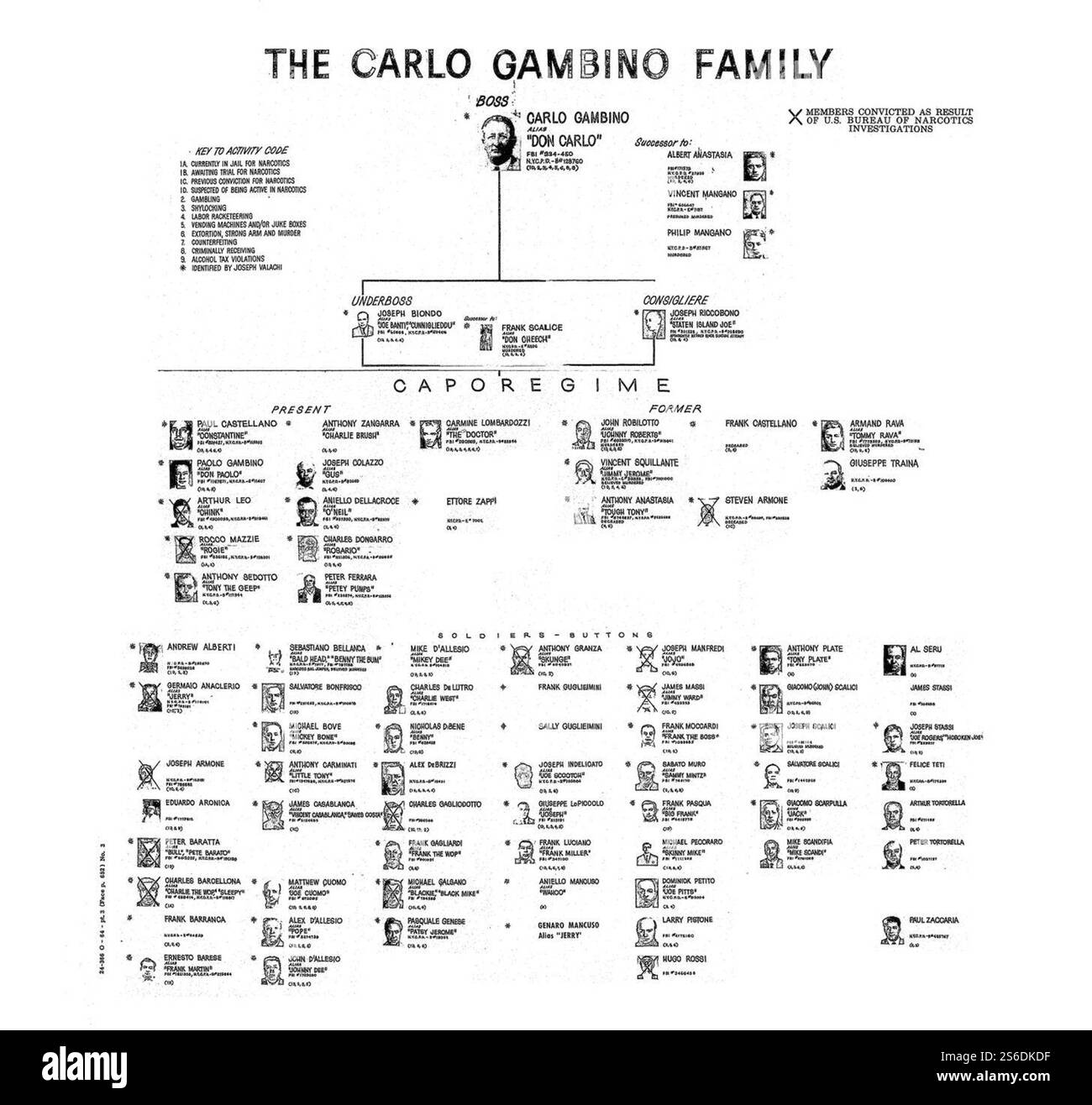
The Gambino crime family stands as one of the most powerful and structured syndicates in the history of American organized crime. Originating from Sicilian street gangs in the early 1910s, the organization evolved under iconic bosses like Carlo Gambino and John Gotti into a multi-million-dollar criminal enterprise. Its history is a clear study in the mechanics of corruption, corporate infiltration, and the eventual impact of federal racketeering laws.
Operating primarily across New York's five boroughs, New Jersey, and South Florida, the syndicate built its empire on labor racketeering, extortion, loansharking, and construction fraud. While media portrayals often focus on the flashy violence of the mob, the true longevity of the Gambino dynasty came from its ability to embed itself into legitimate industries and political networks.
Origins and the Formation of the Five Families
The roots of the Gambino syndicate trace back to immigrants arriving from Palermo, Sicily, in the early twentieth century. Early factions were loose coalitions of street thugs and extortionists until Salvatore D'Aquila organized them into a coherent network. D'Aquila became a dominant force in East Harlem, commanding allegiance from various Sicilian crews before the outbreak of the Castellammarese War in 1930.
The conflict reshaped Italian-American organized crime. Following the assassinations of key leaders like D'Aquila and Joe Masseria, visionary mobster Charles "Lucky" Luciano helped establish the Commission, a governing body designed to settle disputes among New York's dominant factions—known as the Five Families.
Vincent Mangano took control of the family in 1931, running it for two decades alongside his aggressive underboss, Albert Anastasia. Mangano's tenure ended abruptly in 1951 when he disappeared without a trace, and his brother Phillip was found murdered. Anastasia, known as the "Lord High Executioner", seized the throne and aligned himself with powerful underworld figures before his own violent downfall.
The Carlo Gambino Golden Era
In October 1957, Albert Anastasia was assassinated while sitting in a barber chair at the Park Sheraton Hotel in Manhattan. The hit was orchestrated with the backing of rival bosses, allowing Carlo Gambino to take over the family. Under Gambino's nineteen-year stewardship, the syndicate entered its most stable and lucrative era.
Carlo Gambino avoided the media spotlight, operating with a quiet corporate efficiency that contrasted sharply with Anastasia's brutality. He expanded the family's reach into international narcotics, garment district trucking, and municipal construction contracts. By partnering with legendary financier Meyer Lansky, Gambino also profited from offshore gaming operations.
The family's political corruption grew during this period through systematic bribery of labor union officials and local politicians. According to historical Encyclopædia Britannica accounts, the organization generated hundreds of millions of dollars annually while maintaining a facade of legitimacy. Gambino wielded so much influence that he even blocked moves by other families to assassinate law enforcement officials, preferring stability over chaos that invited federal scrutiny.
The Castellano Reign and Internal Division
When Carlo Gambino died of natural causes in 1976, he bypassed traditional street captains and appointed his brother-in-law, Paul Castellano, as his successor. This decision fractured the organization.
Castellano operated more like a corporate CEO than a traditional mob boss. He lived in a sprawling mansion on Staten Island, drove expensive cars, and distanced himself from street-level crews, delegating traditional rackets like loansharking and extortion while focusing on white-collar crimes and stock fraud.
Meanwhile, powerful caporegime Aniello Dellacroce commanded the loyalty of traditionalists who resented Castellano's corporate style and perceived greed. This internal split created deep resentment among ambitious younger members, notably John Gotti, who viewed Castellano as out of touch with street realities. When Dellacroce died of cancer in late 1985, the fragile peace shattered completely.
John Gotti and the Flamboyant Era
On December 16, 1985, Paul Castellano and his driver, Thomas Bilotti, were gunned down outside Sparks Steak House in midtown Manhattan. The hit was orchestrated by John Gotti, who quickly seized control of the family.
Gotti's reign marked a radical departure from Carlo Gambino's quiet approach. Dressed in custom Brioni suits and sporting styled hair, Gotti embraced the tabloid media, earning the moniker "The Teflon Don" because federal prosecutors repeatedly failed to secure convictions against him in high-profile trials.
However, this public visibility proved disastrous for the syndicate. The constant media attention forced the Federal Bureau of Investigation to deploy extensive electronic surveillance and long-term wiretaps against Gotti's inner circle.
The beginning of the end came when Gotti's underboss, Salvatore "Sammy the Bull" Gravano, facing life imprisonment on racketeering charges, decided to cooperate with federal authorities. Gravano's testimony provided the definitive evidence needed to dismantle the leadership. In 1992, Gotti was convicted of murder and racketeering, receiving a sentence of life imprisonment without the possibility of parole, effectively ending the flashy era of New York mob dominance.
Modern Operations and Federal Pressure
Following Gotti's imprisonment, the Gambino family was forced to adapt to an aggressive federal landscape shaped by the Racketeer Influenced and Corrupt Organizations (RICO) Act. Leadership transitioned through various figures, including Peter Gotti and Domenico Cefalù, before shifting focus toward Sicilian-born factions.
In March 2019, the organization made international headlines when reigning boss Frank Cali was shot and killed outside his Staten Island home, an event that shocked law enforcement because it was the first assassination of a New York mob boss in decades. Despite ongoing federal crackdowns, multi-jurisdictional task forces note that remnants of the syndicate continue to operate through decentralized cells, focusing on lower-visibility crimes like digital fraud, localized extortion, and traditional loan sharking while avoiding the public glare of past decades.
Frequently Asked Questions
Who founded the Gambino crime family?
The organization traces its roots back to early Sicilian gangs in Brooklyn organized by Salvatore D'Aquila around 1910. However, it did not take the Gambino name until Carlo Gambino assumed control in 1957 following the murder of Albert Anastasia.
How did John Gotti get caught?
Gotti was ultimately brought down by the testimony of his own underboss, Sammy Gravano. Gravano turned state's evidence in 1991 and provided federal prosecutors with the insider testimony required to convict Gotti on multiple counts of murder and racketeering in 1992.
What industries did the Gambino family infiltrate?
The syndicate historically infiltrated commercial construction, garment district trucking, the New York waterfront piers, major labor unions, and garbage collection. These industries allowed them to control jobs, extract kickbacks, and launder illegal proceeds.
Is the Gambino family still active today?
Yes, law enforcement agencies report that the family remains operational, though it is significantly smaller and more secretive than it was during its mid-century peak. Modern members prioritize low-profile financial schemes over the high-visibility violence and media exposure of the Gotti era.



