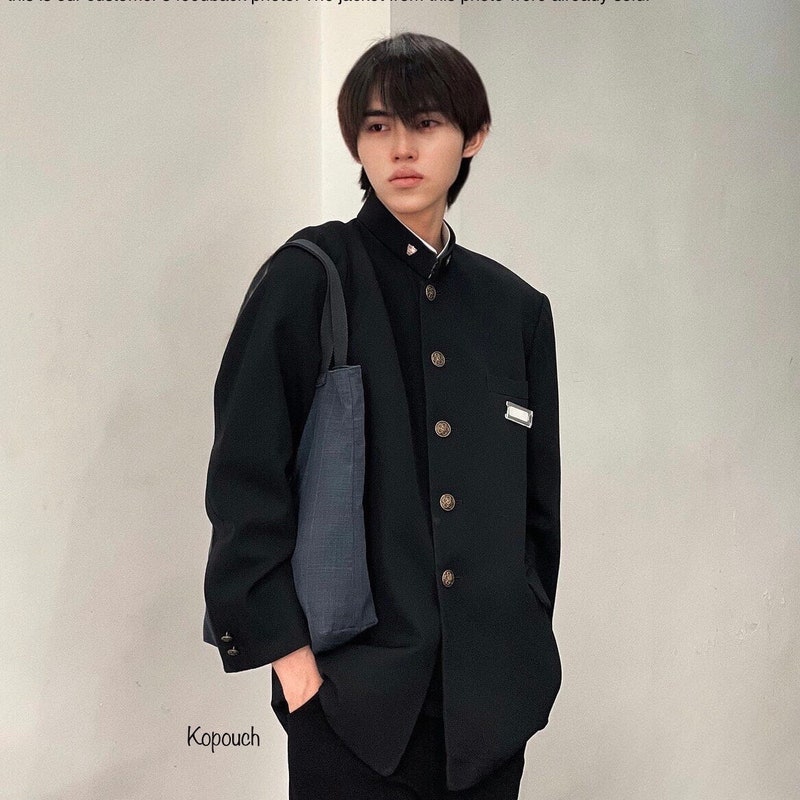
The gakuran jacket stands as one of the most recognizable garments in global school culture. If you've ever watched a classic anime or Japanese television drama, you've likely seen its signature high collar, dark fabric, and brass buttons. It's the traditional boy's uniform for junior high and high schools across Japan, combining military origins with enduring academic tradition.
Rooted in the Meiji period, the uniform tells a story of rapid industrialization, national identity, and changing social norms. While many schools now transition toward blazers for greater comfort and gender inclusivity, the uniform remains a powerful cultural touchstone. Let's look at how this garment came to be, how it's constructed, and why it still captures our imagination today.
Origins and Military Roots
The word combines gaku (meaning study or student) and ran (referring to the West, specifically the Netherlands historically, but used broadly for Western nations). During the late nineteenth century, the Japanese government embarked on a massive modernization campaign. Leaders looked outward to build a strong state, adopting Western institutional models across military, legal, and educational systems.
The jacket itself directly descends from Prussian military uniforms. Early Japanese military academies adopted Prussian-style wool tunics complete with stand-up collars and gleaming metal buttons. Because educational institutions often mirrored state discipline, schools soon adopted similar tunics for male students.
By the late 1880s, Imperial University and various middle schools across Tokyo made the dark wool tunic standard wear. It signaled that students belonged to an elite tier preparing to serve the nation. Over decades, the design shifted from a purely military imitation into a distinct civilian academic uniform.
Anatomy and Design Details
A traditional gakuran jacket features specific tailoring choices that set it apart from standard blazers or suits. Understanding these components reveals how deeply functional and symbolic the garment was designed to be.
- The Standing Collar: Known as a tsume-eri, the collar stands stiffly upright, typically measuring about three to four centimeters tall. It fastens tightly at the throat with a metal hook-and-eye closure.
- Metal Buttons: The front features a row of five brass buttons stamped with the school's emblem or crest. In many pop culture traditions, the second button holds immense romantic significance, as we'll explore shortly.
- Dark Wool Construction: Traditional jackets use heavy, durable black or very dark navy wool designed to withstand daily wear and seasonal chill.
- Pockets and Cut: The cut is straight and boxy, prioritizing neatness and uniformity over relaxed tailoring. Pockets are often flap-style or welted to maintain clean vertical lines.
Pairing the jacket with matching straight-leg trousers and a leather belt completes the standard ensemble. In colder months, students layer thermal wear underneath, while summer months often prompt a switch to short-sleeve white button-down shirts without the outer coat.
Cultural Impact and Pop Culture Lore
Beyond the classroom, the garment occupies a legendary status in Japanese popular culture. It's tied deeply to youth rebellion, loyalty, and romance.
In manga and anime, rebellious characters often wear their jackets unbuttoned, with the collar popped or sleeves draped casually over their shoulders. This visual shorthand signals a delinquent or bancho character who bends school rules. Conversely, diligent student council presidents wear the jacket meticulously buttoned to the top, embodying absolute order.
One of the most famous cultural traditions associated with the uniform involves graduation day. According to popular lore, a female student can ask the boy she likes for the second button of his gakuran jacket. Because that button sits closest to the heart, giving it away symbolizes giving one's heart or a promise of future romance.
You can learn more about how traditional dress intersects with modern Japanese society through resources like Nippon.com, which offers deep cultural analysis on daily life.
Modern Shifts and Controversies
Times change, and so do school wardrobes. The uniform faces significant scrutiny today as educational institutions rethink rigid traditions.
For decades, the strict dress code enforced strict conformity. Critics argue that the stiff wool tunics are uncomfortable, expensive, and out of touch with modern pedagogical goals that encourage individuality. Furthermore, traditional gender binaries—where boys wear the stiff collar jacket and girls wear sailor-style fuku—are increasingly seen as exclusionary.
Many school boards now replace traditional uniforms with gender-neutral blazers and slack options. Students can choose garments based on personal comfort rather than assigned gender, leading many historic institutions to retire the traditional look. Despite this decline in daily wear, secondhand markets remain active, and vintage pieces are prized by collectors and fashion enthusiasts.
Frequently Asked Questions
Why do gakuran jackets have metal buttons?
The brass buttons originate from Meiji-era military uniforms. They traditionally feature embossed crests representing the specific school, allowing administrators to identify students easily outside campus grounds.
Are students still required to wear them today?
Some traditional private and public secondary schools still mandate them, but a growing number of institutions have switched to flexible, gender-neutral blazers.
What is the difference between gakuran and standard blazers?
Gakuran jackets feature a rigid, stand-up mandarin-style collar and a row of metal buttons, whereas standard blazers feature a lapel collar, open neckline, and flat plastic buttons.
Can anyone purchase a gakuran jacket?
Yes, specialty tailors and online retailers sell them. They are popular purchases for cosplay, fashion events, and cultural festivals like school bunkasai. For official historical context on Japanese education reform, check out the Ministry of Education, Culture, Sports, Science and Technology.



