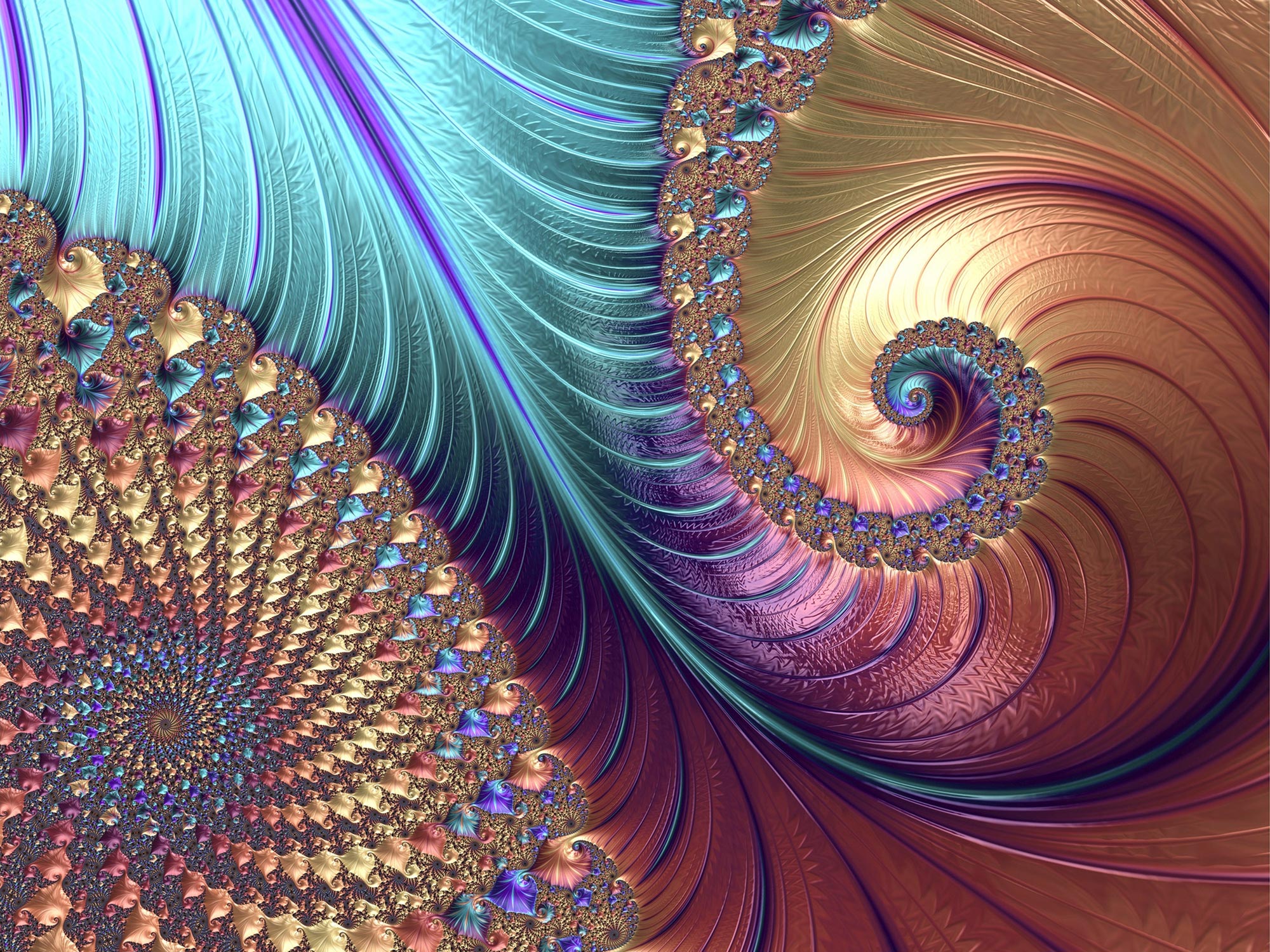
Look at a jagged coastline on a map, and then zoom in closer on a single bay. You'll see smaller inlets, minor peninsulas, and rocky outcrops mirroring the exact shape of the larger coast. Look closer still at a single rock, and the roughness repeats itself. This infinite self-similarity is the core of the fractal nature of reality, showing up everywhere from the branching of blood vessels to the chaotic swings of global trade.
Classical geometry gave us smooth circles, rigid squares, and predictable triangles. But nature doesn't build with straight lines. It builds with iterations—simple rules repeated endlessly over different scales. Understanding how these patterns operate gives us a completely different lens for viewing biology, physics, and even human economics.
Defining Fractals Beyond Euclidean Math
For centuries, mathematics relied on Euclidean geometry, which assumes smooth shapes and integer dimensions. A line is one-dimensional, a flat sheet of paper is two-dimensional, and a cube is three-dimensional. But clouds aren't spheres, and mountains aren't cones.
Mathematician Benoit Mandelbrot changed that framework in the 1970s when he popularized fractal geometry. The term comes from the Latin fractus, meaning broken or fractured.
A true fractal possesses specific properties that separate it from standard shapes:
- Self-similarity: The pattern repeats itself across different magnification levels, whether you zoom in or out.
- Fractional dimension: Instead of fitting neatly into whole-number dimensions, fractals occupy space with a fractional or Hausdorff dimension, meaning they fill space more than a line but less than a solid plane.
- Recursive generation: They are created through iteration, where the output of a mathematical equation becomes the input for the next cycle.
When you plot these equations, you don't get a static picture. You get an infinite landscape of recursive detail that never ends, no matter how far you zoom.
Why Nature Prefers Recursive Design
Natural systems don't develop fractal patterns for aesthetic reasons. Evolution and physical forces push toward efficiency, and fractal geometry is the ultimate space-saving, resource-distributing design.
Think about how your lungs need to oxygenate your blood. They have to pack a massive surface area—roughly the size of a tennis court—inside a tight chest cavity. The solution is biological iteration. The trachea splits into two bronchi, which split into smaller bronchioles, eventually ending in microscopic alveoli. This branching network maximizes surface area within a restricted volume.
The same logic applies across ecosystems:
- River networks: Watersheds branch out in a fractal structure that optimizes the collection of rainwater over a massive geographic basin, directing every drop toward a single outlet with minimal energy loss.
- Lightning bolts: An electrical discharge navigates the path of least resistance through the atmosphere by branching in a jagged, fractal tree that maximizes electrical dissipation.
- Plant growth: Romanesco broccoli and fern fronds replicate their buds at smaller scales to maximize sunlight exposure without blocking neighboring leaves.
These designs aren't accidents. They're physical necessities for moving matter, energy, and information efficiently through space.
Fractals in Human Technology and Design
Engineers don't just observe fractals; they build them. Because fractal structures can pack a huge electrical length into a tiny physical footprint, they've revolutionized modern communication.
Take mobile phones and GPS devices. Traditional antennas are tuned to a single specific frequency. But a fractal antenna—shaped like a Koch snowflake or a space-filling curve—operates across multiple frequencies simultaneously. It receives signals across a broad spectrum because its self-similar geometry provides resonant paths at various scales.
Computer graphics rely heavily on recursive algorithms to generate realistic digital worlds. Instead of manually modeling every single rock, tree, and mountain range in a video game or film, developers use procedural generation based on fractal mathematics. By applying a simple equation with random variance, a computer can render breathtakingly complex landscapes on the fly, saving massive amounts of storage and processing power.
The Fractal Nature of Markets and Human Behavior
One of the most fascinating extensions of fractal geometry is found in finance and sociology. Classical economic theory often treats market movements like a bell curve, assuming that extreme price crashes are rare statistical anomalies.
Mandelbrot challenged this view when analyzing cotton prices. He discovered that market charts are scale-independent. A price chart covering ten years looks remarkably similar in its jagged volatility to a chart covering ten minutes.
This self-similarity means that financial markets are inherently prone to extreme swings because the mechanisms driving small trades mirror the panic driving major crashes. Risk doesn't distribute smoothly; it clusters.
Human social systems often follow similar recurring patterns:
- Urban expansion: City growth spreads outward along transit corridors in fractal clusters rather than expanding as uniform circles.
- Language structures: Word frequency and syntax often organize according to power-law distributions, which share deep mathematical ties with fractal scaling.
Common Misunderstandings About Fractals
People often confuse chaos with randomness. While a fractal pattern looks chaotic and unpredictable at first glance, it is actually deterministic. It stems from a strict, repeating set of rules.
Another frequent mistake is assuming every natural irregularity is a true mathematical fractal. In nature, exact self-similarity breaks down after a few iterations because physical limits take over. A coastline can only be broken down into smaller inlets until you reach the scale of individual sand grains or atoms, where the mathematical ideal stops. Scientists call these systems statistical fractals rather than pure mathematical ones.
Frequently Asked Questions
Are fractals infinite in the real world?
Mathematically, yes, because an equation can be iterated infinitely. In the physical world, no. Physical fractals are limited by the scale of atoms and molecules, so they only exhibit self-similarity across a finite number of scales.
Did Benoit Mandelbrot invent fractals?
Mandelbrot coined the term and brought them into mainstream mathematics using computers in the 1970s. However, earlier mathematicians like Gaston Julia and Helge von Koch studied the underlying geometric concepts decades earlier.
How do fractals help us understand earthquakes?
Seismologists use fractal analysis to study fault lines and seismic energy release. The distribution of small tremors often mirrors the frequency of larger earthquakes, helping researchers model tectonic stress across different scales.
Can you create fractals by hand?
Yes. Classic examples like the Koch snowflake or the Sierpinski triangle are generated by starting with a simple shape and repeatedly drawing or removing smaller geometric components using a fixed rule.



