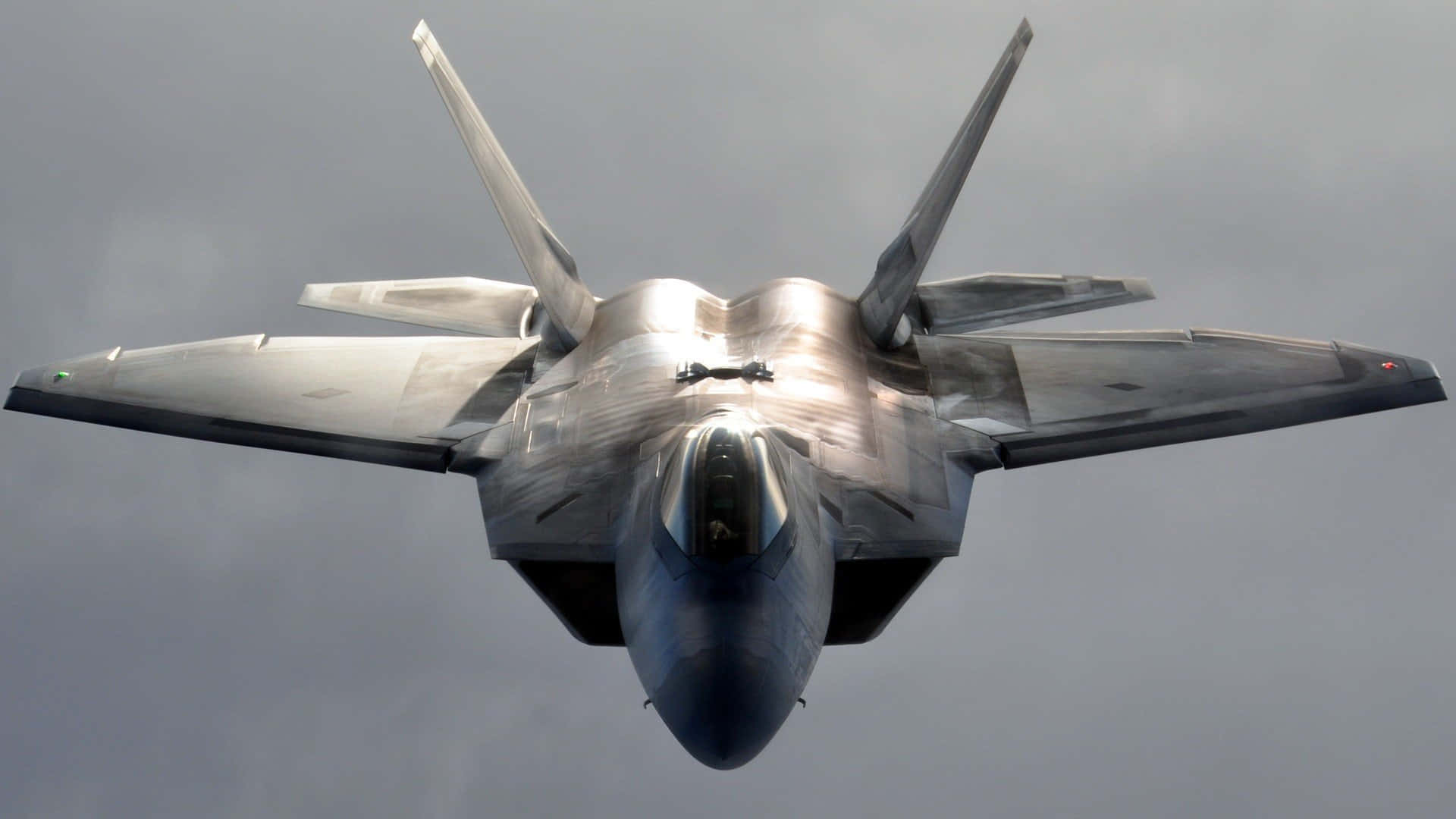
The Lockheed Martin F-22 Raptor achieves a classified top speed estimated at Mach 2.25 (roughly 1,500 mph or 2,414 km/h) at altitude. Unlike legacy jets that burn through internal fuel reserves instantly to break Mach 1, the Raptor relies on a defining performance mechanic called supercruise. It maintains supersonic speeds above Mach 1.5 without lighting its afterburners, keeping fuel burn lower and thermal signatures suppressed.
Understanding how this fifth-generation air superiority fighter commands the skies requires looking past basic dashboard metrics into thermodynamics, propulsion engineering, and aerodynamic design.
The Anatomy of F-22 Speed and Thrust
Raw velocity in modern tactical aviation isn't just about sticking massive engines onto a metal tube. It's a delicate balance of thrust-to-weight ratios, drag reduction, and structural thermal management.
Pratt and Whitney F119 Engines
The backbone of the aircraft's performance is its twin Pratt & Whitney F119-PW-100 afterburning turbofan engines. Each engine generates an estimated 35,000 pounds of thrust. These powerplants are engineered to run at extremely high turbine temperatures without degrading structural integrity.
- Dry Thrust: Delivers massive power without afterburners, enabling efficient supersonic cruising.
- Wet Thrust: Engages fuel-injection afterburners for short, high-energy combat dashes.
- Durability: Built to handle the extreme thermal expansion caused by continuous friction at high Mach numbers.
Two-Dimensional Thrust Vectoring
The F-22 features pitch-axis two-dimensional thrust vectoring nozzles. These nozzles can deflect exhaust upward or downward by up to 20 degrees. While vectoring is famous for letting the jet pull off radical low-speed maneuvers like the Herbst maneuver, it also contributes at high speeds. By managing pitch control aerodynamically and mechanically through vectoring, engineers reduced the need for large, drag-inducing control surfaces.
Breaking the Sound Barrier Without Afterburners
Most supersonic fighters require afterburners—dumping raw fuel directly into the hot exhaust stream—to punch through the sound barrier. This creates an enormous infrared signature that ground-based tracking systems and enemy sensors spot instantly.
The F-22 changes this tactical calculus through supercruise.
[Subsonic Flight] --> [Supercruise (Mach 1.5 - 1.8 without afterburners)] --> [Max Dash (Mach 2.25+ with afterburners)]
When operating at supercruise speeds between Mach 1.5 and Mach 1.8, the aircraft maintains high kinetic energy while staying relatively stealthy. Pilots cross vast operational theaters rapidly, arrive at intercept points sooner, and launch internal weapons with extra kinematic energy imparted by the launch platform's high baseline speed. This kinematic boost increases the effective range of onboard air-to-air missiles.
Aerodynamic Secrets of Air Dominance
Reaching Mach 2+ requires an airframe that actively fights aerodynamic heating and shockwave drag.
Planform Alignment and Stealth Integration
Every edge, sweep angle, and control surface on the F-22 is parallelized to deflect radar waves. Fortunately, this stealth geometry also serves aerodynamics well. The blended wing-body design spreads lift across a wide area, reducing wing loading during high-speed turns at high altitude.
Altitude and Thin Air Performance
The aircraft has an operational service ceiling exceeding 65,000 feet. At this altitude, air density drops significantly.
- Reduced Drag: Thinner air creates less skin friction drag, allowing the jet to sustain high Mach numbers more efficiently than it can down low.
- Sensor Advantage: The high vantage point expands the detection horizon for the AN/APG-77 active electronically scanned array radar.
Operational Reality: Fuel Management and Limits
Pushing an aircraft to its absolute limits involves strict trade-offs.
When a pilot engages full afterburners for a high-speed intercept or evasion, internal fuel depletes rapidly. The F-22 carries roughly 18,000 pounds of internal fuel. Storing weapons internally inside weapon bays preserves stealth, but it limits the total volume available for fuel compared to legacy jets that strap massive external drop tanks onto their wings—though external tanks can be fitted for ferry flights at the cost of stealth and top-end agility.
Furthermore, aerodynamic heating at sustained supersonic speeds places intense stress on composite materials and canopy seals. Technicians must conduct specialized maintenance to ensure radar-absorbent coatings don't degrade under the intense frictional heat of high-Mach flight.
Frequently Asked Questions
What is the exact top speed of the F-22 Raptor?
The exact top speed is classified by the United States Air Force. Public defense estimates consistently place it around Mach 2.25 (approximately 1,500 mph) at altitude.
Can the F-22 supercruise with a full weapons load?
Yes. Because its primary armaments—such as AIM-120 AMRAAMs—are housed internally within weapon bays, the aircraft preserves its clean aerodynamic profile. It maintains supercruise capability even when fully loaded for combat missions.
How does the F-22 compare to the F-35 in top speed?
The F-22 is faster. While the F-35 Lightning II is optimized for multi-role strike missions and tops out around Mach 1.6, the F-22 is a dedicated air superiority fighter built to achieve sustained supercruise past Mach 1.5 and maximum dashes exceeding Mach 2.2.
Why can't other countries buy the F-22?
United States federal law banned the export of the F-22 Raptor under the Obey Amendment of 1997. Congress enacted this restriction to protect the jet's classified stealth shaping, electronic warfare systems, and radar technology from foreign espionage or reverse-engineering.



