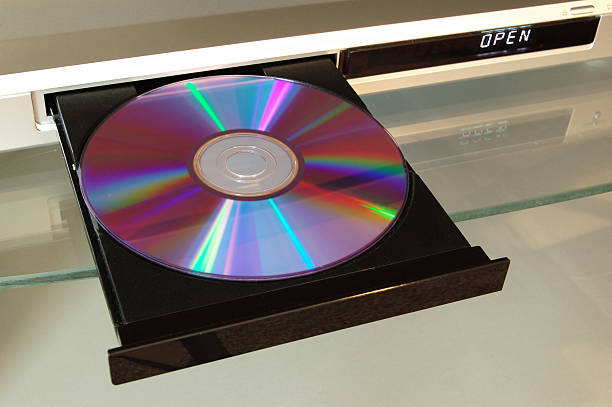
The letters DVD originally stood for digital video disc when the format launched in 1995. As manufacturers realized the hardware could handle software, computer backups, and audio just as well as motion pictures, the industry shifted the official phrasing to digital versatile disc.
Understanding this acronym scratches the surface of how a 4.7-inch plastic disc fundamentally reshaped home entertainment and personal computing before streaming took over. If you're curious about how these discs store data, why they replaced VHS, and how they work under the hood, let's break down the mechanics behind the technology.
The Origins of the Format and the Name Debate
Back in the early 1990s, the consumer electronics market faced a major fragmentation risk. Two rival camps were developing high-density optical storage systems independently.
On one side, Sony and Philips backed the MultiMediaCompact Disc. On the other, Toshiba and Time Warner championed the Super Density disc. Sony and Philips had already conquered the music market with the Compact Disc (CD), while Toshiba wanted a dominant standard for movies.
Hollywood studios threatened to withhold support if two incompatible formats hit store shelves. They remembered the messy VHS versus Betamax format war of the 1980s and refused to pick a side. Under heavy pressure from content creators, the rival consortia formed the DVD Consortium—later renamed the DVD Forum—to create a single, unified standard.
When the format debuted, executives marketed it as a digital video disc to position it as a direct replacement for videotapes. But computer hardware developers pushed back. They saw massive potential for general data storage, interactive games, and software suites. By 1999, the DVD Forum officially adopted digital versatile disc as the universal definition to reflect its expanding utility beyond cinema.
Technical Specifications: How a DVD Stores Data
At first glance, a DVD looks identical to an audio CD. Both measure 120 millimeters in diameter and 1.2 millimeters in thickness. Yet a standard DVD holds roughly seven times more information.
The secret lies in the physics of light and laser precision.
- Laser Wavelength: CDs use an infrared laser with a wavelength of 780 nanometers. DVDs use a red laser with a shorter wavelength of 650 nanometers. A tighter beam allows the hardware to read much smaller pits stamped into the disc.
- Track Pitch: The spiral track holding the data sits much closer together on a DVD—0.74 micrometers apart, compared to 1.6 micrometers on a CD.
- Pit Size: The physical pits and lands that encode binary data are nearly half the size of those on a CD, dropping down to a minimum length of 0.4 micrometers.
A standard single-layer DVD stores 4.7 gigabytes (GB) of data. Engineers achieved higher capacities through clever manufacturing tricks. A dual-layer DVD (DVD-9) features a second semi-reflective layer underneath the first. By refocusing the laser through the top layer, the optical pickup reads the second layer, pushing total capacity to 8.5 gigabytes. Manufacturers also produced double-sided discs, though users had to physically flip them over.
For a deeper dive into the physics of optical data reading, you can explore the Library of Congress preservation guidelines on optical media stability and structure.
The Commercial Boom and Cultural Shift
When DVDs launched in Japan in late 1996 and North America in 1997, adoption rates shattered consumer electronics records. Blockbuster movies like Twister and Blade Runner proved that digital video offered a massive leap over VHS.
Viewers no longer had to rewind tapes. They enjoyed letterboxed widescreen presentations instead of cropped 4:3 pan-and-scan video. Scene selection menus replaced fast-forwarding through previews, and bonus features like director commentaries turned home video into an interactive art form.
By 2003, annual DVD rentals and sales in the United States officially surpassed VHS tapes. Video rental stores completely overhauled their inventory. For personal computer users, internal DVD-ROM drives became standard equipment, replacing floppy disks and CD-ROMs for installing heavy software suites and playing PC games.
Common Misconceptions About DVDs
People often confuse optical disc standards or misunderstand how to care for physical media. Here are a few clarifications:
- DVD-R vs. DVD+R: These competing write-once formats use different physical wobbles on the track to guide the laser. Most modern drives read both, but older standalone players sometimes choked on one or the other.
- Scratch Repair: A scratch on the bottom label side of a CD ruins the data layer because the aluminum reflective coating sits right beneath the label. On a DVD, the data layer sits sandwiched in the exact middle of the 1.2 mm polycarbonate plastic. Superficial scratches on the bottom often buff out safely because the laser focuses through the plastic to the internal layer.
- Lifespan: While manufacturers marketed DVDs as permanent storage, organic dye layers in recordable discs degrade over time when exposed to UV light and high humidity. Factory-pressed commercial movie discs last much longer than home-burned recordable discs.
Frequently Asked Questions
Why do some DVDs not play in certain players?
Region coding restricts playback geographically. Studios divided the globe into six regions to control release dates and pricing. A DVD purchased in North America (Region 1) won't play in a standard European player (Region 2) unless the player is region-free.
What is the difference between MPEG-2 and modern codecs?
DVD video relies on MPEG-2 compression, an older standard that requires significant bitrate to look sharp. Modern streaming platforms use advanced codecs like H.264, HEVC, or AV1, which deliver high-definition or 4K video at a fraction of the data bandwidth required by legacy DVD encoding.
Can a regular CD drive read a DVD?
No. CD drives use an infrared laser with a 780 nm wavelength. That beam is too wide to read the tightly packed pits on a DVD layer. However, DVD drives contain lasers capable of reading CDs, DVDs, and sometimes Blu-ray discs backward compatibly.
Why did Blu-ray eventually replace standard DVD?
High-definition televisions demanded higher resolutions. Standard DVDs max out at 480i or 576i resolution (Standard Definition). Blu-ray discs use a blue-violet laser with a 405 nm wavelength, allowing for much tighter data packing and full 1080p high-definition video storage.



