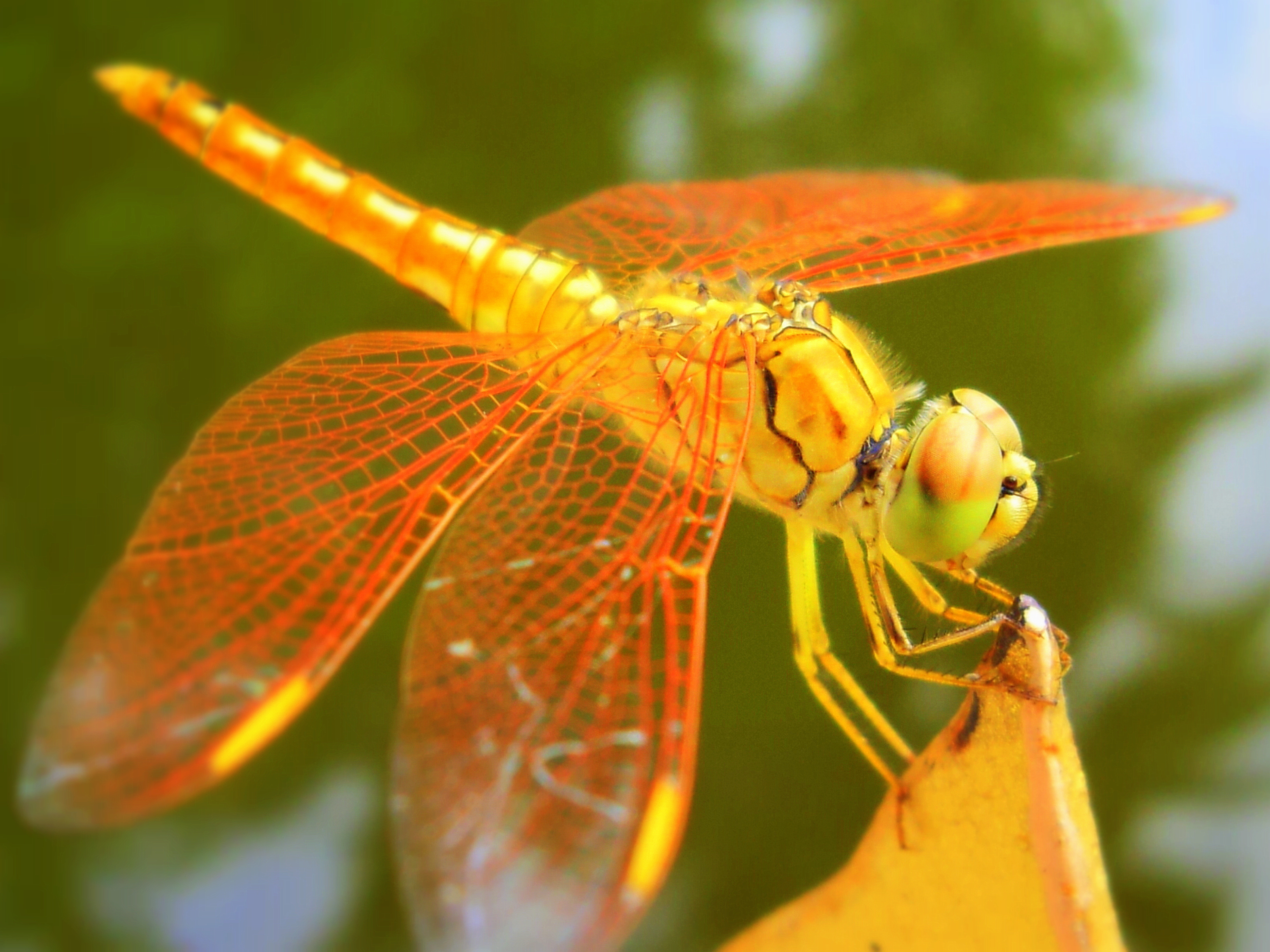
A dragonfly's visual system operates through up to 30,000 individual lenses known as ommatidia, capturing a nearly 360-degree panorama of its environment. Unlike human eyes that rely on a single lens to focus light onto a single retina, this compound architecture splits visual data into thousands of independent pixel streams. This biological setup enables apex predatory insects to process rapid motion and calculate intercept trajectories with extreme precision.
Understanding how insect compound eyes work requires looking past the common myth that they see thousands of disjointed mosaic tiles. Instead, their brains integrate these thousands of visual inputs into a fluid, high-speed perception of motion. This deep dive examines the anatomy, processing speed, and specialized adaptations that make dragonfly vision one of the most effective sensory apparatuses in nature.
Anatomy of an Ommatidium: The Building Block of Compound Vision
Each compound eye is a dense cluster of independent light-sensing units called ommatidia. Looking at a dragonfly's eye under a microscope reveals a hexagonal grid where every facet points in a slightly different direction.
- Corneal Lens: The rigid outer surface that gathers light from a specific angle in space.
- Crystalline Cone: A transparent structure beneath the cornea that focuses light inward toward the photoreceptor cells.
- Retinula Cells: Typically a cluster of eight sensory cells inside each ommatidium that convert light photons into electrical neural impulses.
- Pigment Cells: Dark cells surrounding each ommatidium that isolate it optically, preventing light scatter between adjacent lenses.
Because each ommatidium acts as an independent tube pointing outward, the entire eye functions like a multi-directional optical array. The upper region of the eye often features specialized ommatidia optimized for detecting ultraviolet light against the open sky, while the lower region fine-tunes contrast for tracking movement against terrestrial backgrounds.
Temporal Resolution: Why Insects Live in Fast-Forward Time
Vision quality isn't just about spatial resolution or how sharp an image looks. It also depends heavily on temporal resolution—the speed at which the visual system can update frames.
Human eyes possess a flicker fusion rate of about 50 to 60 Hertz. If a light flashes faster than 60 times per second, humans see it as a continuous steady beam. By contrast, a dragonfly processes visual information at rates exceeding 200 Hertz.
This high temporal resolution means dragonflies perceive human motion or standard video playback as a series of slow, distinct, frame-by-frame images. While this trades away the high-resolution fine detail found in human foveal vision, it gives them an absolute advantage in tracking fast-moving prey like mosquitoes or rival dragonflies mid-air.
Neural Processing and Target Interception
Having thousands of visual inputs creates a massive data processing challenge. A dragonfly's brain dedicates a significant proportion of its neural capacity to visual processing, particularly through specialized neurons known as Small Movement Detecting Neurons (SMDNs) and Target Selective Descending Neurons (TSDNs).
When a dragonfly spots prey, it doesn't just chase where the target is. It calculates the prey's future trajectory and steers its flight path to intercept it, mirroring the guidance systems used by modern heat-seeking missiles.
- Detection: Peripheral ommatidia register a sudden change in photon absorption or contrast as a tiny dot moves across a few facets.
- Isolation: TSDNs filter out stationary background scenery like trees or water, locking onto the moving target despite erratic flight backgrounds.
- Prediction: Neural loops compute the intercept angle, adjusting the dragonfly's wing muscles in real time to match velocity and heading.
This closed-loop feedback system achieves a capture success rate exceeding 95 percent, making dragonflies one of the most lethal hunters in the animal kingdom.
Color Perception and Ultraviolet Sensitivity
Humans view the visible light spectrum through three types of color receptor cones sensitive to red, green, and blue. Dragonflies possess a much more complex array of opsin proteins, often featuring four or more distinct photoreceptor classes sensitive to ultraviolet, blue, green, and polarized light.
Polarized light sensitivity is particularly useful near water bodies. The light reflecting off water surfaces becomes horizontally polarized, and dragonflies use this sensory cue to locate breeding ponds, territory boundaries, and mates from great distances. Ultraviolet vision allows them to distinguish between different species of prey or recognize specific wing patterns on potential mates that remain completely invisible to human eyes.
Common Misconceptions About Compound Eyes
Popular science media often simplifies insect vision into inaccurate tropes. Clearing up these misconceptions highlights the actual sophistication of compound eyes.
- The Mosaic Myth: Early scientific drawings suggested that insect eyes produce a kaleidoscope image made of thousands of individual puzzle pieces. Modern neurobiology shows that the brain blends these signals into a continuous, albeit lower-resolution, panoramic field.
- Total Blindness to Detail: While compound eyes have lower spatial acuity than human eyes due to physical diffraction limits imposed by tiny lenses, their sheer density in predatory insects compensates enough to spot small flying insects meters away.
- Uniform Structure: Not all ommatidia within a single eye are identical. Specialized zones, such as the acute zone where facets are larger and packed more tightly, provide a localized region of higher visual acuity facing forward and upward.
Frequently Asked Questions
Do dragonflies have blind spots?
Because their compound eyes bulge outward into a spherical shape, dragonflies achieve a field of view approaching 360 degrees. Their only major blind spot is a small cone directly behind their head and body, which they compensate for by tilting their head during flight.
Can compound eyes focus like human lenses?
Ommatidia are fixed-focus optical units. They do not possess flexible muscles like the human eye's lens to adjust focus for near and far objects. Instead, almost everything across their field of view remains in focus simultaneously, relying on spatial separation rather than focal adjustment to judge distance.
How do dragonfly eyes compare to fly eyes?
House flies have compound eyes optimized for high-speed panoramic detection to evade swatters, but their visual acuity is significantly lower. Dragonflies invest heavily in a specialized frontal binocular zone that provides sharp stereoscopic tracking crucial for predatory interception.
Why don't humans have compound eyes?
Scaling compound eyes up to human head sizes would make them impractically large to achieve the same visual clarity. A human-sized eye built with ommatidia would need to be several meters wide to match the visual acuity provided by a single mammalian lens.