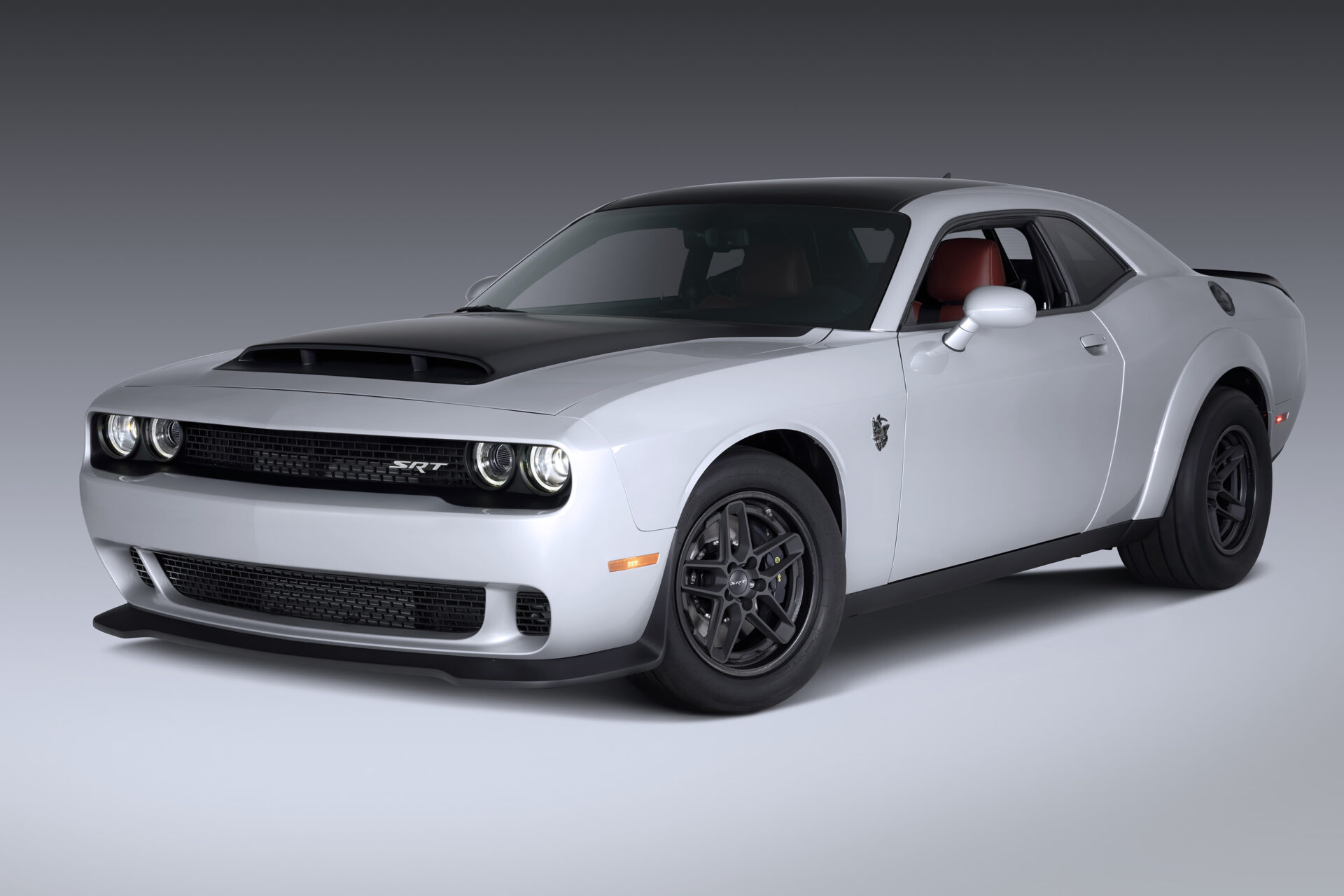
When Dodge announced the Challenger SRT Demon 170, they didn't just build another special-edition muscle car. They engineered a mechanical boundary-pushing monster designed to shut down the gas-powered era with absolute finality. Pumping out an earth-shattering 1,025 horsepower and 945 lb-ft of torque on high-blend ethanol fuel, this factory drag racer rewrote what street-legal production cars can achieve on a strip.
Understanding the vehicle requires looking past the marketing slogans and examining the raw engineering metrics. From its reinforced powertrain to its specialized fuel-sensing logic, every component was rebuilt to withstand pressures that would snap traditional internal combustion components.
Engine Architecture and Fuel Flexibility
At the heart of the car sits a heavily modified 6.2-liter HEMI V8 engine paired with a massive 3.0-liter supercharger. Unlike the standard Hellcat or even the original 2018 Demon, the 170 designation refers directly to "170-proof" ethanol—or E85 fuel.
The block required radical structural updates to handle the immense cylinder pressures. Dodge engineers incorporated modified block machining for head studs and main bearing cap bolts, upgraded heavy-duty connecting rods, and high-strength pistons. The valvetrain features sodium-filled exhaust valves and a lower heat-range spark plug setup designed specifically to optimize ethanol combustion.
The powertrain management system utilizes an innovative fuel-composition sensor. When you pull up to a pump, the car automatically detects the ethanol percentage:
- Low Ethanol (E10): The cluster icon shows white, limiting output to 900 horsepower and 810 lb-ft of torque.
- High Ethanol (E65+): The cluster icon shifts to blue, unlocking the full 1,025 horsepower and 945 lb-ft of torque at 6,500 rpm.
Powertrain and Drivetrain Reinforcements
Putting a thousand horsepower to the pavement requires more than just engine output; it demands a driveline that won't shatter under shock load. The transmission is an upgraded TorqueFlite 8HP90 eight-speed automatic, featuring an updated output flange to accommodate a thicker, stronger propeller shaft.
The rear end utilizes a 3.09 asymmetric limited-slip differential paired with heavy-duty 43-spline rear half shafts. Both the inboard and outboard CV joints feature larger inner-connecting splines and a revised heat treatment process to absorb the brutal initial launch.
According to Dodge, the vehicle delivers a staggering 2.004 g-force acceleration rating—the highest of any production car ever built.
Track Performance and Drag Strip Metrics
Numbers on a dyno are one thing, but track slips tell the real story. The Demon 170 achieves a 0-60 mph time of 1.66 seconds under ideal prepped-track conditions using its customized drag radial setup.
The quarter-mile data proves just how violent this acceleration is:
- E.T. (Elapsed Time): 8.91 seconds
- Trap Speed: 151.17 mph
- Certification: Officially certified by the National Hot Rod Association (NHRA) as an eight-second car, requiring drivers to use the optional direct-connection parachute system in official competition.
To achieve these figures, the car features TransBrake 2.0, which lets drivers lock the output shaft, build boost before launch, and select custom launch torque profiles depending on track grip levels.
Suspension, Chassis, and Weight Management
Managing weight transfer during a launch requires a specialized suspension strategy. Up front, the Bilstein adaptive-damping shocks are tuned for firm compression and soft rebound, allowing the front end to rise easily and unload weight onto the rear tires. In the rear, the shocks utilize firm compression and firm rebound to keep the contact patch glued to the asphalt.
The car rides on a staggered widebody setup. Up front, lightweight 18-by-8-inch forged aluminum wheels wear Mickey Thompson 245/55R18 street legal tires, while the rear features Mickey Thompson ET Street R 315/50R17 drag radials. Buyers could also opt for full carbon-fiber wheels to shave off precious unsprung weight, bringing the total curb weight down to roughly 4,280 pounds.
For more context on vehicle production guidelines and industry standards, you can review details provided by the National Highway Traffic Safety Administration.
Common Misconceptions
Many enthusiasts assume the Demon 170 is simply a retuned Hellcat Redeye with bigger injectors. That misunderstanding ignores the depth of the engineering overhaul. Every major structural element from the crankshaft damper to the rear axle housing was redesigned.
Another frequent myth is that the car requires race fuel to hit its top figures. In reality, it achieves its peak 1,025 horsepower using standard pump E85 ethanol available at commercial service stations, making its power delivery accessible without specialized barrel purchases.
Frequently Asked Questions
How many Dodge Demon 170 units were produced?
Dodge capped production at 3,300 units total, with the vast majority allocated to the North American market before assembly concluded at the Brampton Assembly Plant.
Can you drive the Demon 170 legally on public streets?
Yes. Despite running the quarter mile in under nine seconds and featuring an optional parachute mount, the car is fully federalized and street-legal in all 50 states.
What kind of fuel economy does it get?
Fuel economy is heavily compromised by the massive supercharger and high-flow fuel system. Expect low double-digits on the highway and single-digits when exploiting the throttle on a track.
Does it come with a passenger seat?
The vehicle ships standard with only a driver's seat to save weight, but buyers could check a box to add a passenger seat and rear seats for nominal costs during the ordering process.



