The derivative of the natural logarithm function, written as $\frac{d}{dx}(\ln x)$, equals $\frac{1}{x}$ for all $x > 0$. This simple rule measures the instantaneous rate of change of a natural logarithmic curve at any given input. As input values grow larger, the slope of the tangent line flattens out, which matches the behavior of its reciprocal derivative.
Understanding this calculus rule allows you to solve rates of change in physics, economics, and probability. While memorizing the formula takes seconds, working through its foundational principles reveals why exponential growth and logarithmic scaling are deeply connected through Euler's number ($e$).
The Definition and Graph of the Natural Logarithm
The natural logarithm function, $\ln x$, is the inverse of the natural exponential function $e^x$. Where $e$ is approximately equal to $2.71828$, the statement $y = \ln x$ means that $e^y = x$.
On a coordinate plane, the graph of $\ln x$ starts vertically near the y-axis for positive values close to zero, crosses the x-axis at $(1, 0)$, and climbs steadily toward the right while growing progressively slower.
- Domain: $x > 0$ (negative numbers and zero are undefined for standard real-valued natural logs).
- Range: All real numbers $(-\infty, \infty)$.
- Behavior: Increasing and concave down across its entire domain.
Because the curve rises steeply near zero and flattens out as $x$ increases, its slope—the derivative—must reflect this decreasing rate of change. That is precisely what the function $\frac{1}{x}$ represents.
Proving the Derivative from First Principles
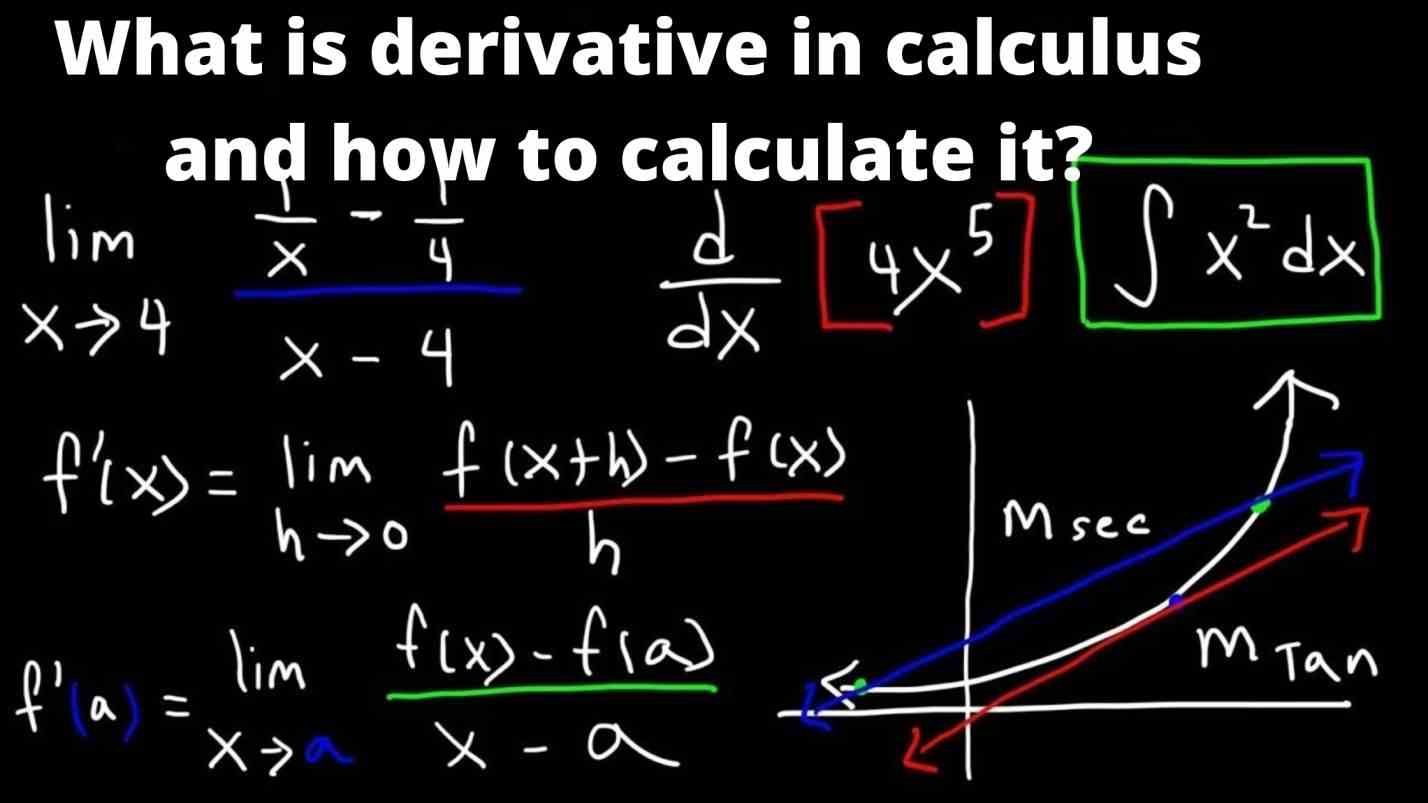
To prove why the derivative equals $\frac{1}{x}$, you use the limit definition of the derivative. The average rate of change over a small interval $h$ is expressed as:
$$f'(x) = \lim_{h \to 0} \frac{\ln(x + h) - \ln x}{h}$$
You can simplify the numerator using standard logarithm quotient properties:
$$\ln(x + h) - \ln x = \ln\left(\frac{x + h}{x}\right) = \ln\left(1 + \frac{h}{x}\right)$$
Substituting this back into the limit expression gives:
$$f'(x) = \lim_{h \to 0} \frac{1}{h} \ln\left(1 + \frac{h}{x}\right)$$
Next, rewrite the multiplier $\frac{1}{h}$ as $\frac{1}{x} \cdot \frac{x}{h}$, or introduce a substitution variable. Let $u = \frac{h}{x}$. As $h$ approaches $0$, $u$ also approaches $0$. The expression transforms into:
$$f'(x) = \frac{1}{x} \cdot \lim_{u \to 0} \frac{\ln(1 + u)}{u}$$
From standard calculus limits, $\lim_{u \to 0} \frac{\ln(1 + u)}{u} = 1$. Multiplying this result by $\frac{1}{x}$ leaves you with:
$$\frac{d}{dx}(\ln x) = \frac{1}{x}$$
Chain Rule Applications and Absolute Values
In real-world calculus problems, you rarely differentiate just a bare variable $x$. When dealing with composite functions, you apply the chain rule. If you have a differentiable function $u(x)$, the derivative becomes:
$$\frac{d}{dx}(\ln u) = \frac{1}{u} \cdot \frac{du}{dx}$$
For instance, finding the derivative of $\ln(3x^2 + 5)$ yields:
$$\frac{1}{3x^2 + 5} \cdot (6x) = \frac{6x}{3x^2 + 5}$$
Another important extension involves negative inputs within absolute value bars, written as $\ln|x|$. Because logarithms cannot accept negative numbers, absolute value bars expand the domain to all non-zero real numbers ($x \neq 0$). The derivative of $\ln|x|$ is still $\frac{1}{x}$ because piecewise analysis confirms that the derivative for negative inputs yields the exact same reciprocal form. You can explore further structural properties of logarithmic differentiation via Paul's Online Math Notes.
Common Mistakes to Avoid
When differentiating and integrating logarithmic expressions, learners often stumble on a few recurring conceptual traps:
- Confusing exponents and logs: Remember that $\frac{d}{dx}(e^x) = e^x$, whereas $\frac{d}{dx}(\ln x) = \frac{1}{x}$. Do not mix up exponential differentiation rules with logarithmic rules.
- Ignoring domain constraints: Trying to evaluate $\ln(-4)$ or taking a derivative where $x \le 0$ produces undefined mathematical errors. Always verify that your input satisfies the domain restriction $x > 0$.
- Forgetting the chain rule: When differentiating $\ln(5x)$, students sometimes write $\frac{1}{5x}$ and omit multiplying by the inner derivative of $5$. The correct result is $\frac{5}{5x} = \frac{1}{x}$.
- Misapplying power rules: You cannot use standard polynomial power rules directly on logarithmic functions without rewriting or applying implicit differentiation techniques.
Practical Examples in Calculus
Logarithmic derivatives simplify complex algebraic expressions through a technique called logarithmic differentiation. This approach helps when differentiating functions raised to other functions, such as $y = x^x$.
To differentiate $y = x^x$:
- Take the natural logarithm of both sides: $\ln y = \ln(x^x)$.
- Use log properties to bring the exponent down: $\ln y = x \ln x$.
- Differentiate both sides implicitly with respect to $x$: $\frac{1}{y} \frac{dy}{dx} = (1)(\ln x) + (x)\left(\frac{1}{x}\right)$.
- Simplify the right side: $\ln x + 1$.
- Multiply by $y$ to solve for $\frac{dy}{dx}$: $\frac{dy}{dx} = x^x(\ln x + 1)$.
This method transforms cumbersome multiplicative and exponential hurdles into manageable linear parts. For additional mathematical definitions and historical context, consult the Wolfram MathWorld Logarithmic Derivative Reference.
Frequently Asked Questions
Why is the derivative of $\ln x$ not $\frac{1}{x} \ln x$?
Differentiation measures the infinitesimal slope, not an algebraic scaling factor. The limit definition proves that the growth factor converges strictly to the reciprocal $\frac{1}{x}$, leaving no residual logarithmic term behind.
Can you take the derivative of $\ln x$ when $x$ is negative?
No. The standard real-valued natural logarithm function is undefined for zero and negative numbers. To handle negative values in advanced calculus, mathematicians use complex analysis, where branch cuts allow logarithms of negative and complex numbers.
How does $\frac{1}{x}$ relate to the integral of $\frac{1}{x}$?
Integration is the reverse of differentiation. Because the derivative of $\ln|x|$ is $\frac{1}{x}$, the antiderivative (integral) of $\frac{1}{x}$ with respect to $x$ is $\ln|x| + C$, where $C$ represents the constant of integration.
What is the second derivative of $\ln x$?
To find the second derivative, differentiate the first derivative $\frac{1}{x}$ (or $x^{-1}$) using the power rule. This gives $-\frac{1}{x^2}$, which indicates that the curve's downward concavity steepens as values increase.



