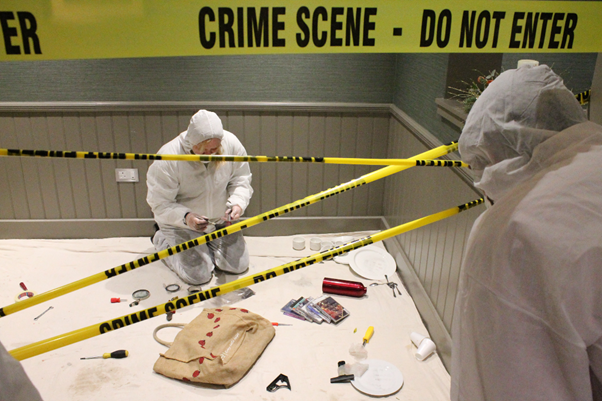
When law enforcement entered a suburban home in Knox County, Tennessee, in November 2016, they walked into one of the most gruesome crime scenes in modern American history. The visual evidence captured by investigators laid bare a meticulously planned and horrifyingly executed double murder committed by Joel Guy Jr. against his parents, Joel Guy Sr. and Lisa Guy. While public fascination often centers on the sensationalism of true crime, the actual photographic and physical evidence tells a chilling story of premeditation, financial desperation, and chilling detachment.
The visual documentation compiled by the Knox County Sheriff's Office and state investigators went far beyond a standard homicide record. The images revealed a house transformed into a makeshift industrial laboratory of horror, where chemicals were used in an attempt to dissolve human remains. Understanding the reality behind these images requires looking past the shock value and examining the actual forensic timeline, the handwritten plot notes left behind, and the cold logic of an unhinged plan.
The Anatomy of a Premeditated Crime
Long before investigators analyzed the physical rooms, Joel Guy Jr. had mapped out his intentions on paper. Detectives recovered a handwritten notebook in Guy's rented vehicle that served as a step-by-step manual for the murders. This notebook detailed how to attack his parents, where to hide the bodies, how to clean up blood, and how he expected to inherit an estate funded by life insurance policies.
The crime scene photos corroborated every line of that notebook. Unlike crimes of passion driven by sudden rage, the physical arrangement of the house showed deliberate staging. Guy had traveled from Louisiana to Tennessee for Thanksgiving, ostensibly to visit his parents, but his true objective was financial annihilation. When his parents announced plans to cut off his long-standing financial support, he enacted his plan.
- The Attack Locations: Evidence indicated the attacks began in separate areas of the home, preventing the victims from mounting a coordinated defense.
- The Disposal Plan: Notebook entries outlined a plan to dissolve the remains in a chemical acid bath inside the home's bathrooms to eliminate evidence.
- The Financial Motive: The killer targeted specific paperwork, identification documents, and financial records to access assets after the deaths.
What the Crime Scene Photos Actually Showed
The photographs taken by forensic technicians documented a scene of profound calculated destruction. Rather than a chaotic struggle confined to a single bedroom, the evidence spanned multiple levels of the residence.
Investigators found Lisa Guy's remains in a second-floor bathroom, where an attempt had been made to submerge parts of her body in a corrosive chemical mixture inside a plastic bin. Joel Guy Sr. was located in a utility room on the lower level. The photographic evidence showed extensive defensive wounds on both victims, proving they fought desperately for their lives against their thirty-two-year-old son.
The sheer volume of blood spatter documented across walls, hallways, and stairwells contradicted any notion that the attack was quick or clean. Forensic analysts used high-resolution imaging to map arterial spray patterns, confirming the sequence of the assaults and establishing that the victims were attacked with knives in various parts of the house before being moved.
Forensic Evidence and the Handwritten Notebook
While the photographs captured the physical horror, the evidentiary slam dunk came from the juxtaposition of the crime scene and Guy's planning documents.
- The Blueprint: The notebook outlined specific supplies to purchase, including muriatic acid, hydrogen peroxide, bleach, and large plastic containers. Receipts found in Guy's possession matched these items.
- Digital Footprints: Computers seized during the investigation revealed internet searches regarding human anatomy, lethal knife wounds, and the time it takes for human remains to decompose under various chemical agents.
- Trace Evidence: Forensic teams recovered Guy's DNA mixed with his father's blood on tools left at the scene, neutralizing any argument of an alternate intruder.
Following the murders, Guy returned to his apartment in Baton Rouge, Louisiana, where police arrested him. His physical appearance at the time of his arrest—featuring visible chemical burns on his hands—tied him directly to the botched attempt to dissolve the bodies in the Tennessee home.
The Trial and Conviction
During the trial in 2021, prosecutors presented the crime scene photos to the jury to demonstrate the chilling level of premeditation. Guy chose not to testify and showed no visible emotion as gruesome exhibits were displayed in the courtroom.
The Tennessee Bureau of Investigation and local prosecutors relied on the physical evidence to dismantle any defense arguments. The jury deliberated for less than two hours before finding Joel Guy Jr. guilty on all counts of first-degree murder, abuse of a corpse, and felony theft. He received two consecutive life sentences without the possibility of parole, ensuring he will spend the rest of his life behind bars.
Frequently Asked Questions
Why did Joel Guy Jr. murder his parents?
The primary motive was financial gain. His parents were planning to retire and cut off his financial support, prompting Guy to target them in hopes of collecting on insurance policies and selling their assets.
How did investigators connect Joel Guy Jr. to the crime scene?
Investigators matched his DNA and fingerprints to items left in the house, recovered receipts for supplies used in the crime, and found a handwritten notebook detailing the entire murder and cleanup plot in his vehicle.
Were the crime scene photos released to the public?
While portions of the evidence, including the notebook and trial exhibits, became part of the public court record, graphic imagery remains strictly managed under judicial rules regarding evidentiary privacy.
What sentence did Joel Guy Jr. receive?
A Tennessee judge sentenced him to two consecutive life sentences plus additional time for abuse of a corpse and theft, eliminating any possibility of early release.



