Introduction
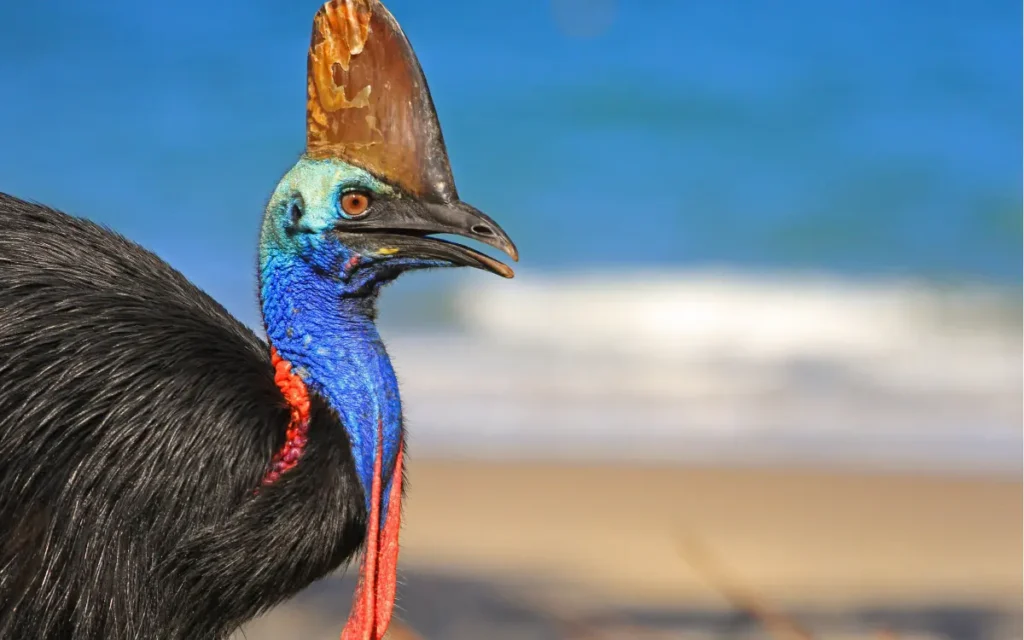
The southern cassowary (Casuarius casuarius) commands attention in the lowland rainforests of New Guinea and northeastern Australia. Standing up to two meters tall and weighing up to sixty kilograms, this flightless bird carries a prehistoric silhouette that reflects its dinosaur lineage. Its most famous and feared feature is the second toe on each foot, which terminates in a dagger-like spike measuring up to twelve centimeters long.
Popular culture labels the cassowary the most dangerous bird alive, largely because of this formidable digit. Yet viewing this feature merely as a weapon ignores its broader biological purpose. The structure functions as a foraging instrument, an ecological tool for forest regeneration, and a blueprint for advanced material science.
Anatomy and Mechanics of the Cassowary Claw
Unlike raptor talons designed to grasp and lift prey from the air, the cassowary foot is built for ground combat and propulsion. The foot possesses three forward-facing toes, with the inner toe bearing the distinctive weapon. This digit isn't a retractable claw like a cat's; it remains fixed and exposed during locomotion.
When threatened, a cassowary doesn't flee dense brush. Instead, it charges forward and delivers powerful, downward-thrusting kicks powered by dense, muscular legs. The strike exploits the biomechanics of the blade-like tip. Because the claw concentrates force onto a minute surface area, the resulting pressure can pierce thick animal hides and human tissue with ease.
- Composition: Like human fingernails and hair, the outer sheath consists of keratin.
- Internal Structure: A rigid bone core provides structural support while absorbing high-impact stress.
- Curvature: The sharp downward curve ensures that the point penetrates instantly upon impact without glancing off targets.
Evolutionary Background and Dinosaur Links
The resemblance between the cassowary and non-avian theropod dinosaurs isn't just aesthetic. Evolutionary biologists study ratites—the group including ostriches, emus, kiwis, and cassowaries—to understand how avian anatomy shifted following the Cretaceous-Paleogene extinction event.
The enlarged second toe mirrors adaptations seen in certain dromaeosaurids, though developed independently through convergent evolution. While predatory dinosaurs used specialized foot morphology to grapple with struggling prey, the cassowary repurposed a similar structural template for defensive territorial strikes. Its heavy, solid bone structure and aggressive stance offer a living window into how large, ground-dwelling theropods may have interacted with their environments.
Ecological Role in Rainforest Seed Dispersal
Beyond self-defense, the cassowary relies on its feet and claws to navigate the complex understory of tropical canopies. These birds are keystone species, often called the gardeners of the rainforest. They consume over a hundred species of fleshy fruits, many bearing tough husks that smaller animals cannot crack or ingest.
As the birds forage on the forest floor, their claws scrape away thick layers of damp leaf litter and debris to uncover fallen fruit or invertebrates. This scratching behavior helps clear patches of soil, exposing organic matter to air and moisture. After ingestion, seeds pass through the digestive tract intact and are deposited miles away in nutrient-dense droppings. Several large-fruited rainforest trees rely entirely on this dispersal cycle to propagate across fragmented habitats.
Biomimetic Insights for Modern Engineering
Materials scientists and biomechanists examine the cassowary claw to solve long-standing engineering problems. Traditional cutting instruments face a trade-off between extreme hardness—which makes a blade sharp but brittle—and toughness, which resists fracturing under heavy loads.
The keratin-and-bone composition of the cassowary claw achieves a natural gradient of mechanical properties. The very tip maintains high hardness for penetration, while the wider base offers high fracture toughness. Researchers studying avian biomechanics, such as structural engineers at the University of Queensland, use these natural blueprints to design durable surgical scalpels, impact-resistant industrial blades, and protective composite gear that withstands high-velocity shock without shattering.
Human Safety and Coexistence
Interactions between humans and cassowaries typically occur in rural or semi-urban fringes where rainforest borders residential development. Most defensive charges happen when birds lose their natural fear of humans due to artificial feeding, or when a territorial male protects chicks or a prime food tree.
Avoiding injury requires understanding simple behavioral boundaries:
- Never feed cassowaries under any circumstances.
- Maintain a distance of at least fifty meters if you encounter one in the wild.
- Back away slowly behind a solid barrier, such as a vehicle or large tree, if the bird displays aggressive postures like fluffing feathers or hissing.
Fatalities remain extremely rare, with most historical injuries resulting from accidental contact or provoked defensive strikes rather than unprovoked predation.
Frequently Asked Questions
Can a cassowary really kill a human?
Yes. While attacks are uncommon, the combination of massive body weight, powerful legs, and a twelve-centimeter blade can sever major blood vessels or cause fatal trauma if an individual is knocked to the ground.
Do cassowaries use their claws for hunting?
No. Cassowaries are primarily frugivorous herbivores. They use their claws exclusively for self-defense, territorial displays, and clearing leaf litter during foraging.
Are cassowary claws retractable?
No. Their claws remain fixed and exposed at all times, wearing down naturally against rocks, soil, and hard ground as the bird walks through its territory.
Why are cassowaries considered keystone species?
They consume large fruits whole and distribute undamaged seeds across wide territories through their droppings, making them indispensable for maintaining rainforest plant diversity.



