When you look at a globe, the boundaries between massive bodies of water blur into shades of blue. Yet the line separating the Caribbean Sea and the Atlantic Ocean is far more than just a cartographic convention. The Caribbean Sea is a semi-enclosed body of water framed by island chains and continental coastlines, while the Atlantic Ocean is a vast, open expanse that circles the globe.
You'll find that these two water bodies differ fundamentally in depth, temperature, ecological structure, and weather generation. The Caribbean sits physically inside the Atlantic basin, functioning as a sheltered marginal sea rather than a separate oceanic entity. Understanding how they interact reveals a lot about global marine currents and regional weather systems.
Defining the Core Categories
People often swap the terms sea and ocean without thinking, but oceanographers rely on specific criteria. An ocean is a primary, planetary-scale basin containing saltwater that covers the majority of the Earth's surface. Oceans aren't entirely bounded by land and operate as massive, autonomous water systems driven by global thermohaline circulation and major wind bands.
A sea, by contrast, is a smaller subdivision of an ocean. Seas are usually partially enclosed by landmasses, peninsulas, or island arcs. Because of this geographic containment, seas develop distinct local characteristics. They often feature higher evaporation rates, shallower average depths, and localized marine ecosystems that don't mirror the open ocean.
The Caribbean Sea follows this rulebook precisely. It occupies an independent tectonic plate—the Caribbean Plate—and is bound on the north and east by the Greater and Lesser Antilles, and on the south and west by Central and South America. It doesn't float free; it relies on the greater Atlantic to feed its waters.
Geographic Boundaries and Scale
Scale is the most obvious differentiator when you compare the two environments. The Atlantic Ocean covers roughly 106.4 million square kilometers, making it the second-largest ocean on Earth. It stretches uninterrupted from the icy waters near the Arctic down to the Southern Ocean, separating the Americas from Europe and Africa.
The Caribbean Sea spans roughly 2.75 million square kilometers. It's a fraction of the Atlantic's size, representing just a tiny pocket of the broader marine neighborhood.
Physical boundaries dictate how water moves between them. The Atlantic has wide-open frontiers. The Caribbean, however, is guarded by island chains. Water enters the Caribbean primarily through deep trenches and passages between the Lesser Antilles, such as the Anegada and Dominica Passages, before pooling in its deep basins like the Cayman Trough, which drops to over 7,500 meters.
Water Dynamics, Temperature, and Salinity
Because the Caribbean sits entirely within the tropics, solar radiation warms its surface intensely year-round. Average surface temperatures hover comfortably between 25°C and 28°C. The island arcs block out deep, cold vertical mixing from the open Atlantic, keeping surface waters warm, clear, and turquoise.
The Atlantic Ocean varies wildly. In its northern reaches near Greenland or its southern expanses near Antarctica, water temperatures drop close to freezing. Even in its temperate zones, the open Atlantic experiences heavy wind-driven churning, deep mixing, and strong upwellings that bring nutrient-dense, cold water to the surface.
Salinity levels also tell a different story. The Caribbean receives massive freshwater runoff from major continental rivers like the Orinoco and the Magdalena. This influx lowers surface salinity in certain areas compared to the open, saltier mid-Atlantic gyres where evaporation outpaces precipitation.
The Current Connection and the Gulf Stream
These two bodies don't exist in isolation; they are part of a continuous conveyor belt. The North Equatorial Current pushes water westward across the Atlantic, driving it straight into the Caribbean basin.
Once inside, this water banks against Central America and forces its way northward through the Yucatán Channel into the Gulf of Mexico. It loops around, exits between Cuba and the Florida Keys, and emerges as the Gulf Stream. This powerful current accelerates northeast across the Atlantic, carrying tropical heat all the way toward Western Europe. Without the Caribbean acting as a collection basin and thermal engine, the Gulf Stream would look entirely different.
Ecological and Climatic Contrasts
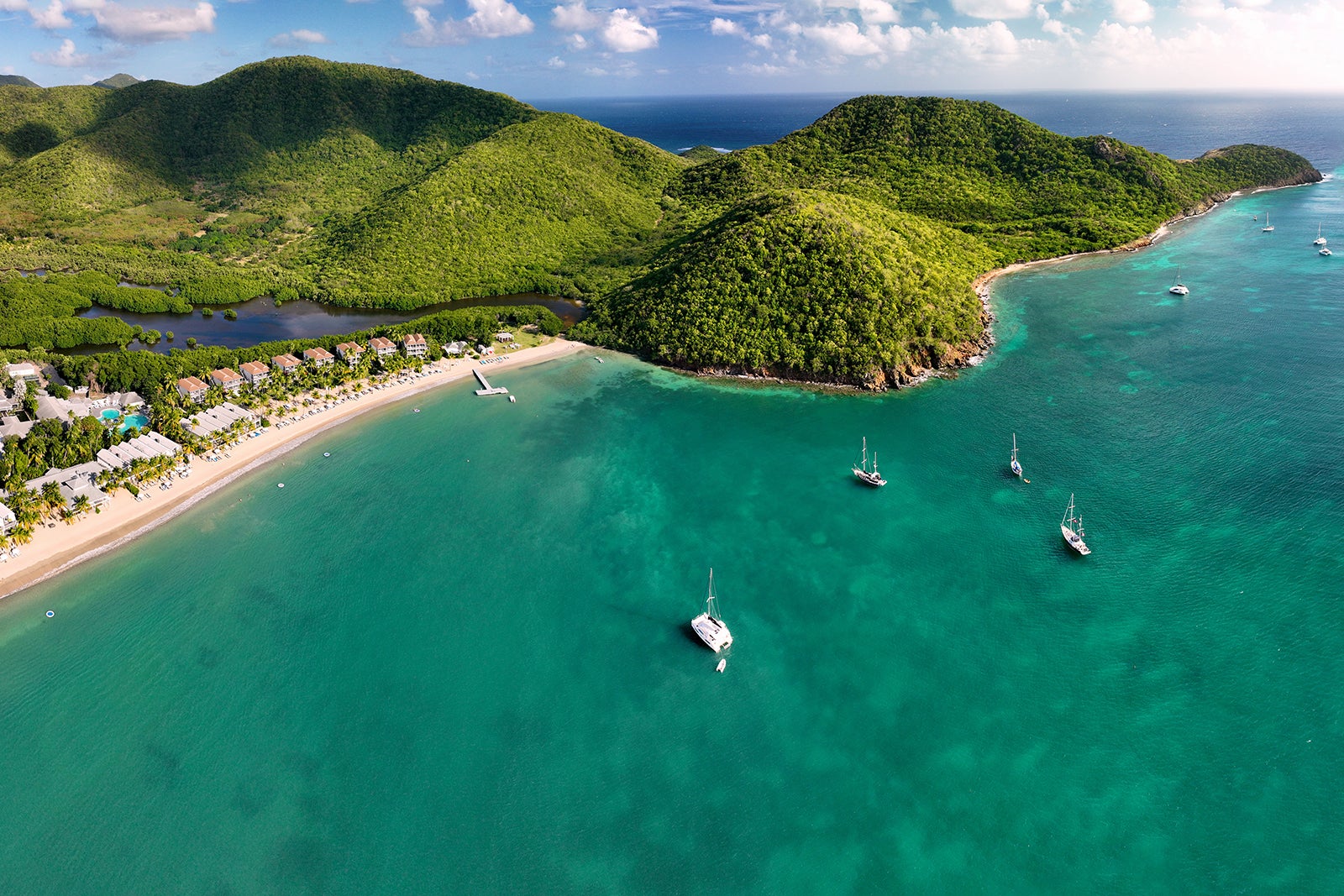
The sheltered, warm environment of the Caribbean fosters high marine biodiversity in shallow waters. Coral reef systems, mangrove forests, and seagrass beds thrive here because they aren't battered by the massive, raw swells of the open ocean.
The open Atlantic hosts different biological communities. Its pelagic zones support migratory species like bluefin tuna, sea turtles, and various cetaceans that travel thousands of miles across open water.
Weather generation is another major point of divergence. While the Caribbean experiences tropical storms, the open Atlantic is the actual birthplace of major hurricanes. Warm easterly waves rolling off the coast of Africa feed on the open Atlantic's vast surface heat, organizing into destructive hurricanes that eventually track westward to strike the Caribbean islands and North America.
Common Misconceptions
Many travelers assume you can spot a hard, visible line where the Caribbean meets the Atlantic. Social media often circulates videos claiming to show two distinct water colors refusing to mix at an ocean boundary.
In reality, water mixing is a continuous, fluid process driven by density, temperature, and currents. While water properties change gradually as you move from a sheltered reef into deep ocean swells, you won't find a permanent wall of separation.
Another myth treats the Caribbean as an independent ocean. Because it's so large and famous for its vacation spots, people forget it's a marginal sea. Calling it an ocean ignores the vital tectonic and geographic framework provided by the Atlantic basin.
Frequently Asked Questions
Is the Caribbean Sea safer to swim in than the Atlantic Ocean?
Generally, yes. The Caribbean features calmer waters, protected bays, and extensive barrier reefs that blunt heavy ocean swells. The open Atlantic features stronger rip currents, higher surf, and unpredictable undertows.
Can you sail directly from the Atlantic into the Caribbean?
Yes, mariners cross regularly through deep gaps in the island chains like the Windward Passage or the Anegada Passage. These crossings require careful navigation because local currents and wind funnels between islands can create choppy seas.
Do hurricanes form inside the Caribbean Sea?
Most major hurricanes form out in the open tropical Atlantic near Cape Verde, though some intense storms do develop locally inside the Caribbean basin when sea surface temperatures spike during late summer.
How deep does the Caribbean get compared to the Atlantic?
The Caribbean is quite deep in places, with the Cayman Trench reaching over 7,500 meters. However, the Atlantic holds even deeper extremes, such as the Puerto Rico Trench, which plunges past 8,300 meters.



