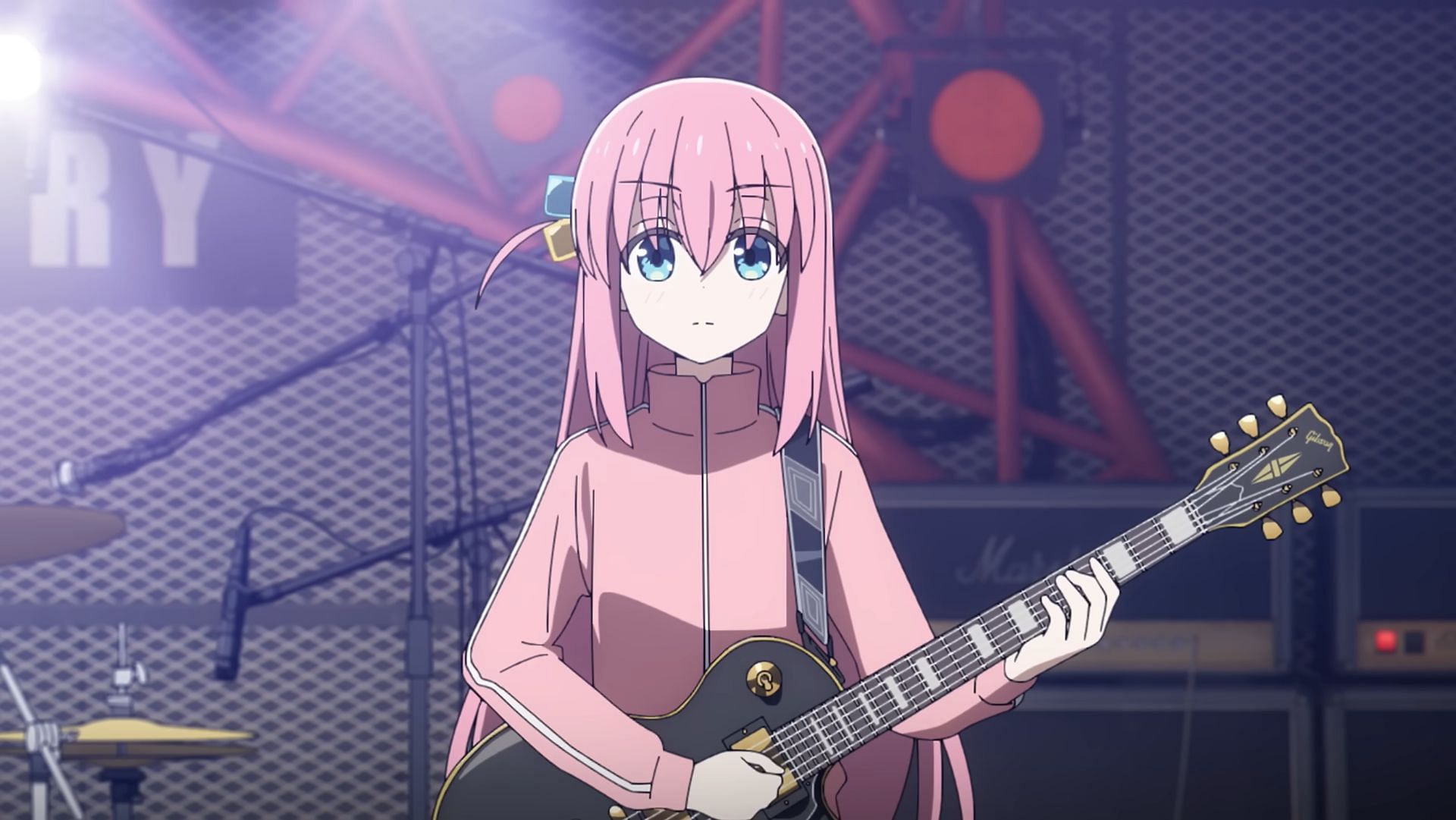
Hitori Gotō doesn't just play guitar; she uses it as a soundproof armor against a world that overwhelms her. Bocchi the Rock! upends standard band tropes by anchoring its narrative in genuine, messy social anxiety rather than polished rockstar dreams. This psychological realism turned an unassuming 2022 adaptation by CloverWorks into a defining cultural touchstone for viewers who see their own quiet struggles mirrored on screen.
Instead of treating mental health struggles as a minor quirk to be instantly cured by the power of friendship, the series treats anxiety as a chronic, non-linear reality. Hitori doesn't magically transform into a social butterfly after her first live performance. She still panics, hides in trash cans, and dissolves into pixelated puddles of despair. That unyielding honesty is precisely why the show resonated so deeply with an anxious generation navigating digital isolation.
The Evolution of the Reluctant Rocker
The source material, a four-panel manga by Aki Hamazaki serialized in Houbunsha's Manga Time Kirara, relied on compressed comedic timing to land its jokes. Translating that pacing to a 12-episode anime required a distinct visual strategy. Director Keiichirō Saitō leaned heavily into mixed-media animation, shifting abruptly from polished character designs to chaotic sketches, stop-motion doll segments, and live-action sequences.
This stylistic volatility reflects how a racing mind distorts everyday reality. When Hitori faces an ordinary social interaction, the frame warps, colors desaturate, and mundane sounds magnify into deafening noise. It’s an effective translation of panic into a kinetic medium, moving past generic shonen tropes to capture the specific paralysis of modern youth.
Dissecting Kessoku Band's Dysfunctional Chemistry
Standard music anime follow a predictable trajectory: prodigious talents unite, overcome minor friction, and conquer the charts. Bocchi the Rock! subverts this by assembling a band where every member is weighed down by their own distinct psychological baggage.
- Nijika Ijichi: The driven drummer whose relentless cheerfulness masks the heavy administrative burden of keeping the live house running and her bandmates focused.
- Ryō Yamada: The deadpan bassist who relies on eccentric independence and social detachment, cultivating an aloof persona that hides a deep fear of genuine conformity.
- Ikuyo Kita: The popular vocalist who projects an enviable social ease, though her sunny exterior is fueled by an exhausting impostor syndrome and performance pressure.
When these four personalities collide in studio rehearsals or narrow backstage rooms, the tension doesn't stem from rival bands or contractual disputes. It arises from the sheer awkwardness of human vulnerability. Tuning an instrument or handing out flyers becomes an uphill battle against mutual miscommunication.
Why Realism Resonates More Than Perfection
Recent anime trends often lean toward escapist fantasies where protagonists conquer every obstacle with effortless grace. By contrast, Hitori's victories are microscopic. Scoring a part-time job, making eye contact for more than three seconds, or managing to speak without her voice cracking are treated as monumental achievements.
This granular focus on small steps mirrors modern discussions surrounding neurodivergence and generalized anxiety disorder. Fans didn't just watch the series; they adopted its visual lexicon. Memes featuring Hitori's melting face flooded online spaces because they provided a shared language for exhaustion, overthinking, and introverted isolation.
Frequently Asked Questions
Is Bocchi the Rock! based on a true story?
No, the series is a fictional work created by manga artist Aki Hamazaki. However, the creator has noted that many of the awkward social encounters and performance nerves draw loosely from universal experiences with stage fright and social isolation.
Will there be a second season of Bocchi the Rock!?
While CloverWorks and the production committee have released theatrical compilation films and continuation announcements following the anime's initial broadcast, specific premiere timelines for a full second television season depend on studio schedules and source material availability.
How does the anime portray panic attacks accurately?
The series uses mixed media—including stop-motion animation, live-action footage, and sudden shifts in art style—to externalize internal chaos. This stylistic choice visually represents sensory overload and racing thoughts during high-stress social moments.
Where can I read the original manga?
The manga is published in Japan by Houbunsha and is available in English translation through Yen Press, offering deeper context into Hitori's internal monologues and secondary character arcs.



