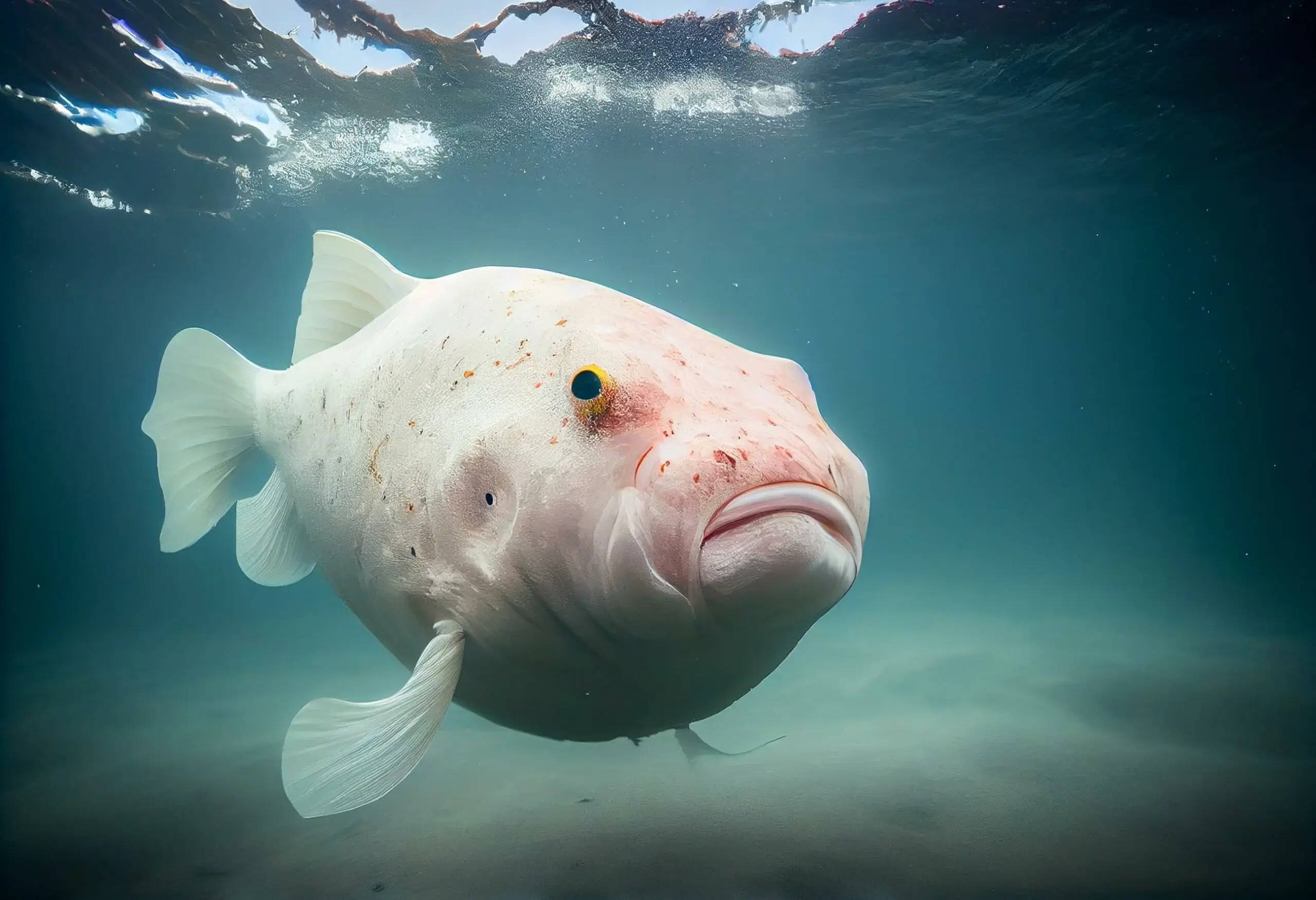
The blobfish (Psychrolutes marcidus) often tops lists of unusual marine animals, but almost everything popular culture thinks it knows about this creature comes from a misunderstanding of deep-sea biology. When hauled to the surface, the blobfish collapses into a gelatinous, misshapen pink mass. However, in its natural deep-sea habitat, it looks entirely different, maintaining a structured fish body that suits crushing underwater pressure.
Living between 2,000 and 4,000 feet beneath the surface off the coasts of mainland Australia and Tasmania, the blobfish endures hydrostatic pressures dozens of times greater than at sea level. Understanding this animal requires looking past its famous museum-specimen appearance and examining how it thrives in the bathypelagic zone.
Natural Appearance Underwater
At depths where sunlight fails to penetrate, the blobfish doesn't need a rigid, muscular skeleton to swim against currents. Instead, its body consists primarily of a gelatinous mass with a density slightly less than water. This biological adaptation allows the fish to float effortlessly just above the ocean floor without expending precious energy.
When researchers observe blobfish in their natural environment using remotely operated vehicles, the animal features a distinct, tadpole-like shape with a prominent nose-like protrusion, loose skin, and large, dark eyes adapted to capture faint bioluminescent flashes. It lacks the deflated, sad-faced look that made it an internet meme; instead, it appears as a typical, albeit soft-bodied, bottom-dwelling marine fish.
Biological Adaptations for the Deep Sea
The deep ocean presents extreme challenges for marine life, including near-freezing temperatures, absolute darkness, and immense pressure. The blobfish handles these conditions through specific evolutionary traits:
- Lack of Swim Bladders: Most fish use a gas-filled swim bladder to control buoyancy, but high pressures make gas bladders collapse. The blobfish solved this by evolving gelatinous flesh that provides neutral buoyancy naturally.
- Minimal Muscle Mass: Because prey is scarce in the deep sea, the blobfish conserves energy by having very few fast-twitch muscles. It doesn't actively chase meals; it sits patiently and waits for passing food.
- Skeletal Structure: Its bones are significantly softened and underdeveloped compared to shallow-water fish, relying on water pressure and its gelatinous matrix to maintain its shape while submerged.
Diet and Hunting Strategy
The blobfish is an ambush predator. It anchors itself near the ocean floor and waits for drifting or swimming prey to wander within striking distance. Its diet consists primarily of sea urchins, molluscans, crustaceans, and other small benthic organisms that share its deep-sea habitat.
Because metabolic rates in the deep sea are remarkably slow, the blobfish can survive long periods between meals. It expends almost zero energy while hunting, conserving every calorie in an environment where food is rare.
Reproduction and Life Cycle
Very little is documented about the reproduction of Psychrolutes marcidus due to the extreme difficulty of studying live specimens in their natural habitat. Marine biologists have observed that female blobfish lay thousands of small, pink eggs on the ocean floor, often tucked beneath rocks or ledges.
Unlike many shallow-water fish that abandon their eggs, female blobfish have been observed brooding their nests, sitting atop or near the egg masses to protect them from scavengers until they hatch. This parental investment increases the survival rate of the fry in a harsh environment.
The Myth of the "Ugliest Animal"
In 2013, the Ugly Animal Preservation Society held a popular vote to name an official mascot, and the blobfish "won" the title based on photographs of specimens that had suffered severe cellular and tissue damage from explosive decompression during capture.
When a deep-sea fish is dragged rapidly to the surface, the sudden drop from crushing pressure to atmospheric pressure causes gases to expand, tissues to rupture, and cells to collapse. The resulting gelatinous blob is an artifact of trauma, not the living animal's normal appearance. This widespread misconception has led to decades of public amusement at the expense of an ordinary, highly specialized creature doing what it evolved to do.
Frequently Asked Questions
Why does the blobfish look different out of water?
The blobfish relies on the immense hydrostatic pressure of the deep ocean to keep its body compact and structured. When brought to the surface, the sudden loss of pressure causes its gelatinous tissues to expand and distort, creating the drooping, misshapen appearance seen in photographs.
Can humans keep a blobfish in an aquarium?
No. The blobfish cannot survive at the surface or in standard aquarium conditions. The rapid change in pressure and temperature is fatal, and reproducing the dark, high-pressure, cold environment of the deep ocean in captivity is currently impossible.
How deep do blobfish live?
Blobfish inhabit the bathypelagic zone, typically ranging from 2,000 to 4,000 feet (600 to 1,200 meters) below the ocean surface.
What are the blobfish's natural predators?
Due to the extreme depth of its habitat, the blobfish faces very few natural predators, though certain deep-diving marine mammals and large deep-sea sharks occasionally encounter them. Human bottom-trawling fisheries pose the most significant threat to local populations.