The babylon river song echoes through millennia, rooted in the twin channels of the Tigris and Euphrates that shaped early human civilization. These rivers weren't just geographic features; they served as the literal cradle where writing, law codes, and urban centers first took root over five thousand years ago.
When we look back at the ancient world, the valley between these rivers—known to historians as Mesopotamia—represented an engine of human innovation. Today, the enduring cultural footprint of this region persists through mythology, archaeological discoveries, and historical accounts of empires that rose and fell along the banks of the Euphrates.
Geography and the Mesopotamia Cradle
The physical foundation of ancient Babylon relied completely on the seasonal flooding of the Tigris and Euphrates rivers. Originating in the mountains of eastern Turkey, these waterways carried nutrient-rich silt down into the arid plains of modern-day Iraq, creating a fertile delta capable of supporting high-yield agriculture.
Ancient engineers didn't just accept natural flood cycles; they mastered them. Communities built complex networks of canals, dikes, and reservoirs to distribute water across dry fields. This large-scale water management required centralized authority, which accelerated the transition from small farming villages to organized city-states like Uruk, Ur, and eventually Babylon.
- The Euphrates: Spanning roughly 2,800 kilometers, it served as the primary trade and transport artery for western Mesopotamia.
- The Tigris: Faster-flowing and prone to violent floods, it defined the eastern boundary of the Mesopotamian heartland.
- The Shatt al-Arab: The unified confluence where both rivers meet before emptying into the Persian Gulf.
The Rise of Babylon and Its Iconic Engineering
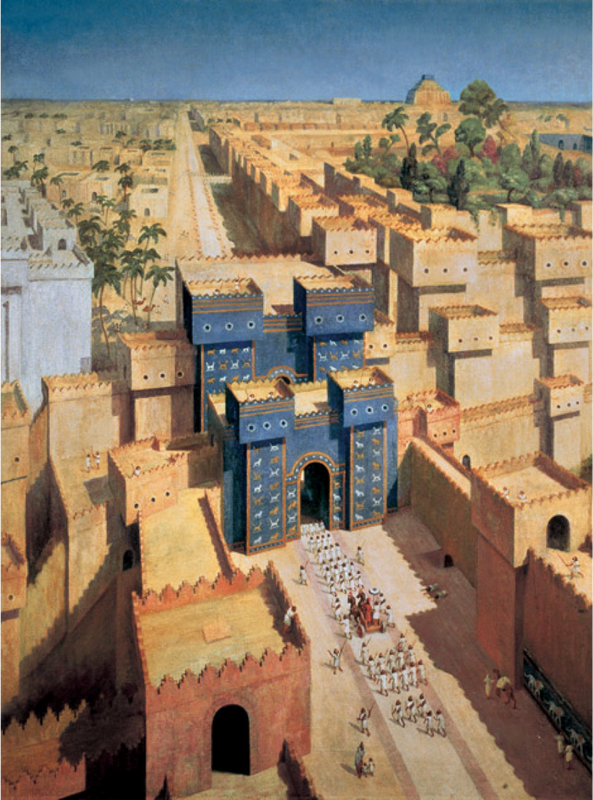
Positioned directly on the banks of the Euphrates, the city of Babylon grew from a modest administrative outpost into the capital of a massive empire. Its architecture and urban design stunned contemporary travelers, most notably through structures like the Ishtar Gate and the legendary Hanging Gardens.
While archaeological debates continue regarding the exact physical location of the Hanging Gardens, historical records indicate they relied on sophisticated hydraulic Archimedes screws or chained bucket pumps. Water was lifted continuously from the Euphrates riverbed to irrigate elevated terraces filled with exotic flora.
Governance evolved alongside engineering. King Hammurabi unified much of the region under a centralized legal framework. Inscribed on stone stelae, Hammurabi's Code regulated daily life, commerce, and punishments based on an eye-for-an-eye philosophy, reflecting a society deeply concerned with order, property, and river-dependent agriculture.
Mythology, Hymns, and Spiritual Resonance
Water held immense sacred value for ancient Mesopotamians. In foundational texts like the Enuma Elish, primordial waters formed the raw material out of which the cosmos was carved by deities such as Marduk. Rivers were viewed as living entities gifted by the gods to sustain human life.
Sumerian and Babylonian scribes composed temple hymns praising the rivers for bringing abundance, beer, grain, and livestock. These compositions functioned as early forms of a babylon river song, celebrating the life-giving currents that kept famine at bay. Later traditions, including biblical accounts of exile, imbued the riverbanks with deep emotional and cultural yearning, cementing the imagery of Babylonian waters in global collective memory.
Chronology of Empires Along the Rivers
Control over the Tigris-Euphrates basin shifted across distinct historical epochs, each leaving structural and cultural layers:
- Sumerian Period (c. 4000–2000 BCE): Invention of cuneiform script on clay tablets and the development of early irrigation wheels.
- Akkadian Empire (c. 2334–2154 BCE): Establishment of the world's first multi-ethnic empire, unified largely to control trade along the Euphrates.
- Neo-Babylonian Empire (626–539 BCE): The golden age of Nebuchadnezzar II, featuring monumental ziggurats and defensive fortifications.
- Persian and Hellenistic Conquests (539 BCE onward): The fall of Babylon to Cyrus the Great, followed later by Alexander the Heart of Empire integration.
Modern Hydrology and Geopolitical Realities
The historical landscape of the Tigris and Euphrates looks radically different today. Large-scale dam construction projects across Turkey, Syria, and Iraq—such as the Southeastern Anatolian Project—have fundamentally altered downstream water volume.
These modern interventions have transformed the environment. Key wetland ecosystems, like the Mesopotamian Marshes in southern Iraq, suffered severe drying periods in the late 20th century, disrupting indigenous Marsh Arab communities that relied on traditional reed-harvesting and fishing lifestyles. Negotiating fair water allocation remains a critical diplomatic challenge for governments across the basin.
The legacy of the region endures not just in museums, but in ongoing efforts to balance ecological preservation with modern hydroelectric needs. The narrative of the rivers remains a powerful reminder of how human societies depend entirely on the health of their natural waterways.
Frequently Asked Questions
What rivers made up the ancient Babylonian water system?
The primary rivers were the Euphrates and the Tigris. Babylon itself was built directly along the banks of the Euphrates River, which provided water for drinking, crop irrigation, and trade.
Why were the Tigris and Euphrates important to early civilizations?
They provided fertile silt through regular flooding, enabling surplus agriculture. This agricultural surplus allowed societies to build cities, develop writing systems like cuneiform, and establish complex legal codes.
Are the Hanging Gardens of Babylon archaeologically verified?
While ancient writers documented the gardens in detail, physical archaeological proof at the site of Babylon in Iraq remains disputed. Some scholars suggest the gardens may have been located further north in Nineveh instead.
How has the flow of the rivers changed in modern times?
Dozens of large dams built upstream in Turkey, Syria, and Iraq have significantly reduced water flow into the lower reaches of the rivers, causing downstream ecological challenges and shrinking historical marshlands. You can read more about global river monitoring through organizations like UNESCO.



