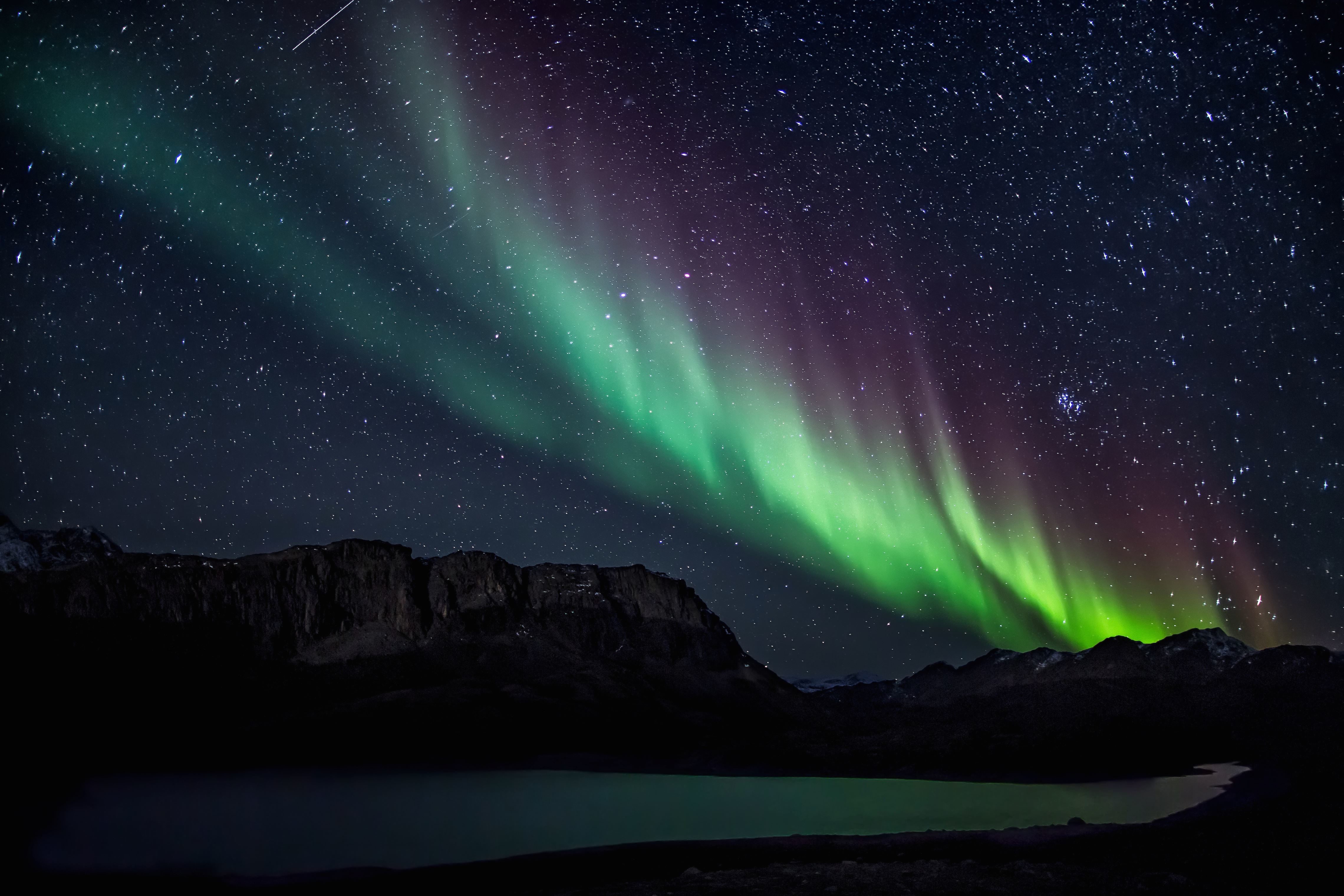
Aurora formation is a planetary light show driven by the Sun, Earth's invisible magnetic field, and the chemistry of our upper atmosphere. When energetic particles from space crash into gas molecules high above the ground, they release photons of visible light. We see this interaction as glowing curtains of green, red, and purple rippling across the night sky.
Understanding this process requires tracking the journey of solar plasma from 93 million miles away down to an altitude of 80 kilometers. It is not just a pretty atmospheric trick; it's a direct window into the complex mechanics of space weather that protects and illuminates our planet.
The Solar Engine and the Solar Wind
The entire sequence begins on the Sun. Nuclear fusion deep within our star generates extreme heat and pressure, constantly driving a stream of charged particles—mostly electrons and protons—away from the solar corona. This outward flow is the solar wind, and it bathes the entire solar system in plasma.
While the solar wind flows constantly, its intensity shifts dramatically based on the eleven-year solar cycle. When the Sun's magnetic field twists and tangles, it unleashes severe space weather events: Additional reporting by Popular Science delves into related perspectives on the subject.
- Solar Flares: Sudden flashes of high-energy radiation that travel across space at the speed of light, reaching Earth in about eight minutes.
- Coronal Mass Ejections (CMEs): Gigantic bubbles of magnetized plasma ejected from the solar surface. If launched toward Earth, a CME takes between one and three days to cross the void.
When a high-speed solar wind stream or a CME slams into Earth's immediate space environment, it compresses our planetary defenses and sets the stage for a geomagnetic storm.
The Magnetosphere and Magnetic Reconnection
If Earth lacked a magnetic field, the solar wind would strip away our atmosphere over millions of years, much like what happened to Mars. Our magnetosphere acts as a barrier, deflecting the vast majority of incoming solar plasma around the planet.
However, this barrier has a flaw. The solar wind carries its own embedded magnetic field, known as the interplanetary magnetic field (IMF). When this field points southward, it collides directly with Earth's northward magnetic field.
This clash triggers magnetic reconnection, a process where opposing magnetic field lines snap, break, and reconnect. This connection opens temporary gateways in the magnetosphere, allowing solar particles to bypass the shield. Once inside, these charged particles are captured by Earth's magnetic field lines and funneled straight toward the polar regions.
Atmospheric Collisions and Color Chemistry
The particles descend along magnetic field lines, gaining speed until they slam into the upper atmosphere. This interaction takes place primarily in the thermosphere, between 80 and 400 kilometers above the surface.
When a high-speed electron collides with an atmospheric gas molecule, it transfers kinetic energy, exciting the molecule to a higher energy state. Because this excited state is unstable, the molecule quickly sheds the extra energy by emitting a particle of light.
The color of that light depends entirely on the gas involved and the altitude of the collision:
- Green Oxygen: The most common auroral hue occurs when electrons collide with oxygen molecules between 100 and 240 kilometers high.
- Red Oxygen: At extreme altitudes above 300 kilometers, rare collisions with atomic oxygen produce a deep, faint red glow.
- Blue and Purple Nitrogen: Nitrogen molecules ionized by high-energy impacts emit blue and purple light, often appearing at the lower fringes of the display during intense geomagnetic storms.
The fluid, dancing curtains we observe—known as arcs, rays, and coronas—are visual proof of fluctuating magnetic pressure. As field lines twist and snap back into place, they accelerate particles in rapid waves, making the lights ripple across the night sky.
Geographic Range and Viewing Realities
Aurora displays are not restricted to a single narrow band; they follow the auroral ovals centered around Earth's magnetic poles. Under normal conditions, skywatchers in northern Scandinavia, Iceland, northern Canada, and Alaska see them regularly.
During intense geomagnetic activity, the auroral oval expands toward lower latitudes. For example, severe storms can push the visible boundary south into parts of the northern United States, the UK, and central Europe.
Capturing or viewing these lights requires escaping light pollution, waiting for clear winter nights, and monitoring real-time Kp index forecasts provided by organizations like the NOAA Space Weather Prediction Center.
Frequently Asked Questions
Can you hear the aurora making a sound?
For centuries, travelers reported hearing swishing or crackling sounds during intense auroral displays. Modern acoustic research confirms that under very specific conditions, electrostatic discharges close to the ground can occur during geomagnetic storms, though the actual light show happens too high in the vacuum of the thermosphere to produce audible sound waves at ground level.
Why are some auroras steady while others move fast?
Steady, low-activity auroras are typically driven by a smooth, continuous solar wind. Fast-moving, dynamic displays happen when Earth's magnetic tail undergoes substorms—sudden releases of pent-up magnetic energy that fling particles downward at much higher speeds.
Can auroras happen on other planets?
Yes. Any planet with a strong magnetic field and an atmosphere can host auroras. NASA's Juno mission has captured massive ultraviolet auroras swirling around Jupiter's poles, driven by both the solar wind and volcanic material ejected from its moon Io.
Do auroras pose any danger to people on the ground?
No. The atmosphere blocks all harmful radiation long before it reaches the surface. However, severe geomagnetic storms driven by the same solar particles can disrupt satellite communications, GPS signals, and high-voltage power grids.



