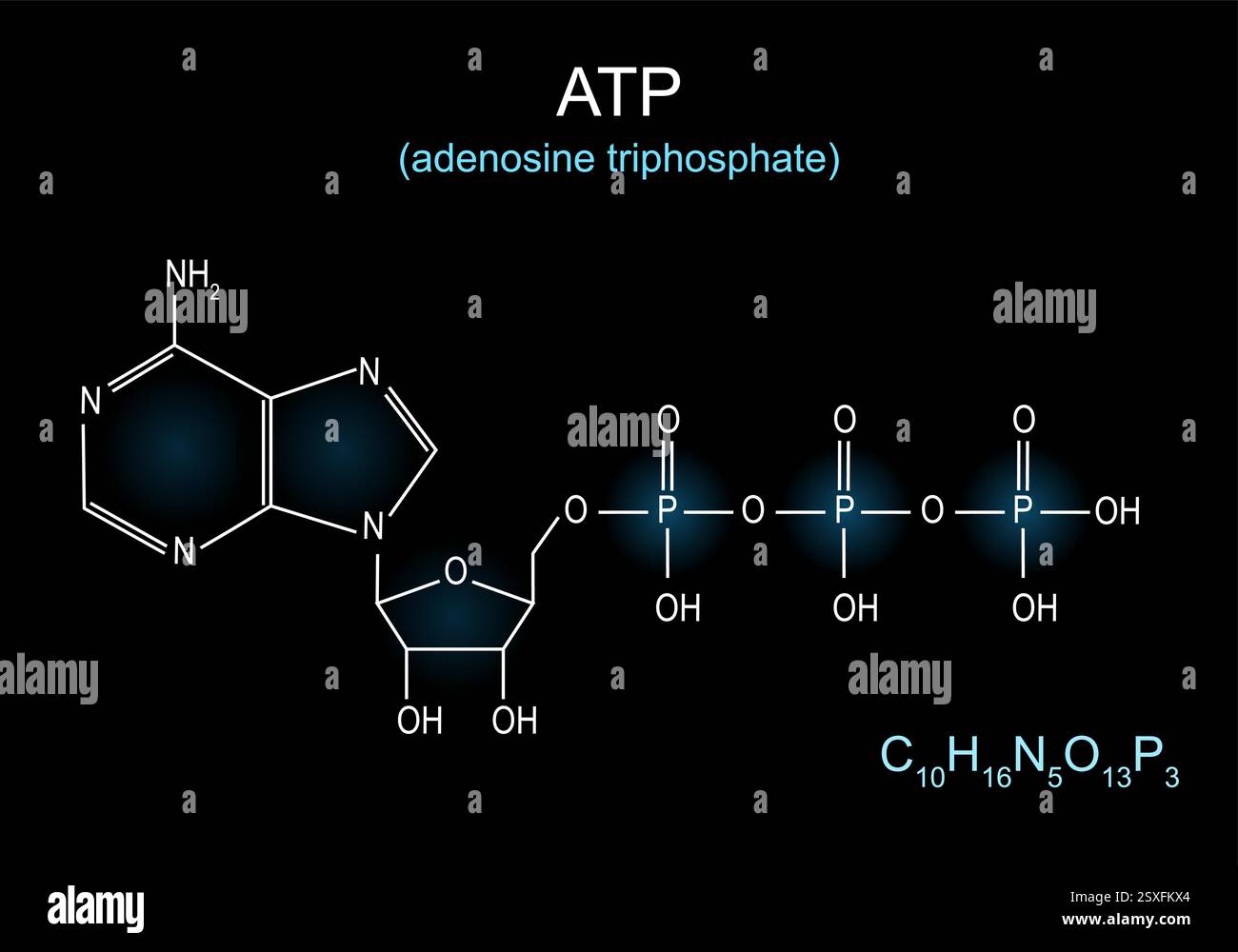
Adenosine triphosphate, universally known as ATP, is the primary energy currency of all living cells. Without this molecule, biological systems can't maintain homeostasis, power muscle contraction, or transmit nerve signals. It acts as an immediate chemical battery, storing energy from nutrient breakdown and releasing it precisely where cellular machinery needs it.
At its core, ATP is a nucleotide composed of three distinct parts: a nitrogenous base called adenine, a five-carbon sugar named ribose, and a chain of three phosphate groups bonded sequentially. The true secret to its utility lies in those phosphate groups. Because phosphate groups carry negative charges, forcing them together creates chemical instability. The bonds holding the terminal phosphates together store a high amount of potential energy. When a cell needs power, it breaks these bonds through hydrolysis, converting ATP into adenosine diphosphate and releasing usable energy.
The Molecular Mechanics of ATP Hydrolysis
Energy release happens when an enzyme splits the terminal phosphate group off ATP. This reaction yields adenosine diphosphate, an inorganic phosphate ion, and roughly 30.5 kilojoules of energy per mole under standard conditions.
Cells don't let this energy go to waste as heat. Instead, they couple ATP hydrolysis with energy-requiring reactions. For example, membrane transport proteins use the energy released from ATP to pump ions against concentration gradients. Similarly, motor proteins like kinesin physically walk along cellular cytoskeletal tracks, dragging vesicles by burning through ATP molecules one step at a time.
You can think of ATP as cash in your wallet. Nutrients like glucose represent long-term investments or real estate—valuable, but you can't use a house to buy a cup of coffee. ATP is small, portable, and accepted everywhere in the cell.
How Cells Synthesize ATP
Because cells consume millions of ATP molecules every second, they need continuous replenishment. The body generates ATP through three primary metabolic pathways, primarily housed within cellular structures called mitochondria.
- Glycolysis: This initial step occurs in the cell cytoplasm without oxygen. It splits one glucose molecule into two pyruvate molecules, netting a modest two ATP.
- The Citric Acid Cycle: Also known as the Krebs cycle, this pathway processes pyruvate inside the mitochondrial matrix, stripping away electrons to load up carrier molecules like NADH and FADH2.
- Oxidative Phosphorylation: The most productive phase. Electrons flow down an electron transport chain embedded in the inner mitochondrial membrane, driving protons across the membrane. This creates a chemical gradient that spins an enzyme turbine called ATP synthase, yielding up to thirty-two additional ATP per glucose molecule.
Plants run a parallel system called photosynthesis, capturing sunlight via chlorophyll to drive photophosphorylation, which produces the ATP needed to fix carbon dioxide into sugars.
Common Misconceptions About Cellular Energy
Many people misunderstand how energy storage works in the human body. It's common to assume that fat or glycogen is what cells burn directly for every immediate task. In reality, fat and carbohydrates are fuel reserves. They can't power a protein pump or a muscle twitch directly until their chemical bonds are converted into ATP.
Another frequent mix-up involves confusing ATP with ADP. Think of ATP as a fully charged rechargeable battery and ADP as the depleted version. The cell constantly recycles ADP back into ATP by slapping a new phosphate group on it using the energy extracted from your last meal.
Frequently Asked Questions
What happens if a cell runs out of ATP?
When ATP production stops—such as during cellular suffocation or severe poisoning—ion pumps fail immediately. Sodium floods the cell, water follows, and the cell swells and ruptures, leading to cell death.
How much ATP does a human body use daily?
An average adult turns over roughly their own body weight in ATP every single day. During intense exercise, ATP consumption spikes dramatically, requiring rapid acceleration of mitochondrial respiration.
Can you take ATP supplements to boost energy?
Oral ATP supplements have limited bioavailability because digestive enzymes break down the molecule before it reaches tissues intact. Instead, the body relies on eating balanced macronutrients to fuel its own internal synthesis.
Why is ATP used instead of glucose directly?
Glucose molecules are too bulky and chemically reactive to use safely as universal currency inside delicate protein machinery. ATP provides a standardized, tightly regulated packet of energy that fits active sites across thousands of different enzymes.



