Every contraction of a muscle fiber, every electrical impulse firing across a neuron, and every chemical reaction building new proteins inside your body relies on a single molecule: adenosine triphosphate. Often called the energy currency of the cell, ATP in biology acts as the immediate financial capital that living systems spend to stay alive. Without a continuous supply of this molecule, cellular processes grind to a halt within seconds.
Cells can't use the raw chemical energy locked inside a glucose molecule directly. Think of glucose as a large gold bar—valuable, but too cumbersome to buy a cup of coffee with. ATP is the loose change. It's portable, instantly recognizable by cellular machinery, and packed with precisely enough energy to drive individual chemical reactions without wasting resources or overheating the tissue.
Molecular Structure of ATP
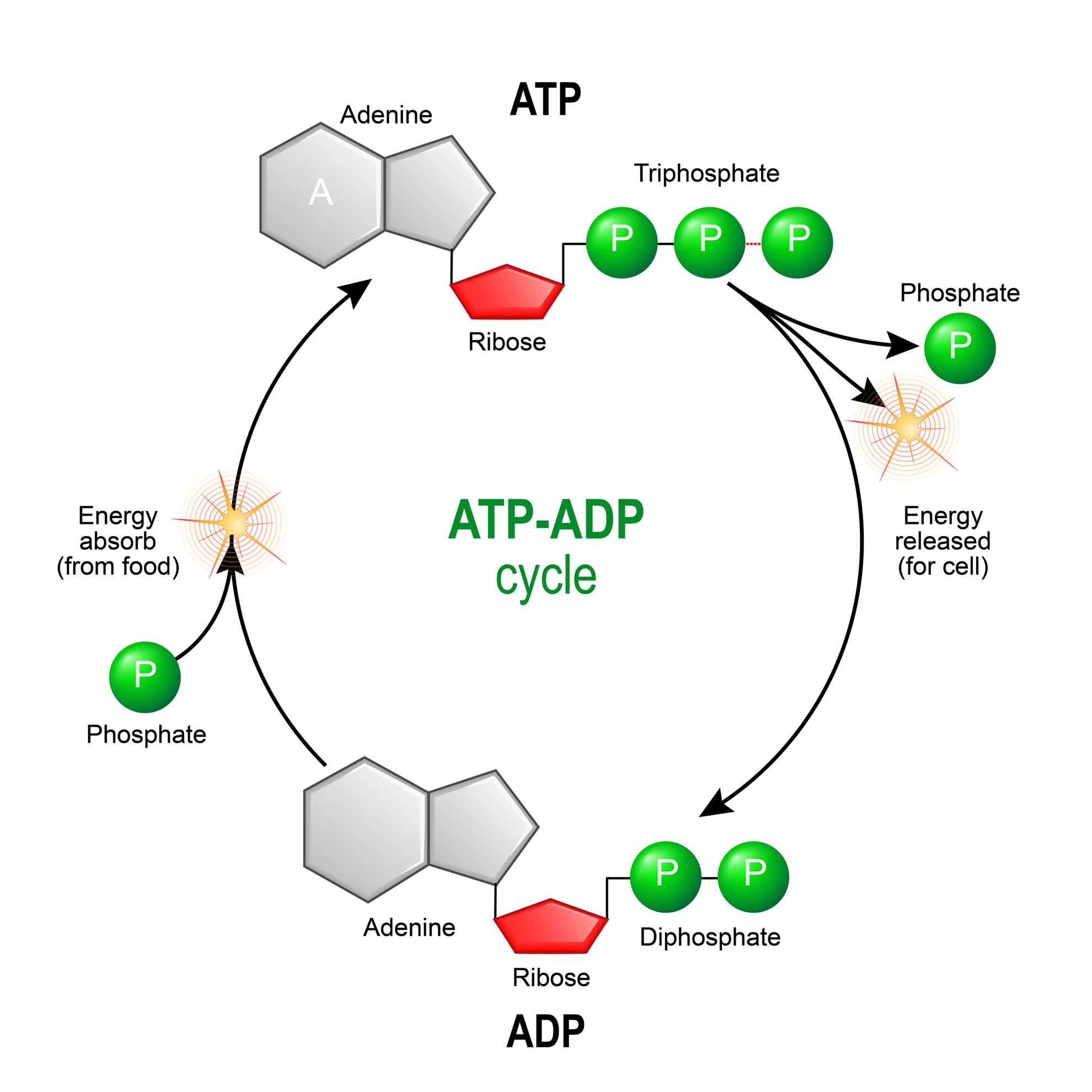
To understand how ATP functions, we need to look at its atomic architecture. The molecule consists of three distinct parts linked together in a specific chain.
First, there's adenine, a nitrogenous base that also serves as a building block for DNA and RNA. Attached to adenine is ribose, a five-carbon sugar molecule. Together, adenine and ribose form a compound called adenosine.
The real action happens at the tail end of the molecule, where a chain of three phosphate groups is attached to the ribose sugar. These phosphate groups are negatively charged. Because like charges repel each other, packing three phosphate groups tightly together creates immense electrostatic stress. The bonds holding the terminal phosphates in place—specifically the phosphoanhydride bonds—are unstable and primed to release energy when broken.
When a cell needs power, it cleaves off the outermost phosphate group through hydrolysis. This reaction converts ATP into adenosine diphosphate, or ADP, releasing a packet of free energy that cellular enzymes immediately capture to do work.
How Cells Generate ATP
Cells don't store massive reserves of ATP; they manufacture it on demand through continuous metabolic pathways. Under normal conditions, an active human recycles roughly their own body weight in ATP every single day. This production relies on three primary biochemical stages.
Glycolysis
Glycolysis takes place in the cytoplasm of the cell and doesn't require oxygen. During this process, a single six-carbon glucose molecule splits into two three-carbon molecules called pyruvate.
This breakdown yields a net gain of two ATP molecules and produces high-energy electron carriers known as NADH. While two molecules of ATP per glucose isn't much, glycolysis happens fast and serves as the universal starting point for cellular metabolism across both aerobic and anaerobic organisms.
The Krebs Cycle
When oxygen is present, pyruvate moves from the cytoplasm into the mitochondrial matrix. Here, it enters the Krebs cycle (also known as the citric acid cycle).
During this series of enzyme-driven reactions, the carbon skeleton of pyruvate is completely dismantled and exhaled as carbon dioxide. The cycle generates a small amount of direct ATP (or its chemical cousin GTP) but exports most of its harvested energy via loaded electron carriers—NADH and FADH2—into the final phase of cellular respiration.
Oxidative Phosphorylation
The grand finale of ATP production happens along the inner mitochondrial membrane. As electrons pass through a series of protein complexes known as the electron transport chain, protons are pumped across the membrane. This creates a dense electrochemical gradient.
Protons rush back into the mitochondrial matrix through a remarkable molecular turbine called ATP synthase. As protons flow through its rotor, the enzyme spins, physically forcing inorganic phosphate back onto ADP to synthesize fresh ATP. This oxidative phosphorylation phase produces roughly 26 to 28 additional molecules for every glucose oxidized. For deeper reading on these cellular mechanics, check out the National Institutes of Health research portal.
Cellular Work Powered by ATP
Cells spend their ATP budget across three main categories of biological labor. Without this constant expenditure, homeostasis collapses.
- Mechanical work: Muscle contraction relies entirely on ATP. Motor proteins like myosin walk along actin filaments, pulling muscle fibers together. Every single step requires binding and breaking down an ATP molecule.
- Transport work: Active transport proteins use ATP to pump ions and molecules against their concentration gradients across cell membranes. The classic example is the sodium-potassium pump, which maintains the resting electrical potential of nerve and muscle cells.
- Chemical work: Building complex macromolecules—such as linking amino acids into proteins or assembling nucleotides into DNA—is endergonic, meaning it requires an energy input. Cells couple these synthetic reactions directly with ATP hydrolysis.
Common Mistakes and Misconceptions
When studying cellular energetics, students and writers often fall into several predictable traps. Avoiding these errors ensures a scientifically accurate view of metabolism.
- Treating ATP like a battery: Batteries store electrical charge inside a closed container for long periods. ATP is not a long-term storage medium. It's a transient, high-turnover coin that has a cellular lifetime of less than a minute. For long-term storage, cells rely on glycogen, starch, or fats.
- Confusing ATP with calories: Calories measure the total heat energy released when food is completely burned. ATP is the specific biochemical vehicle that living systems use to channel a portion of that energy into usable work.
- Assuming ATP is the only energy carrier: While ATP dominates, cells also use other nucleotide triphosphates like GTP, UTP, and CTP for specific biosynthetic tasks, along with proton gradients themselves.
Frequently Asked Questions
What happens when a cell runs out of ATP?
When ATP levels plummet, cells can no longer maintain their ion gradients or synthesize essential proteins. The sodium-potassium pump fails, causing water to rush into the cell and lead to osmotic swelling. In muscle tissue, a lack of ATP prevents myosin heads from detaching from actin filaments, causing the stiffening known as rigor mortis.
Can the human body recycle ADP back into ATP?
Yes, constantly. The human body doesn't build new ATP from scratch every time it needs energy. Instead, it recycles the existing pool of adenine nucleotides thousands of times a day by attaching free phosphate groups back onto ADP via cellular respiration or creatine phosphate buffering.
Why is ATP used instead of a higher-energy molecule?
While molecules like phosphoenolpyruvate release even more energy when broken down, ATP hits a biochemical sweet spot. Its hydrolysis releases enough free energy to drive difficult cellular reactions, but not so much that the energy is wasted as heat or destabilizes the cellular environment.
How do plants make ATP without eating food?
Plants perform photosynthesis in chloroplasts. Light reactions capture solar photons to split water molecules, generating a proton gradient across the thylakoid membrane that drives ATP synthase to produce ATP. The plant then spends this ATP during the Calvin cycle to convert carbon dioxide into glucose. You can explore more plant biology resources through the National Science Foundation.



