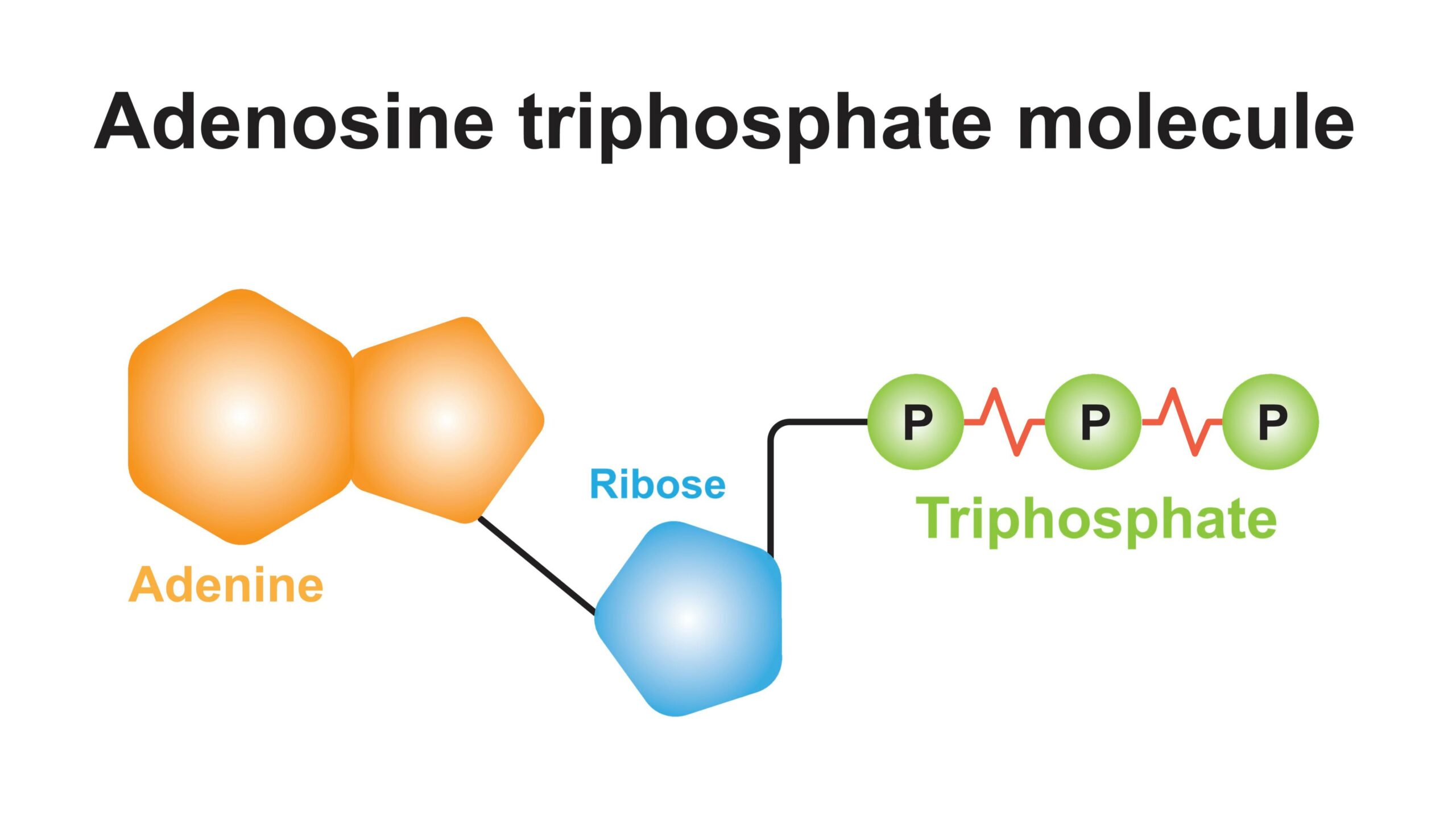
Every movement you make, every thought you process, and every breath you take depends on a single biochemical transaction: the splitting of adenosine triphosphate (ATP). When cells need to drive a reaction that wouldn't happen on its own, they turn to ATP hydrolysis, breaking down their primary energy currency to keep biological systems running.
Without this constant molecular turnover, cells would run out of usable energy within seconds. Understanding how this reaction works reveals the exact mechanisms that power muscle contraction, active transport, and metabolic regulation across every living organism.
What Is ATP Hydrolysis?
At its core, ATP hydrolysis is the chemical reaction where water is used to split the terminal phosphate group off an ATP molecule. This reaction converts ATP into adenosine diphosphate (ADP) and an inorganic phosphate group, releasing usable free energy in the process.
The chemical equation looks like this:
$$ATP + H_2O \rightarrow ADP + P_i + Energy$$
In biochemical terms, this reaction is exergonic, meaning it has a negative standard free energy change. Under standard conditions, the free energy change ($\Delta G^\circ'$) is roughly $-30.5\text{ kJ/mol}$. Inside a living cell, actual concentrations of ATP, ADP, and phosphate make that value even more negative, often ranging between $-50$ and $-55\text{ kJ/mol}$. This high thermodynamic drive ensures the reaction proceeds quickly when catalyzed by the correct enzymes.
Why ATP Holds Energy: Busting the "High-Energy Bond" Myth
A common misconception in biology textbooks is that ATP stores energy in a mysterious "high-energy bond" that acts like a coiled spring. Thermodynamics tells a different story.
The bonds linking phosphate groups together aren't inherently fragile or packed with explosive energy. Instead, the energy yield of ATP hydrolysis comes from a change in stability between the reactants and the products.
- Electrostatic Repulsion: The triphosphate tail of ATP carries four negative charges tightly packed close together. These negative charges repel each other, placing mechanical strain on the molecule.
- Product Stability: When water cleaves off the end phosphate, that electrostatic strain is relieved. Furthermore, the resulting inorganic phosphate and ADP benefit from resonance stabilization, meaning their electrons can spread out more evenly than they could inside intact ATP.
- Hydration Effects: Water molecules form more stable hydration shells around the separated ADP and inorganic phosphate than they do around ATP alone.
The products are simply at a much lower free energy state than the starting molecule. The energy released isn't unlocked from a broken bond; it's the net drop in free energy when the system moves toward a more stable chemical configuration.
The Role of ATPases and Energy Coupling
ATP doesn't just fall apart randomly in water; the rate of spontaneous hydrolysis is far too slow to sustain life. Cells rely on specialized enzymes called ATPases to speed up the reaction and couple the released energy to work that requires an energy input.
This process is known as energy coupling. An energetically unfavorable reaction (one with a positive $\Delta G$) cannot happen on its own. By coupling that reaction directly to the hydrolysis of ATP, the combined overall free energy change becomes negative, driving the process forward.
A classic example is the sodium-potassium pump ($Na^+/K^+$-ATPase), an integral membrane protein found in animal cells. To keep nerve signaling and muscle tone intact, this pump must move sodium ions out of the cell and potassium ions inward, working directly against their natural concentration gradients.
- The pump binds three sodium ions from inside the cell.
- An ATP molecule transfers its terminal phosphate group directly to the pump protein in a process called phosphorylation.
- This phosphorylation causes a rapid shift in the protein's shape, opening the gate outward and releasing the sodium ions.
- Two extracellular potassium ions then bind to the altered protein, triggering the release of the attached phosphate group.
- The pump snaps back to its original shape, depositing the potassium ions inside the cell.
Without ATP hydrolysis driving this specific conformational cycle, cells would lose their ion gradients, causing cellular swelling, electrical failure, and rapid cell death.
Major Classes of ATPases
Not all ATPases do the same job. Evolution has shaped distinct classes of these enzymes to handle different cellular tasks, ranging from ion transport to mechanical rotation.
- P-type ATPases: These enzymes get phosphorylated during their catalytic cycle. They are responsible for moving ions across cell membranes. Examples include the sodium-potassium pump and the calcium pumps that clear calcium ions from the cytoplasm to let muscle fibers relax.
- V-type ATPases: Found primarily in the membranes of cellular organelles like lysosomes, endosomes, and plant vacuoles, these act as proton pumps. They use ATP hydrolysis to pump hydrogen ions inward, keeping the inside of these compartments acidic to break down waste or drive secondary transport.
- F-type ATPases: Located in the inner mitochondrial membrane and bacterial plasma membranes, these work in reverse under normal physiological conditions. Instead of consuming ATP to pump protons, they allow protons to flow down an electrochemical gradient, using that mechanical rotation to synthesize ATP from ADP and inorganic phosphate. This is the final step of cellular respiration.
You can read more about how membrane transport proteins function in cellular physiology through resources provided by the National Center for Biotechnology Information.
Metabolic Regulation: Keeping Cellular Supply Balanced
Cells don't stockpile massive reserves of ATP because it's chemically unstable in high concentrations and too heavy for efficient bulk storage. Instead, a human adult recycles an amount of ATP roughly equal to their own body weight every single day, turning ADP back into ATP through cellular respiration and glycolysis.
This recycling loop requires tight metabolic control. If ATP levels drop too low, cellular processes grind to a halt. If ATP accumulates without being used, metabolic pathways run inefficiently.
- Energy Charge: Cells monitor their energy status using the ratio of ATP to ADP and AMP. When energy demand spikes—such as during a heavy sprint—the concentration of ADP rises sharply.
- Allosteric Activation: High levels of ADP and AMP act as molecular green lights, binding to key regulatory enzymes in glycolysis (like phosphofructokinase) and the citric acid cycle to ramp up ATP production.
- Feedback Inhibition: When ATP is plentiful, it binds to those same enzymes as an inhibitor, slowing down catabolic pathways so the cell doesn't waste resources making energy it doesn't need.
Frequently Asked Questions
How long does an ATP molecule last before it is hydrolyzed?
Inside an active cell, an individual ATP molecule has a very short lifespan—often less than a minute, and in vigorously contracting muscle tissue, it can be turned over in a fraction of a second. The cellular pool of ATP is constantly being consumed and regenerated.
Can cells use energy sources other than ATP?
Yes. While ATP is the primary currency, cells also use guanosine triphosphate (GTP) to power protein synthesis and signal transduction, and molecules like cytidine triphosphate (CTP) and uridine triphosphate (UTP) to build lipids and carbohydrates. However, ATP remains responsible for the vast majority of cellular work.
What happens when the body runs out of ATP?
When ATP supplies drop to critically low levels, cells lose their ability to maintain ion gradients across membranes. Calcium floods the cell cytoplasm, regulatory proteins degrade, and the cell undergoes irreversible injury or programmed cell death (apoptosis). This process is what causes tissue damage during a heart attack or stroke when oxygen supplies are cut off.
Does ATP hydrolysis require oxygen?
No. The hydrolysis of ATP itself is simply a chemical reaction involving water and does not require oxygen. However, the vast majority of ATP regeneration—the process that turns ADP back into ATP via oxidative phosphorylation in the mitochondria—requires a continuous supply of oxygen to act as the final electron acceptor.



