You can't convert your ASVAB score into an IQ score. People try anyway. They look at the Armed Services Vocational Aptitude Battery and assume it's just another general intelligence test. It's not. The test measures specific vocational aptitudes and knowledge domains required for military jobs, rather than general cognitive capacity. Treating it like an intelligence quotient assessment misunderstands how psychometric testing works entirely.
The military uses this exam to place recruits into specific career fields, not to rank them by raw intellect. While both tests use standardized scoring and involve cognitive items, they serve completely different purposes. Understanding why conversion formulas fail requires looking at what each assessment actually measures, how scoring scales differ, and why military branches care about specific skill clusters instead of a single general factor.
What the ASVAB Actually Measures
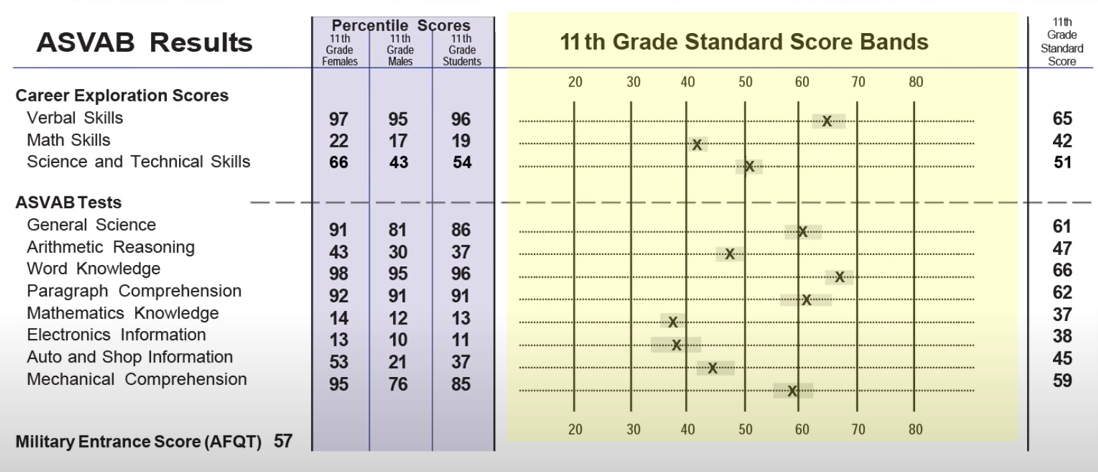
The Armed Services Vocational Aptitude Battery consists of multiple subtests designed to predict success in military training programs. It's a vocational battery. If you want to fix aircraft engines, manage supply chains, or operate combat systems, the military needs to know your specific strengths in mechanical comprehension, electronics, mathematics, and verbal expression.
Nine distinct subtests make up the standard paper-and-pencil or computer-administered versions:
- General Science: Measures knowledge of physical and biological sciences.
- Arithmetic Reasoning: Tests ability to solve basic arithmetic word problems.
- Word Knowledge: Evaluates ability to understand the meaning of words through synonyms.
- Paragraph Comprehension: Assesses capability to obtain information from written text.
- Mathematics Knowledge: Measures knowledge of mathematical concepts and applications.
- Electronics Information: Covers electrical systems, radio principles, and electronics.
- Auto and Shop Information: Tests knowledge of automotive maintenance and wood/metal shop practices.
- Mechanical Comprehension: Evaluates principles of mechanical devices, structural support, and properties of materials.
- Assembling Objects: Measures spatial aptitude through visual puzzle assembly.
Notice what's missing. There's no test for abstract fluid reasoning in the way traditional intelligence assessments test it. You're being tested on acquired knowledge and practical skills alongside basic math and verbal capabilities. That's why you can study for it and see your scores jump.
Understanding IQ Tests and General Intelligence
Intelligence quotient tests, such as the Wechsler Adult Intelligence Scale or the Stanford-Binet, focus heavily on general cognitive ability, often referred to as psychometric $g$. These assessments look at fluid intelligence—the ability to think logically and solve problems in novel situations, independent of acquired knowledge—alongside crystallized intelligence, which represents accumulated learning.
Standardized intelligence tests are structured to minimize the impact of formal schooling and specific vocational training. They evaluate working memory, processing speed, visual-spatial processing, and quantitative reasoning through abstract puzzles and matrix reasoning tasks. You can't easily study for a pure intelligence test because the items don't rely on factual information you can memorize.
When people look for an ASVAB to IQ conversion, they usually misunderstand how test norms are established. An intelligence test centers around a mean score of 100 with a standard deviation of 15. The military entrance exam uses the Armed Forces Qualification Test, or AFQT, which yields a percentile score ranging from 1 to 99. A percentile score tells you how your performance compares to a reference group of test-takers, usually a norming sample of American youth aged 18 to 23 tested in 1997. It isn't an intelligence quotient.
Why Direct Conversion Formulas Do Not Work
You'll find various online calculators and forum threads claiming they've cracked a secret formula to turn military test percentiles into intelligence metrics. These tools are fundamentally flawed.
First, the test domains don't map one-to-one. While the verbal and math subtests (Word Knowledge, Paragraph Comprehension, Arithmetic Reasoning, and Mathematics Knowledge) correlate moderately with general cognitive ability—forming the basis of the AFQT score used for enlistment eligibility—the remaining subtests measure specialized technical knowledge. Someone with high mechanical comprehension might score brilliantly on the military battery while showing average results on a test of abstract visual memory.
Second, the sample populations differ dramatically. The military testing pool consists of a self-selected group of individuals who meet basic citizenship, physical, and legal criteria, and who actively chose to apply for military service. Intelligence test norms are derived from representative samples of the general population. Trying to apply a crosswalk between two entirely different populations breaks the statistical validity of the scores.
If you want to dive deeper into how standardized testing works and how federal agencies approach psychometric validation, check out the guidelines provided by the U.S. Office of Personnel Management. You can also review official updates and structural breakdowns directly through the Official ASVAB Program site.
Common Mistakes When Interpreting Military Scores
Recruits often make critical errors when looking at their score sheets. Avoiding these misinterpretations helps keep your expectations realistic.
- Treating the AFQT percentile as a percentage: An AFQT score of 70 doesn't mean you got 70 percent of the questions right. It means you scored equal to or higher than 70 percent of the reference comparison group.
- Assuming high line scores equal genius: Line scores determine your job qualifications (MOS or AFSC). Scoring high in electronics or mechanical maintenance means you have an aptitude for those fields, not that you possess a genius-level intelligence quotient.
- Believing low scores mean low potential: A poor performance on test day often reflects a lack of preparation in specific math or reading domains, rather than an inherent ceiling on your cognitive capabilities. You can retake the test after a mandatory waiting period.
Frequently Asked Questions
Can I use my AFQT score to find out my mental ability level?
No. The AFQT measures basic verbal and math skills needed for training success, but it's reported as a percentile rank, not an intelligence quotient. There is no valid statistical conversion chart that translates military percentiles into standard intelligence metrics.
Why do some websites offer conversion calculators?
Some online platforms create these tools for entertainment or to capture search traffic. Psychometricians and military researchers do not endorse these calculators because they lack scientific validity and ignore the distinct differences in test design.
Do military branches test for general intelligence at all?
Historically, the military used the Army General Classification Test, but today the battery focuses entirely on vocational aptitude and job performance prediction. The goal is matching the right person to the right job, not measuring innate intellect.
Can studying improve my scores significantly?
Yes. Because the battery includes sections on electronics, mechanical comprehension, and auto shop—along with academic subjects like math and word knowledge—focused preparation and studying can drastically improve your performance. Intelligence scores, by contrast, are far more stable and resistant to short-term coaching.



