Preparing for the Armed Services Vocational Aptitude Battery is the single most important step if you want to secure a technical job in the United States Air Force. Your test performance directly dictates whether you get assigned to work on advanced avionics, cyber systems, or mechanical logistics.
To enlist with a traditional high school diploma, you'll need a minimum Armed Forces Qualification Test score of 31. If you hold a GED, that minimum score requirement jumps to 50. However, just clearing the bare minimum restricts your career options. High-demand fields require much stronger results across specific subtests.
Taking a targeted ASVAB practice test Air Force candidate prep routine helps you bypass common pitfalls and lock in the exact line scores you need.
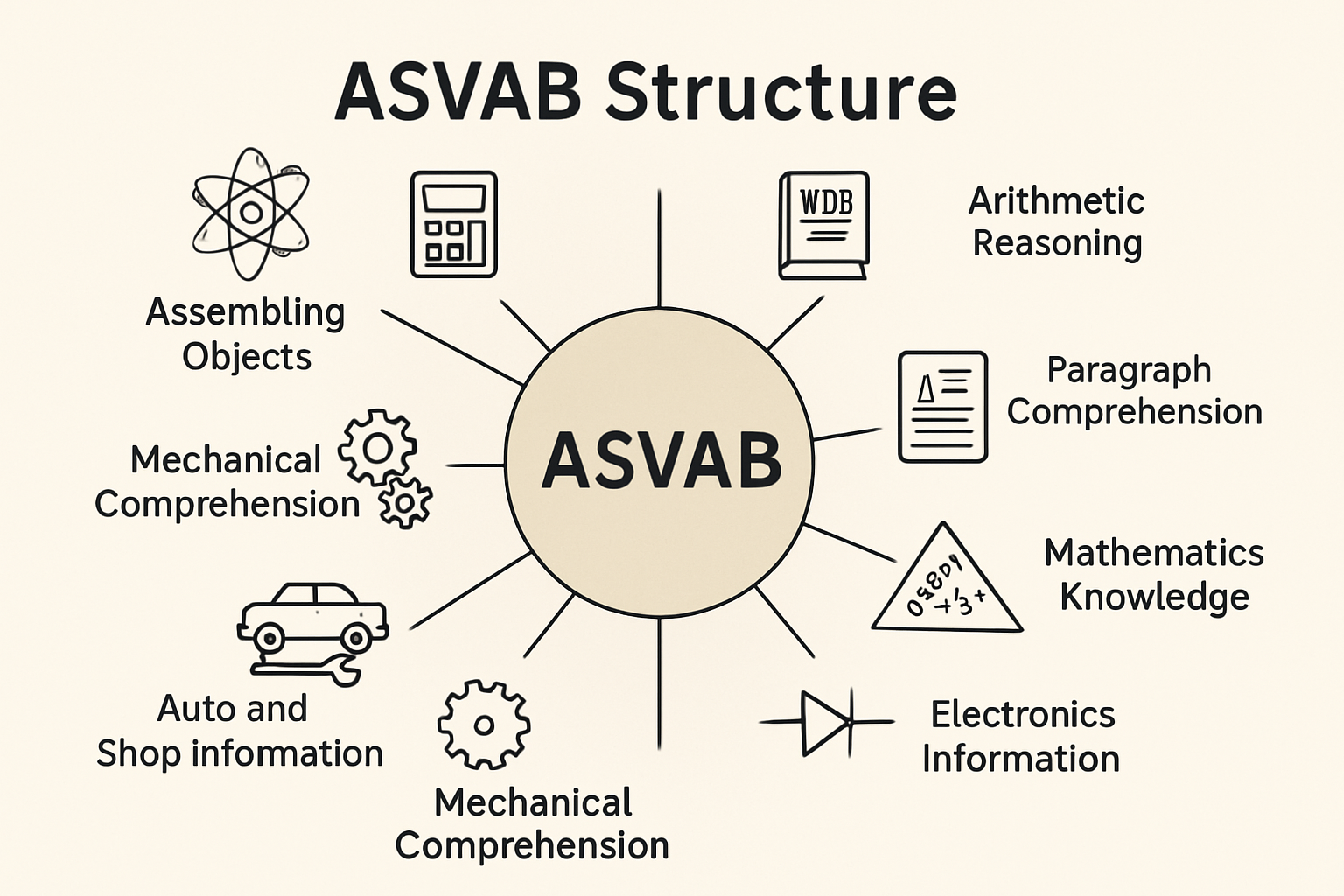
Understanding the Structure of the Air Force ASVAB
The computerized version of the exam, known as the CAT-ASVAB, covers nine core areas for enlistment and job qualification. While your overall AFQT score—calculated from Word Knowledge, Paragraph Comprehension, Arithmetic Reasoning, and Mathematics Knowledge—gets your foot in the door, your individual MAGE scores determine your actual job choices.
MAGE stands for Mechanical, Administrative, General, and Electronic. Each Air Force Specialty Code relies on a specific combination of subtests.
- Mechanical (M): Evaluates your understanding of general science, mechanical concepts, and shop information. It's vital for aircraft maintenance and civil engineering roles.
- Administrative (A): Measures verbal expression and clerical perception. This score matters if you're looking at administration or personnel tracks.
- General (G): Focuses on word knowledge, paragraph comprehension, and arithmetic reasoning. This is the heavy lifter for medical, security, and intelligence careers.
- Electronic (E): Tests general science, mathematics knowledge, electronics information, and arithmetic reasoning. You need a high electronic score for cyber operations, avionics, and communications.
How to Set Up an Effective Practice Schedule
Winging the exam rarely works out. A structured study plan bridges the gap between what you learned in high school and what the military actually tests.
Set up a baseline by taking a timed, full-length diagnostic exam without looking at any study guides. This first score reveals your weak points instantly. If your math foundation feels rusty, don't spend hours memorizing engine parts. Direct your energy where you lose the most points.
Break your prep into weekly sprints. Spend two weeks reviewing core algebra and arithmetic word problems. Shift your focus to mechanical and electrical principles during week three if you're targeting technical fields. Always review the answer explanations for every question you miss on practice exams. Understanding why you missed a question prevents you from repeating the same error on test day.
Common Mistakes Candidates Make
Many applicants sabotage their scores because they approach the exam casually. Watch out for these operational traps during your preparation phase.
- Pacing too slowly: The CAT-ASVAB adapts to your skill level, meaning questions get harder if you answer correctly. Spending ten minutes on a single math problem will destroy your overall score because unanswered questions carry heavy penalties.
- Ignoring the MAGE line scores: Focusing solely on the overall AFQT score leaves you vulnerable. You might qualify for the branch, but you won't qualify for the job you actually want.
- Skipping diagnostic reviews: Taking practice tests without tracking your weak spots is a waste of time. Keep an error log of every missed concept.
- Cramming the night before: Mental fatigue ruins performance on timed technical assessments. Get a full night of sleep before test day.
Frequently Asked Questions
Can I retake the ASVAB if my score is too low?
Yes, you can retake the exam. The Air Force requires a mandatory waiting period of 30 days before your first retest, and another 30 days for your second retest. Subsequent retakes require a six-month wait. Your most recent score counts for enlistment.
Does the Air Force accept the paper-and-pencil version?
The vast majority of applicants take the computerized CAT-ASVAB at a Military Entrance Processing Station or a Military Entrance Test site. The paper version is only administered in remote locations where computer testing isn't available.
What constitutes a good score on the Air Force ASVAB?
While 31 is the baseline minimum for high school graduates, a score of 65 or higher places you in the upper tier. High scores give you leverage to negotiate specific jobs guaranteed in your enlistment contract.
How long are my ASVAB scores valid?
Your qualifying scores remain valid for two years. If you don't enter active duty within that two-year window, you must retake the exam to update your file.
For official details on enlistment guidelines and physical requirements, consult the U.S. Air Force Official Site. To explore structured study modules and diagnostic tools, check out Peterson's Test Prep.



