Writing an APA style research paper doesn't have to feel like decoding a secret language. You're trying to communicate your research clearly, and the rules set by the American Psychological Association are simply designed to keep academic communication consistent across psychology and related social sciences. Let's look at how you can get your paper formatted right from the title page to the final reference list without losing your mind.
The primary goal of APA style is clarity. When you format your paper correctly, readers don't have to guess where your evidence comes from or how your headings relate to one another. They can jump straight into your argument, evaluate your data, and verify your sources using the standard guidelines outlined in the official Publication Manual of the APA.
Setting Up Your Document Layout
Getting your page setup right takes just a few minutes, but fixing formatting errors at the last minute ruins sleep. You'll want to configure your word processor correctly before typing a single word of your draft.
- Margins: Set one-inch margins on all sides of the page. Don't eyeball it; use the page setup menu.
- Font: Pick a legible, standard font. Times New Roman in 12-point, Arial in 11-point, or Calibri in 11-point work best.
- Spacing: Double-space the entire document, including the title page, abstract, main text, and reference list. Never add extra blank lines between paragraphs.
- Page Numbers: Insert page numbers in the top right corner of the header. The title page is page number one.
Running heads used to be mandatory for student papers in older editions, but current rules say student papers don't need them unless your instructor specifically asks for one. Check your assignment prompt before skipping it.
Crafting the Title Page and Abstract
Your title page sets the tone for your reader. It needs specific elements arranged neatly in the upper half of the page, centered.
- Type your paper title in bold, title case, about three to four lines down from the top margin. Keep it focused and concise.
- Press enter twice, then type your name.
- Type your institutional affiliation on the next line, such as your department and university name.
- Include the course number and name, instructor's name, and the due date on subsequent lines.
Right after the title page comes the abstract, if your instructor requires one. Start it on a new page with the word "Abstract" centered and bolded at the top. Write a concise summary of your research problem, participants, methods, results, and conclusions in 150 to 250 words. Don't indent the first line of your abstract paragraph.
Writing In-Text Citations Accurately
When you borrow an idea, statistic, or direct quote, you must give credit. APA style uses the author-date citation system, which points readers directly to your reference list.
If you mention the author's name in your sentence, put the year of publication in parentheses right afterward. For example, Smith (2024) found that students retain more information when they outline first. When you don't mention the author in the sentence text, put both the author's last name and the year inside parentheses at the end of the sentence, separated by a comma.
Direct quotes require a page number. If you're quoting text directly, your parenthetical citation needs the author, year, and page number, like this: (Smith, 2024, p. 45). If the quote spans two pages, use "pp." instead.
Handling multiple authors gets tricky, but the rules are simple. For a work with one or two authors, name them every time. For a work with three or more authors, use the primary author's last name followed by "et al." right from the first citation. It keeps your sentences from getting bogged down in names.
Building Your Reference List
Every source you cite in your text must appear in your reference list, and every source in your reference list must have an in-text citation. Start your references on a new page at the end of your paper. Center the word "References" in bold at the top.
Sort your references alphabetically by the author's last name. Use hanging indents for every entry, meaning the first line of each source starts flush left, and every subsequent line is indented by half an inch.
Book references follow a standard pattern: author last name, initials. (Year of publication). Book title in italics. Publisher name. Notice that you italicize the book title and capitalize only the first word of the title and subtitle, plus any proper nouns.
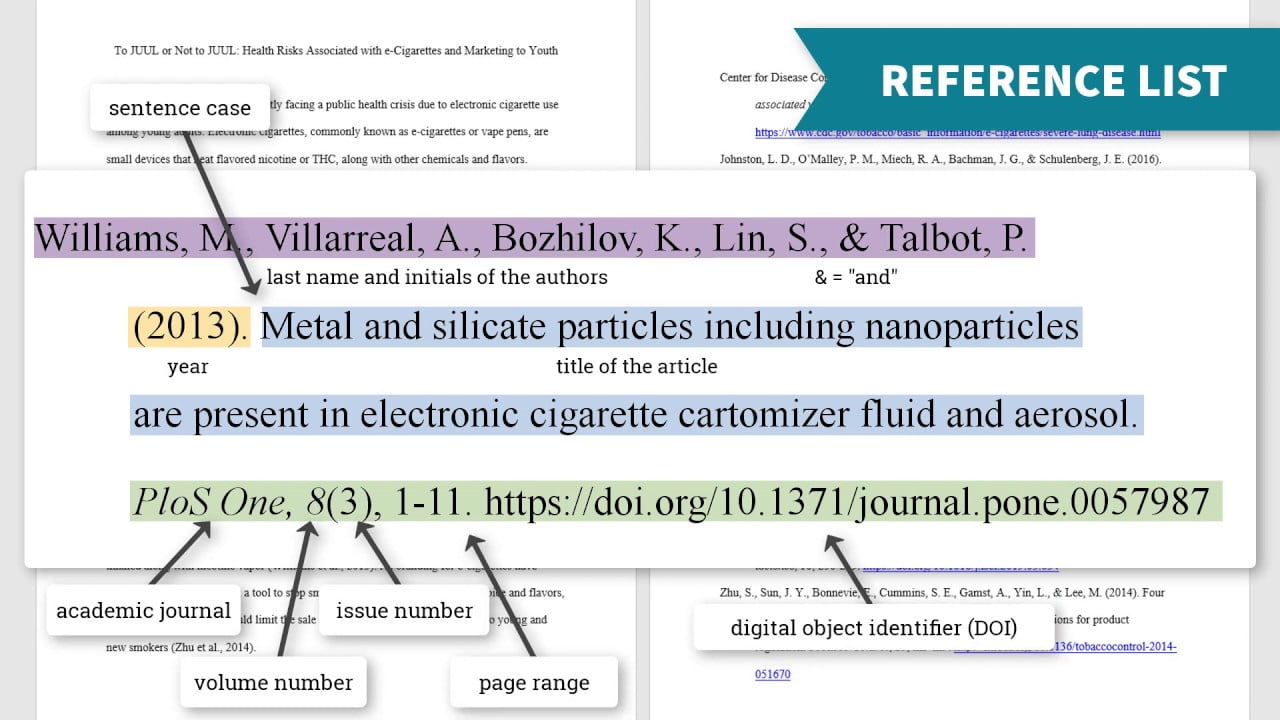
Journal articles look slightly different. Include the author, year, article title in plain text, journal name in italics, volume number in italics, issue number in parentheses, and page range. Include a DOI (Digital Object Identifier) link at the very end if the article has one available online.
Common Mistakes to Avoid
Even experienced writers slip up on formatting details. Watch out for these frequent traps.
- Overquoting: Don't let other people write your paper for you. Paraphrase most sources and reserve direct quotes for language that is genuinely striking or precise.
- Mismatched Citations: Leaving a source out of your reference list or citing a source that isn't listed causes major headaches during grading. Double-check your list against your citations before submission.
- Incorrect Heading Levels: APA uses five specific levels of headings to organize papers. Don't just make things bold randomly; follow the hierarchical rules for section titles.
- Ignoring Source Quality: Relying on unverified blogs instead of peer-reviewed journals or academic books weakens your argument immediately.
Frequently Asked Questions
Do I need an abstract for a short student paper?
Usually, no. Abstracts are typically required only for professional papers or longer student research reports. Ask your instructor if you aren't sure.
How do I cite a source with no publication date?
Use the abbreviation "n.d." in place of the year in both your in-text citation and your reference list entry.
Can I use footnotes in an APA style paper?
Yes, but sparingly. Footnotes should be used only for content notes that provide brief supplementary information or copyright attribution, not for general citations.
How do I format block quotes?
If a direct quotation exceeds 40 words, display it as a block quote. Indent the entire block half an inch from the left margin, double-space it, and omit quotation marks entirely.



