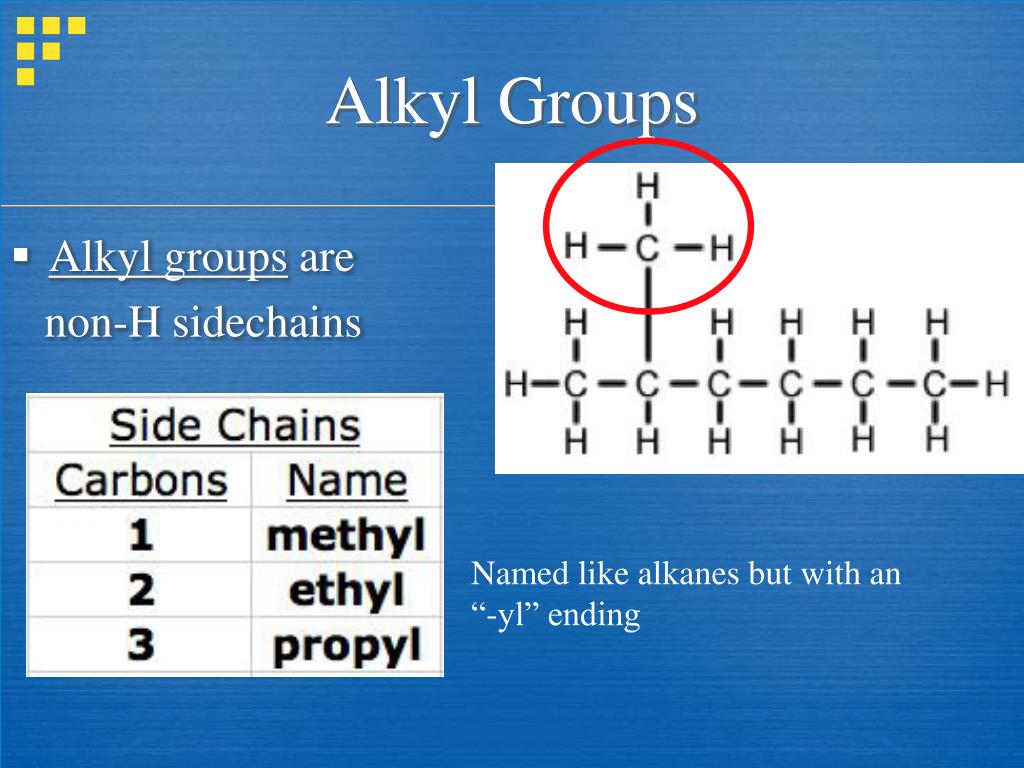
An alkyl group is a substituent derived from an alkane by removing one hydrogen atom. It forms the backbone of countless organic molecules. When you study organic chemistry, alkyl groups act as the foundational building blocks for naming and understanding complex structures.
Chemists write the general formula for an alkyl group as $C_nH_{2n+1}$. By removing a single hydrogen from a stable alkane like methane or ethane, you get a reactive fragment with an open valence. This fragment can attach to carbon chains, rings, or functional groups. Let's look at how these groups work, how to name them properly, and why they matter in chemical synthesis.
What is an Alkyl Group?
To understand an alkyl group, you have to start with alkanes. Alkanes are saturated hydrocarbons containing only single carbon-carbon bonds and carbon-hydrogen bonds. Their general formula is $C_nH_{2n+2}$.
When a hydrogen atom leaves, the remaining hydrocarbon fragment becomes an alkyl group. For example, taking methane ($CH_4$) and removing a hydrogen leaves a methyl group ($-CH_3$). The suffix changes from -ane to -yl. More details into this topic are explored by Associated Press.
Here are the four simplest straight-chain alkyl groups:
- Methyl ($-CH_3$): Derived from methane.
- Ethyl ($-CH_2CH_3$): Derived from ethane.
- Propyl ($-CH_2CH_2CH_3$): Derived from propane.
- Butyl ($-CH_2CH_2CH_2CH_3$): Derived from butane.
These groups don't exist as stable, independent species under normal conditions. Instead, they appear as parts of larger organic molecules, bonded to other atoms or groups.
Structural Variations: Straight-Chain vs. Branched Alkyl Groups
As carbon chains grow longer, the carbon atoms can arrange in different ways. This creates structural isomers, which changes the name and reactivity of the alkyl group.
Straight-Chain Alkyl Groups
In straight-chain groups, the carbon atoms connect in a single, continuous line. The open valence site is always at the terminal carbon. Examples include propyl and butyl groups.
Branched Alkyl Groups
When carbon chains branch out, chemists use specific prefixes to distinguish them:
- Isopropyl: The attachment point is at the middle carbon of a three-carbon chain ($-(CH_3)_2CH$).
- Isobutyl: A four-carbon chain with a branch at the second-to-last carbon.
- sec-Butyl: A four-carbon chain where the attachment is at a secondary carbon (bonded to two other carbons).
- tert-Butyl: A four-carbon chain where the central carbon bonds to three methyl groups, making it a tertiary carbon ($-(CH_3)_3C$).
Recognizing these branching patterns is critical when you name organic compounds using IUPAC rules.
IUPAC Nomenclature Rules for Alkyl Substituents
Naming organic molecules correctly requires clear rules. When an alkyl group attaches to a principal carbon chain, you treat it as a substituent.
Follow these steps when you encounter alkyl groups in IUPAC naming:
- Find the longest continuous carbon chain in the molecule. This forms the parent name.
- Number the chain from the end closest to a substituent to give lowest possible locants.
- Identify the alkyl groups attached to the main chain (such as methyl, ethyl, or isopropyl).
- Alphabetize the substituents when writing the name, ignoring numerical prefixes like di- or tri-.
- Use multipliers (di-, tri-, tetra-) if the same alkyl group appears multiple times.
For example, a six-carbon parent chain with a methyl group at carbon 2 is named 2-methylhexane. If you have two methyl groups at carbon 2 and 4, the name becomes 2,4-dimethylhexane.
Electronic Properties and Reactivity
Alkyl groups aren't just passive spectators on a carbon chain. They actively influence the stability and reactivity of molecules through two main electronic effects: inductive effects and hyperconjugation.
The Inductive Effect
Carbon and hydrogen have similar electronegativities, but alkyl groups are electron-donating compared to a bare hydrogen atom or a more electronegative heteroatom. Through the sigma bonds of the carbon chain, alkyl groups push electron density toward reaction centers. This electron-releasing property stabilizes positive charges.
This explains why carbocation stability follows a clear trend:
- Tertiary ($3^\circ$) carbocations are more stable than secondary ($2^\circ$) carbocations.
- Secondary carbocations are more stable than primary ($1^\circ$) carbocations.
Hyperconjugation
Hyperconjugation involves the delocalization of electrons from sigma ($C-H$) bonds into an empty or partially filled p-orbital. More alkyl groups attached to a carbocation or a double bond mean more adjacent $C-H$ bonds available for hyperconjugation. This makes substituted alkenes and carbocations much more stable.
Common Mistakes to Avoid
Students and early-stage chemists often make a few predictable errors when working with alkyl groups:
- Confusing alkanes with alkyl groups: Don't call a molecule "propane" when it's attached as a substituent; it's a "propyl" group.
- Miscounting chain carbons: Always count the exact number of carbons in branched groups like isopropyl versus propyl. Isopropyl has a central attachment point, while propyl attaches at the end.
- Ignoring alphabetization rules: When naming molecules with multiple different substituents (like ethyl and methyl), list them alphabetically, ignoring prefixes like sec- or tert- when alphabetizing by the main root letter, though hyphenated prefixes can sometimes confuse nomenclature software. Stick to standard IUPAC guidelines.
Frequently Asked Questions
What is the difference between an alkane and an alkyl group?
An alkane is a stable, saturated hydrocarbon with a general formula of $C_nH_{2n+2}$. An alkyl group is a fragment derived from an alkane by removing one hydrogen atom ($C_nH_{2n+1}$), allowing it to bond to other chemical structures.
Can an alkyl group exist by itself as a stable molecule?
No. Alkyl groups have an unpaired electron or an open valence site (like free radicals or carbocations in reaction intermediates), meaning they are highly reactive and quickly bond with other atoms or molecules.
How does branching affect the stability of an alkyl group?
Branching increases the number of adjacent carbon-hydrogen bonds capable of participating in hyperconjugation and inductive electron donation. This stabilizes reactive intermediates, such as carbocations and free radicals, making tertiary alkyl centers significantly more stable than primary ones.
Why are alkyl groups important in organic synthesis?
Alkyl groups form the hydrophobic, non-polar framework of organic molecules. Their steric bulk and electronic donating properties control how functional groups react during substitution and elimination reactions.