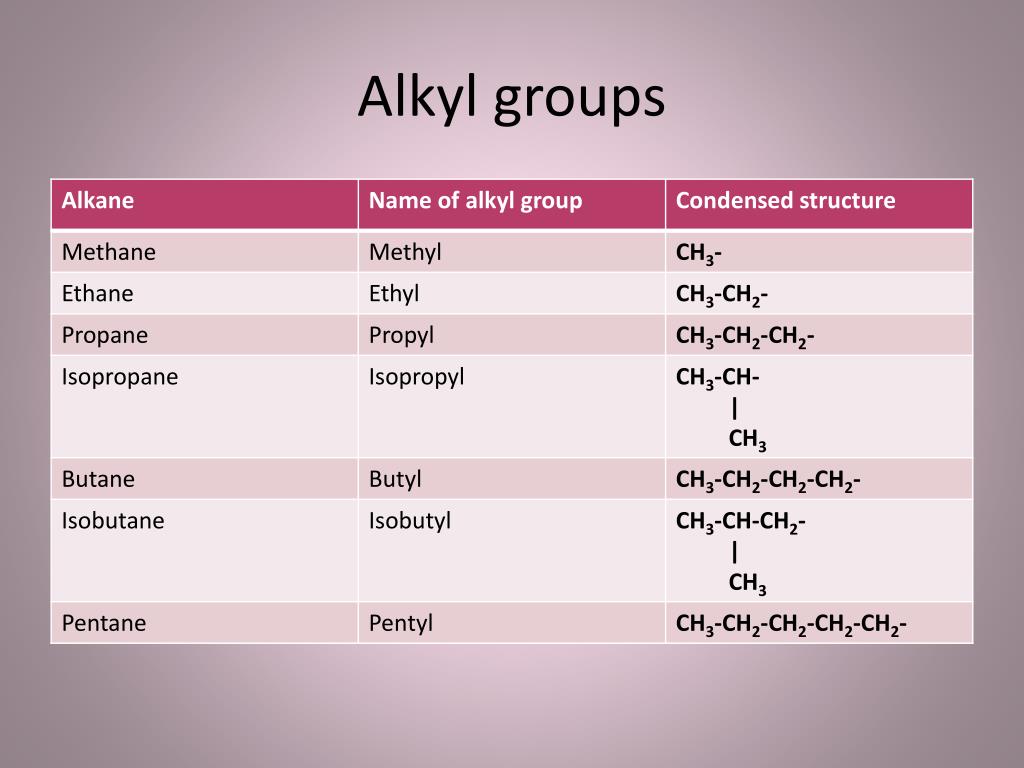
An alkyl group is a functional fragment derived from an alkane by removing a single hydrogen atom, leaving an open valence for bonding. Written with the general formula $C_nH_{2n+1}$, these hydrocarbon substituents form the structural backbone of organic chemistry. They aren't isolated compounds; instead, they act as modular units attached to larger molecular frameworks, dictating physical properties like boiling point, solubility, and reactivity across pharmaceuticals, fuels, and polymers.
Understanding how these carbon chains dictate molecular behavior explains why they drive modern industrial manufacturing. Let's break down their structural types, reaction mechanics, and real-world applications.
Structural Anatomy and Nomenclature
The naming convention for alkyl groups is straightforward. You take the root name of the parent alkane—such as methane, ethane, or propane—and replace the -ane suffix with -yl.
- Methyl Group (-CH3): The simplest possible alkyl substituent, derived from methane. It appears in countless biological and industrial compounds, including acetic acid and various amino acids.
- Ethyl Group (-C2H5): A two-carbon chain derived from ethane. It serves as a foundational component in anaesthetics, solvents, and ethanol derivatives.
- Propyl and Butyl Groups: Three- and four-carbon chains that introduce structural isomerism. For instance, a butyl group can be arranged as straight-chain (n-butyl), secondary, isobutyl, or tertiary-butyl (tert-butyl), each conferring vastly different steric properties to the parent molecule.
- Higher Alkyl Groups: Chains extending past five carbons (pentyl, hexyl, decyl) gain significant hydrophobic character, altering how molecules interact with water and lipids.
When an alkyl group attaches to a halogen, hydroxyl group, or aromatic ring, it alters the electron density of the entire molecule through inductive effects. Alkyl groups are electron-donating via sigma bonds, which stabilizes adjacent carbocations during chemical reactions.
Industrial Synthesis via Alkylation
In chemical manufacturing, attaching an alkyl group to an organic molecule is known as alkylation. This process is vital for producing high-octane gasoline, synthetic rubber, and various specialized chemicals. Refineries use acid catalysts like hydrofluoric acid or sulfuric acid to combine low-molecular-weight alkenes with isobutane.
Petroleum Refining and Fuel Optimization
Crude oil fractions don't inherently burn smoothly in high-compression internal combustion engines. Unbranched straight-chain alkanes cause engine knocking. Refineries use alkylation units to react light olefins with isoparaffins, producing branched alkyl chains (such as isooctane). These branched isomers burn evenly, raising the fuel's octane rating and protecting engine components from destructive pre-ignition. You can explore more about petroleum refining and emissions standards through environmental regulatory bodies.
Pharmaceutical Drug Design
Medicinal chemists use alkyl substituents to tune the pharmacokinetic profile of drug candidates. Adding a bulky alkyl group—such as a tert-butyl group—creates steric hindrance, shielding vulnerable chemical bonds from metabolic degradation in the liver. Furthermore, lengthening a carbon chain increases lipophilicity, helping medications cross the blood-brain barrier or penetrate cell membranes more effectively.
Surfactants and Consumer Goods
Everyday cleaning products rely on alkyl chemistry to lift grease from surfaces. Surfactants feature a dual structure: a water-loving hydrophilic head and a water-fearing hydrophobic tail.
The tail is almost universally a long-chain alkyl group, often sourced from fatty acids or petroleum distillates. In linear alkylbenzene sulfonates, a 10 to 14-carbon alkyl chain anchors into oil droplets, while the sulfonate head group interacts with water. This molecular bridge allows water to rinse away oily residues that would otherwise refuse to mix.
Common Mistakes in Alkyl Chemistry
Working with alkyl groups requires precision. Chemists and students frequently run into specific pitfalls:
- Confusing Alkyl with Alkane: An alkane is a stable, independent molecule (like propane), whereas an alkyl group is a fragment missing a hydrogen atom that must bond to another moiety. You can't put an alkyl group in a bottle by itself.
- Ignoring Steric Hindrance: Assuming that adding a larger alkyl group only changes molecular weight is a mistake. Bulky groups physically block reaction sites, altering reaction pathways from $S_N2$ to $S_N1$.
- Misidentifying Isomers: Failing to account for secondary, tertiary, or cyclic alkyl variations leads to errors in predicting boiling points and reactivity rates.
Frequently Asked Questions
What is the difference between an alkane and an alkyl group?
An alkane is a complete saturated hydrocarbon with all valences satisfied by hydrogen atoms (e.g., $CH_4$ for methane). An alkyl group is an alkane missing one hydrogen atom (e.g., $-CH_3$ for methyl), allowing it to attach to other functional groups.
Why are branched alkyl chains important in gasoline?
Straight-chain hydrocarbons ignite too quickly under pressure, causing engine knock. Branching the carbon chain disrupts this uniform combustion wave, producing a smoother, more efficient energy release that matches modern engine requirements.
How do alkyl groups affect water solubility?
Alkyl groups are hydrophobic because carbon-hydrogen bonds are non-polar. As an alkyl chain grows longer, the molecule becomes less soluble in water and more soluble in non-polar organic solvents like hexane or oils.
Are alkyl groups stable on their own?
No. Because they have an open valence electron site, isolated alkyl radicals are extremely reactive intermediates that quickly combine with other radicals or abstract hydrogen atoms to form stable molecules.



