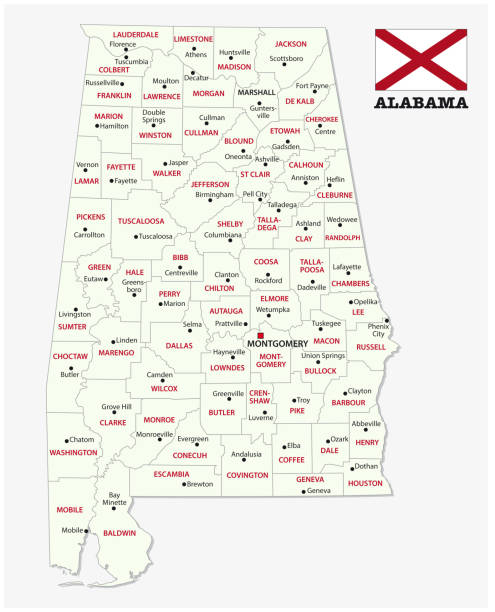
Alabama operates almost entirely on Central Time, syncing its daily rhythms, commerce, and broadcasting with a region stretching from the Great Lakes down to the Gulf Coast. From the manufacturing hubs in Huntsville to the port terminals in Mobile, this single standard keeps millions of residents on the same clock, eliminating internal boundary confusions that complicate life in split-zone states.
Understanding how the Alabama time zone functions in practice requires looking past simple geography. While the state's eastern border touches the Eastern Time Zone in Georgia and Florida, Alabama's unified choice shapes everything from corporate logistics and television schedules to Friday night high school football traditions and emergency response coordination.
The Geography of Alabama Time
The United States is divided into standardized zones originally established by 19th-century railroads and later codified by federal law. Alabama sits squarely within the Central Time Zone, observing Central Standard Time (CST, UTC-6) during winter and Central Daylight Time (CDT, UTC-5) through the warmer months.
However, state borders don't always align perfectly with solar positioning. Alabama spans about six degrees of longitude. The sun reaches its highest point earlier in Phenix City on the eastern border than it does in Epes near the Mississippi line. Despite this solar offset, the entire state chose administrative unity over solar precision.
Some neighboring states, such as Florida and Tennessee, split their jurisdictions between Eastern and Central time to accommodate major metropolitan influences. Alabama bucked that trend. Apart from a few small communities in Chambers County near the Georgia border that informally observe Eastern Time due to commercial ties with Columbus, Georgia, the state maintains a strict single-zone standard.
Business and Logistics Across State Lines
For companies operating in Alabama, a single time zone simplifies internal scheduling, shift handoffs, and supply chain management. A manufacturing plant in Montgomery doesn't need to adjust meetings between its assembly floor and its corporate office in Birmingham.
Interstate commerce, however, requires constant awareness of neighboring zones. Businesses trading heavily with Atlanta, Chattanooga, or the Florida Panhandle operate one hour ahead of local Alabama time for half of the year or more. A logistics manager dispatching trucks from the Port of Mobile toward Jacksonville must calculate arrival windows across the Eastern boundary, a routine mental adjustment that becomes second nature for cross-border freight operators.
Financial markets, federal agencies, and national corporations also dictate operational tempos. Wall Street trading hours open at 8:30 a.m. local Central time, aligning Alabama's financial and legal sectors with the opening bell in New York without requiring pre-dawn office arrivals.
Daily Life, Media, and Culture
Central Time heavily influences how Alabamians structure their evenings, entertainment, and social gatherings. Network television prime time kicks off at 8:00 p.m. local time, an hour later by the clock than it appears to viewers in New York or Atlanta. This scheduling leaves room for extended family dinners and evening outdoor chores during long summer twilights.
Sports culture forms another core pillar of daily timing. College football dominates autumn weekends across the state. A 3:30 p.m. national broadcast slot aligns perfectly with Central Time viewing habits, giving fans time for morning tailgates before kickoff and a reasonable hour for post-game celebrations.
Shared time zones also foster strong regional solidarity. When severe weather strikes, from spring tornado outbreaks in Tuscaloosa to hurricane landfalls along the Gulf Coast, emergency management agencies rely on synchronized clocks to coordinate warnings, shelter openings, and utility repairs across county lines. A weather alert broadcast simultaneously on NOAA radios and mobile devices ensures that residents from Huntsville to Dothan react on the exact same timeline.
Common Misconceptions About Alabama Time
- Myth: Parts of Birmingham are in the Eastern Time Zone. All of Jefferson County and the greater Birmingham metropolitan area are strictly Central Time.
- Myth: Daylight Saving Time is optional in Alabama. Like all U.S. states except Arizona and Hawaii, Alabama strictly follows federal Daylight Saving Time mandates.
- Myth: The entire state border matches Georgia's time. While the Chattahoochee River forms a natural geographic border with Georgia, commercial and social interaction in the Valley and Phenix City areas often leads residents to keep Eastern Time informally.
Frequently Asked Questions
Does any part of Alabama observe Eastern Time?
Officially, the entire state is assigned to the Central Time Zone by the Department of Transportation. Unofficially, a few border towns and communities adjacent to Georgia—such as Lanett, Valley, and Phenix City—often operate on Eastern Time to match their close economic and commuter ties with Columbus, Georgia.
Why doesn't Alabama split into two time zones like Tennessee?
Tennessee is divided into East Tennessee (Eastern Time) and Middle/West Tennessee (Central Time) due to its elongated shape and distinct regional economies centered around Knoxville and Memphis. Alabama's population centers, such as Birmingham, Huntsville, Mobile, and Montgomery, maintain tighter internal economic integration, making a single time zone more practical for state governance and commerce.
When did standard time zones officially begin in the United States?
Railroad companies introduced standard time zones on November 18, 1883, to eliminate confusion caused by thousands of local solar times kept by individual cities. Congress later formalized these zones through the Standard Time Act of 1918.
How does Central Time affect remote workers in Alabama living near the border?
Remote workers living in eastern Alabama who work for companies based in Atlanta or Charlotte must remember that their workday starts an hour earlier relative to local time. A 9:00 a.m. Eastern meeting requires logging in at 8:00 a.m. local Alabama time.



