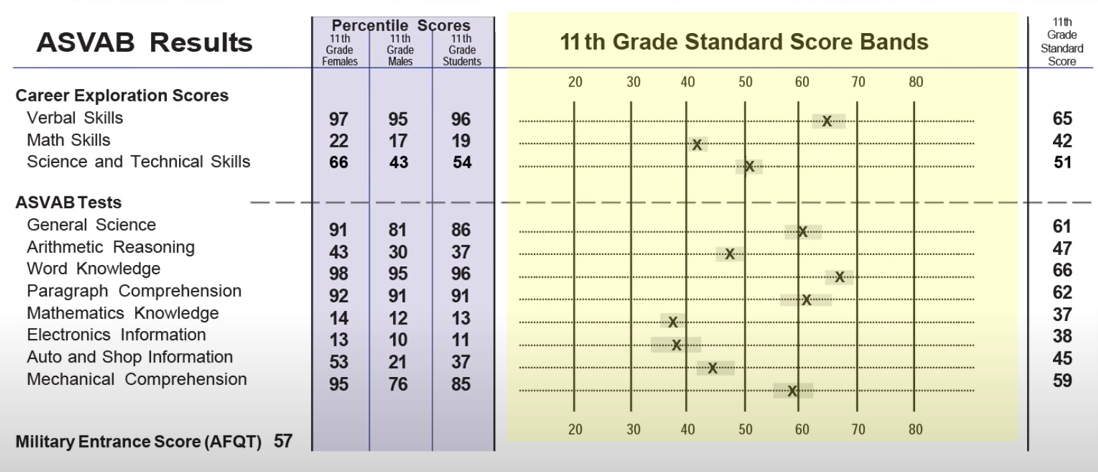
Navigating military enlistment starts with understanding the Armed Services Vocational Aptitude Battery, commonly known as the ASVAB. To join the United States Air Force, you don't just need to pass an entrance exam; you need to meet specific score thresholds that dictate both your eligibility to enlist and your access to particular career fields.
High school diploma holders must achieve a minimum Armed Forces Qualification Test (AFQT) score of 31, while GED holders are required to reach a score of 50. However, clearing this initial hurdle only gets you through the front door. Your actual job options depend on a separate set of metrics called MAGE scores, which evaluate your aptitude in mechanical, administrative, general, and electronic areas.
How Air Force ASVAB Scoring Works
The ASVAB is a multi-aptitude battery that measures your knowledge across various domains. It serves two distinct functions for future airmen: determining overall enlistment qualification and matching you to specific Air Force Specialty Codes (AFSCs).
Your performance is split into two primary categories: For another angle on this event, check out the latest coverage from Reuters.
- The AFQT Score: A percentile score ranging from 1 to 99 derived from four core subtests. This score tells you how you performed relative to a reference group of young adults. It dictates whether you can enlist at all.
- Line Scores (MAGE): Composite scores calculated by combining specific pairs or groups of subtest results. These scores determine which jobs you are qualified to perform.
According to the U.S. Air Force Official Site, the baseline entry requirements are strict, but achieving higher scores opens up a much broader selection of technical career fields.
Breaking Down the MAGE Aptitude Areas
The Air Force groups its jobs into four major categories known by the acronym MAGE. Each category utilizes a specific formula combining relevant ASVAB subtests.
Mechanical (M)
The Mechanical category measures your understanding of general science, mechanical concepts, and physical tools. It uses scores from General Science (GS), Mechanical Comprehension (MC), and Auto & Shop Information (AS).
- Typical Jobs: Aircraft maintenance, vehicle mechanics, and munitions systems.
- What it takes: Strong spatial reasoning and practical knowledge of how physical systems work.
Administrative (A)
The Administrative category relies entirely on your Verbal Expression (VE) score, which combines Word Knowledge (WK) and Paragraph Comprehension (PC).
- Typical Jobs: Personnel, logistics administration, and traffic management.
- What it takes: Strong reading comprehension, vocabulary, and communication skills.
General (G)
The General category evaluates your verbal and mathematical aptitude by combining Verbal Expression (VE) and Arithmetic Reasoning (AR). This is one of the most critical composite areas because it gates a high volume of popular fields.
- Typical Jobs: Intelligence analysis, medical services, security forces, and specialized operations.
- What it takes: Solid analytical thinking, fast problem-solving, and clear reading comprehension.
Electronic (E)
The Electronic category assesses your grasp of technical electrical concepts and foundational math. It incorporates Arithmetic Reasoning (AR), Mathematics Knowledge (MK), Electronics Information (EI), and General Science (GS).
- Typical Jobs: Cyber operations, avionics, communications, and electrical systems maintenance.
- What it takes: Advanced math skills and an intuition for circuitry and physics.
Minimum Score Requirements for Popular Air Force Jobs
Every job in the Air Force has a designated cutoff score within one or more MAGE areas. If a job requires an Electronic score of 60, your calculated E score must be 60 or higher to book that position.
Job requirements vary across specialties. For instance, basic administrative roles like Traffic Management (2T0X1) may only require an Administrative score of 35. Conversely, high-demand technical and cyber fields demand much higher benchmarks. Cyber Warfare Operations (1B4X1) requires an Electronic score of 70, while specific intelligence analysis roles require General scores scaling into the upper 60s.
For official definitions of service standards and recruitment parameters, consult the Department of Defense.
Practical Steps to Maximize Your Score
Preparation is the single biggest factor in changing your career trajectory. If you walk into the Military Entrance Processing Station (MEPS) unprepared, you might miss out on technical training slots that offer lucrative civilian transferable skills.
- Identify target jobs early: Look up specific AFSC requirements before you test so you know exactly which MAGE score you need to clear.
- Target your weak subtests: If you are aiming for a cyber career, don't just study vocabulary. Spend 70 percent of your study time on Mathematics Knowledge and Electronics Information.
- Practice under strict time constraints: The ASVAB is heavily time-pressured. Use timed practice materials from resources like Peterson's Test Prep to build up your pacing.
- Retake if necessary: If your score doesn't match your career ambitions, the Air Force allows retakes under specific waiting periods to give you a chance to improve.
Frequently Asked Questions
Can I choose my job if I only meet the minimum AFQT score of 31?
Meeting the minimum 31 AFQT score grants eligibility to enlist, but it doesn't guarantee your choice of job. If your MAGE line scores are low, your available job selection will be severely restricted to open general pools.
How long are ASVAB scores valid for Air Force enlistment?
Your ASVAB scores remain valid for two years from the date you took the test. If you don't enlist within that window, you'll need to test again.
Do college credits change my ASVAB requirements?
Having college credits doesn't change the underlying ASVAB score requirements, but higher education tiers can sometimes qualify you for advanced rank upon enlistment. However, holding a GED instead of a high school diploma immediately bumps your required minimum AFQT from 31 to 50.
Are calculators allowed during the ASVAB test?
Calculators are not permitted during the official ASVAB exam. You must rely entirely on mental math and scratch paper for sections like Arithmetic Reasoning and Mathematics Knowledge.



