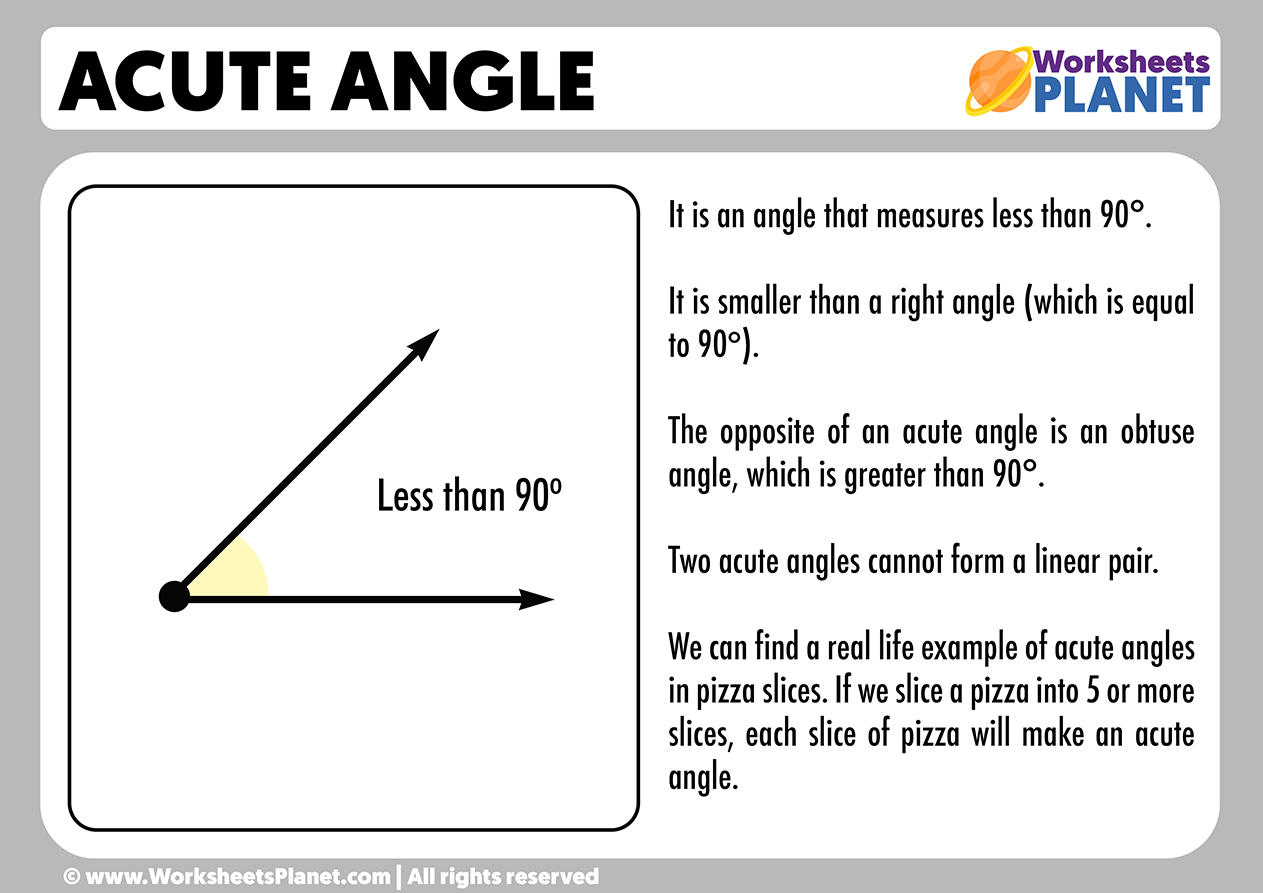
An acute angle is any angle that measures strictly greater than 0 degrees and less than 90 degrees. Unlike right angles that form a square corner or obtuse angles that stretch wider than a quarter turn, acute angles look sharp and narrow, resembling the tip of a needle or a pinched corner.
You'll encounter these angles everywhere, from the structural trusses holding up a roof to the graphic design layouts on your computer screen. Grasping how they function unlocks core concepts in geometry, trigonometry, and everyday engineering.
Mathematical Properties and Classification
In geometry, angles are classified by their degree measurements. While a full circle contains 360 degrees, angles under the quarter-turn mark receive distinct categories based on their relationship to a 90-degree right angle.
- Acute Angles: Measure between 0° and 90° (exclusive).
- Right Angles: Measure exactly 90°.
- Obtuse Angles: Measure between 90° and 180°.
- Straight Angles: Measure exactly 180°.
An acute angle cannot equal 0 degrees, because a 0-degree measure represents a single ray overlapping another with no separation. It also cannot equal 90 degrees, which creates a perpendicular corner. Within triangles, classification often relies on these angles. An acute triangle features three angles, all of which measure less than 90 degrees. If a triangle contains one angle measuring 90 degrees, it's a right triangle, and the remaining two non-right angles must automatically be acute to keep the interior sum at 180 degrees.
Measuring and Constructing Acute Angles
Working with these angles requires basic geometry tools: a protractor and a straightedge. Measuring an existing angle follows a straightforward procedure.
- Align the baseline or center hole of the protractor directly over the vertex (the point where the two rays meet).
- Line up the zero-degree mark of the protractor along one of the rays of the angle.
- Read the scale where the second ray crosses the numerical arc. For an acute angle, you'll always look at the scale number below 90.
To draw your own acute angle, start by sketching a straight horizontal ray with your straightedge. Place your protractor's center point at your chosen vertex on that ray. Find your target number—for example, 42 degrees—and make a pencil mark on the paper. Connect the vertex to that mark using the straightedge. The resulting shape gives you a precise 42-degree acute angle.
Real-World Applications in Architecture and Design
While geometry sounds abstract, structural engineers and architects rely on acute angles to manage physical forces like weight distribution, tension, and compression.
Triangles are the strongest shapes in construction because they rigidify structures against lateral forces. Truss bridges, roof rafters, and crane booms use triangular frameworks made up of acute angles to split loads evenly across support beams. If a roof pitch features too shallow an angle, rain and snow pool on top instead of sliding off. Steeper acute angles at gable peaks allow gravity to clear moisture and debris efficiently.
A well-known example of this geometry in modern design is the Louvre Pyramid in Paris. Its metal framing relies heavily on precise angular geometry to support large glass panels while resisting wind resistance. Similar principles guide aerodynamics; aircraft wing tips and rocket noses use sharp, tapered angles to slice through air currents cleanly, minimizing drag at high speeds.
The Role of Acute Angles in Trigonometry
When you move past basic shapes into trigonometry, acute angles become the foundation for calculating unknown side lengths and distances. The standard ratios—sine, cosine, and tangent—rely on right-angled triangles where one acute angle serves as the reference point.
- Sine: The ratio of the length of the side opposite the angle to the hypotenuse.
- Cosine: The ratio of the adjacent side to the hypotenuse.
- Tangent: The ratio of the opposite side to the adjacent side.
For instance, if you're designing a wheelchair ramp that rises 3 feet over a specific horizontal distance, you use the tangent ratio of an acute angle to find the exact slope required to meet safety codes. Navigation systems, satellite positioning, and computer graphics engines rely on these exact trigonometric formulas to map coordinates in two- and three-dimensional space. You can read more about foundational measurement principles through the National Institute of Standards and Technology.
Common Mistakes to Avoid
Students and professionals alike often slip up when dealing with angular measurements. Keep these pitfalls in mind:
- Reading the wrong protractor scale: Protractors feature two rows of numbers (0 to 180 going left-to-right and right-to-left). Because an acute angle is always less than 90 degrees, if your reading says 115 degrees, you're reading the wrong scale line.
- Confusing acute and obtuse: Remember that "acute" sounds like "cute" (small, sharp), while "obtuse" describes something dull or wide.
- Assuming all acute triangles are equilateral: A triangle can have three different acute angle measurements (such as 50°, 60°, and 70°) as long as none reach or exceed 90°.
Frequently Asked Questions
Can an acute angle measure exactly 90 degrees?
No. An angle measuring precisely 90 degrees is classified as a right angle. Acute angles must be strictly less than 90 degrees.
What is the smallest possible measurement for an acute angle?
An acute angle must be greater than 0 degrees. A 0-degree angle does not exist as an open shape because the two rays completely overlap.
How do you find an acute angle if you know the other angles in a triangle?
The interior angles of any triangle always add up to 180 degrees. If you have a right triangle with a 90-degree angle and a known acute angle of 40 degrees, subtract both from 180 to find the remaining angle: 180 - 90 - 40 = 50 degrees.
Why are acute angles important in bridge building?
Triangles containing acute angles distribute weight and stress forces efficiently across a truss network, preventing the structure from bending or collapsing under heavy loads.


