Helping a child navigate anxiety can leave you feeling helpless, especially when reassurance and traditional fixes fail to work. Acceptance and Commitment Therapy (ACT) offers a proven alternative by teaching children to coexist with anxious feelings rather than fighting to eliminate them. This framework shifts your role from problem-solver to supportive coach, helping your child build psychological flexibility and resilience for the long term.
Anxiety in children rarely looks like rational worry. It often manifests as stomachaches before school, explosive tantrums, rigid routines, or sudden avoidance of everyday activities. Traditional parenting advice usually tells us to reassure our kids that everything is fine or to remove the stressor. However, research in behavioral psychology shows that repeatedly rescuing a child from discomfort actually teaches their brain that the fear was justified, reinforcing the anxiety loop over time. ACT approaches this differently by focusing on willingness, mindfulness, and values-driven action.
Understanding the Core Principles of ACT for Children
Acceptance and Commitment Therapy is rooted in relational frame theory and cognitive behavior therapy, but its core mechanism is psychological flexibility. Instead of trying to change or delete negative thoughts, ACT teaches individuals to change their relationship with those thoughts. When applied to children, these concepts must be translated into language they can easily grasp and visualize.
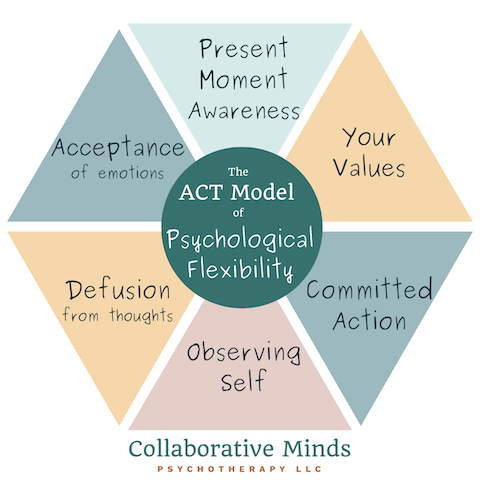
Psychological flexibility relies on six intersecting processes. Here is how they break down in a family setting:
- Acceptance: Making room for difficult emotions like fear, nervousness, or sadness without trying to push them away or pretend they don't exist.
- Cognitive Defusion: Learning to see thoughts as harmless mental events or passing words rather than absolute facts or commands.
- Present Moment Awareness: Tuning into the sights, sounds, and physical sensations of the here and now instead of catastrophizing about the future.
- The Observing Self: Recognizing that there is a stable part of the mind that notices thoughts and feelings, separate from the thoughts and feelings themselves.
- Values Identification: Clarifying what matters most to the child, such as being a loyal friend, a curious learner, or a creative builder.
- Committed Action: Taking steps toward personal goals even when anxiety comes along for the ride.
According to research published by the Association for Contextual Behavioral Science, training children in psychological flexibility significantly reduces behavioral impairment linked to anxiety disorders.
Shifting From Fixer to Coach
When your child experiences a wave of panic or distress, your instinct is naturally to fix it or make the feeling go away. ACT parenting requires a radical shift in posture. You stop trying to lower the temperature of the room immediately and instead help your child learn to weather the storm.
This starts with your own emotional regulation. Children are remarkably adept at reading parental stress. If you panic when your child becomes anxious, your urgency validates their fear. Practice taking a slow breath, acknowledging your own urge to rescue, and responding with a calm, grounded presence.
Instead of saying "There's nothing to be afraid of," try validating the experience while holding the boundary of action. You can say, "I see that your heart is beating fast and this feels terrifying. It's okay to feel scared, and I know you can still walk through that door."
Concrete Strategies to Implement at Home
Translating psychological flexibility into daily family routines requires practical tools that children can use independently when anxiety spikes.
1. Externalize the Anxiety
Children frequently fuse with their anxious thoughts, believing "I am broken" or "I am weak." Externalizing gives the anxiety a separate identity, creating necessary distance. Give the worry a silly name, such as the "What-If Gremlin" or the "Worry Monster."
When your child refuses to try a new activity due to nerves, you can ask: "Is that you talking right now, or is the Worry Monster whispering in your ear?" This simple linguistic shift helps kids realize they are separate from their thoughts and gives them room to talk back to the anxiety.
2. Practice Defusion Techniques
Defusion unhooks children from the literal truth of their scary thoughts. When a child says, "I'm going to fail the spelling test," teach them to change the delivery. Have them sing the thought to the tune of Happy Birthday or repeat the phrase rapidly out loud for thirty seconds until the words lose their scary meaning. Another powerful tool is prefixing thoughts: teach your child to say, "I'm having the thought that I might fail," rather than "I am going to fail."
3. Anchor in the Present
Anxiety lives in future-oriented "what-if" scenarios. Grounding exercises pull the nervous system back into the physical present. The five-senses exercise is an effective tool for this: identify five things you can see, four things you can touch, three things you can hear, two things you can smell, and one thing you can taste. Practicing this during calm moments builds a neural pathway your child can access when panic rises.
4. Pivot Toward Values Over Feelings
Anxiety always demands avoidance. If a child is scared of social settings, anxiety tells them to stay home. ACT refocuses the compass from feelings to values. Ask your child what kind of friend or student they want to be. If they value being a good friend, frame a playdate not around whether they feel nervous, but around the value of showing up for someone they care about. The fear remains present, but the destination changes.
Common Pitfalls Parents Must Avoid
Even with the best intentions, parents often fall into patterns that inadvertently feed childhood anxiety. Recognizing these traps helps you adjust your approach.
- Reassurance Traps: Constant reassurance ("I promise you'll be safe," "Nothing bad will happen") feels kind in the moment, but it acts as a subtle safety behavior that prevents the child from learning they can tolerate uncertainty.
- Over-Accommodation: Changing family schedules, avoiding public places, or speaking for your child to protect them from discomfort teaches their nervous system that the world is genuinely dangerous.
- Invalidation Disguised as Positivity: Telling a child to "cheer up," "stop worrying," or "it's no big deal" communicates that their internal experience is unacceptable or wrong, driving anxiety underground.
For clinical guidance on childhood anxiety disorders and evidence-based interventions, review resources provided by the National Institute of Mental Health.
Frequently Asked Questions
How is ACT different from traditional Cognitive Behavioral Therapy (CBT)?
While CBT focuses on identifying and disputing irrational thoughts to change how you feel, ACT focuses on changing your relationship to your thoughts. Rather than trying to prove an anxious thought is wrong, ACT teaches children to notice the thought without letting it dictate their behavior.
At what age can children start practicing ACT concepts?
Core ACT principles can be introduced to children as young as four or five years old through simple metaphors, externalized characters, and mindfulness games. The language adapts to their developmental stage, focusing heavily on experiential learning rather than abstract theory.
What should I do if my child's anxiety causes physical symptoms like vomiting or severe stomachaches?
Anxiety frequently manifests physically through somatic symptoms. Validate the physical reality of the pain while maintaining gentle routines. If physical complaints lead to chronic school refusal or loss of function, consult a pediatrician and seek out a licensed therapist specializing in contextual behavioral therapies.
How do I know when my child needs professional therapy versus home strategies?
If anxiety prevents your child from participating in normal daily milestones—such as attending school, sleeping independently, maintaining friendships, or engaging in family life—it's time to seek professional support. Look for practitioners certified through organizations like the Association for Behavioral and Cognitive Therapies.


