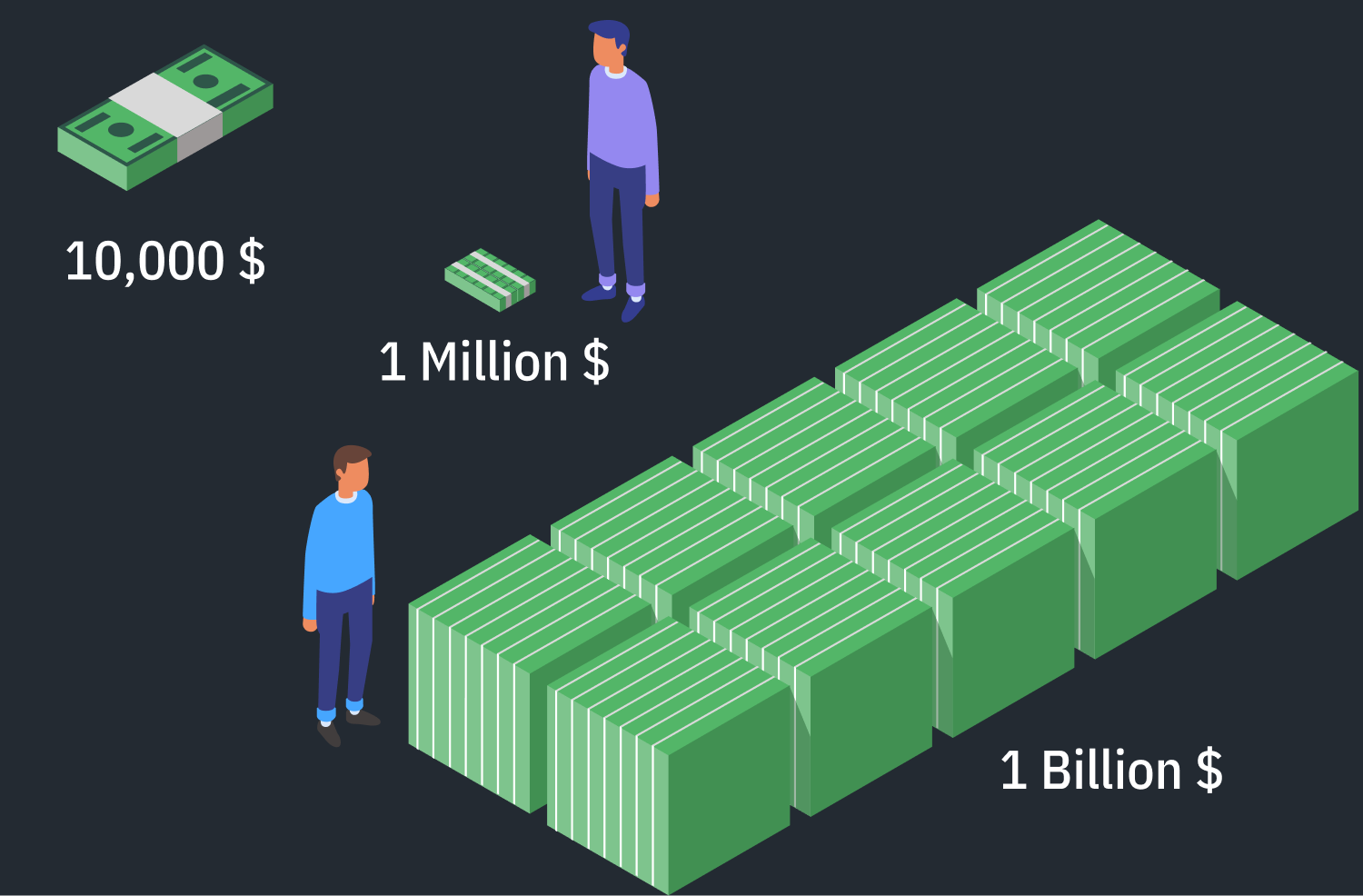
One billion is equal to one thousand million. In the standard short scale numbering system used globally in finance, commerce, and science, writing out a billion means placing nine zeros after the number one ($1,000,000,000$). A million features six zeros ($1,000,000$). When you divide one billion by one million, you get exactly one thousand.
Grasping this exact ratio is necessary for reading national budgets, corporate revenue reports, and astronomical data. Yet human brains struggle to picture these quantities naturally. We process concrete physical objects easily, but numbers past a few thousand blur together into abstract concepts. Let's break down how these figures work, why different naming conventions cause confusion, and how to visualize the true gap between a million and a billion.
The Short Scale and Long Scale Systems
The way people name large numbers depends heavily on historical naming conventions split into two main camps: the short scale and the long scale.
The short scale defines every new major numerical step—such as a million, billion, trillion—as one thousand times the previous step. In this system:
- One million is $10^6$ ($1,000,000$).
- One billion is one thousand million, or $10^9$ ($1,000,000,000$).
- One trillion is one thousand billion, or $10^{12}$ ($1,000,000,000,000$).
The United States, Canada, and modern British English adopted the short scale universally.
The long scale, historically used in many continental European countries and French-speaking regions, operates differently. In the long scale, a billion traditionally meant one million millions ($10^{12}$), while one thousand millions was called a milliard. While international financial reporting and scientific literature have largely standardized around the short scale to avoid catastrophic miscommunication, historical documents or international translations can occasionally retain long scale naming quirks.
Visualizing the Difference Through Time and Space
Numbers on paper look deceptively close. The words million and billion differ by only three letters, and digits add just a couple of zeros. That superficial similarity hides an immense chasm. The best way to comprehend the gap is to translate digits into units of time.
If you started counting out loud right now at a rate of one number per second without stopping to sleep or eat:
- Reaching one million would take you roughly 11 and a half days.
- Reaching one billion would take you nearly 31 and a half years.
This massive multiplier changes how we should view financial and physical data. If a local company generates one million dollars in annual revenue, it's a thriving enterprise. If a multinational corporation reports a profit of one billion dollars, that scale is one thousand times larger—equivalent to running that successful million-dollar business every single year for ten centuries.
Real-World Applications and Conversions
Translating between millions and billions happens constantly across major industries. Knowing how to shift the decimal point prevents costly miscalculations in business forecasts and public policy debates.
When reviewing government spending, figures are frequently tossed around in billions. If a federal infrastructure package costs 4.5 billion dollars, converting that amount into millions means multiplying by one thousand, resulting in 4,500 million dollars. Seeing the figure written out in millions often highlights the localized impact, showing how many smaller regional projects could fit inside that single national budget allocation.
Similarly, corporate tech acquisitions routinely cross these thresholds. When a startup sells for two billion dollars, it equals 2,000 million dollars. Breaking down the figures helps investors evaluate whether a valuation aligns with actual user counts or revenue streams. If an app commands a two billion dollar price tag and has 200 million active users, the math reveals a valuation of ten dollars per user—a concrete metric that's far easier to analyze than staring at raw billion-dollar totals.
Common Mistakes When Working with Large Numbers
People across all professions stumble when communicating large figures, leading to common errors that distort facts.
The most frequent error is dropping or adding a single zero when converting figures between shorthand and numerical notation. Writing $1,000,000,000$ requires counting nine zeros. Dropping one zero turns a billion into one hundred million ($100,000,000$), completely altering the scale of a financial statement or scientific measurement.
Another pitfall is mixing up currency scales in international reporting. A contract negotiated in European markets using older long scale definitions can carry entirely different financial obligations than an agreement drafted under American short scale rules. Always verify which numerical standard a document applies before signing financial agreements or publishing research data.
Finally, relying on vague descriptors like "billions and billions" ruins clarity. Precise communication requires stating exact multipliers so audiences understand whether an increase represents a modest bump or an exponential shift.
Frequently Asked Questions
How many millions make a trillion?
It takes one million millions to make one trillion in standard short scale math. Since one trillion is $10^{12}$ and one million is $10^6$, dividing a trillion by a million leaves one million.
Why do some countries use different names for numbers?
Historical linguistic traditions created the short scale and long scale divergence. English-speaking nations migrated toward the French short scale model over the last two centuries for business efficiency, while parts of Europe kept the long scale system longer before standardizing toward global norms.
How can I easily convert billions to millions in my head?
Add three zeros to the billion figure, or move the decimal point three places to the right. For example, 3.2 billion becomes 3,200 million.
Is a billion written the same way everywhere?
While the digits ($1,000,000,000$) are universally recognized, local punctuation conventions vary. Many countries use periods instead of commas to separate thousands, writing $1.000.000.000$ instead of $1,000,000,000$. Always check regional formatting standards to avoid reading errors.


